

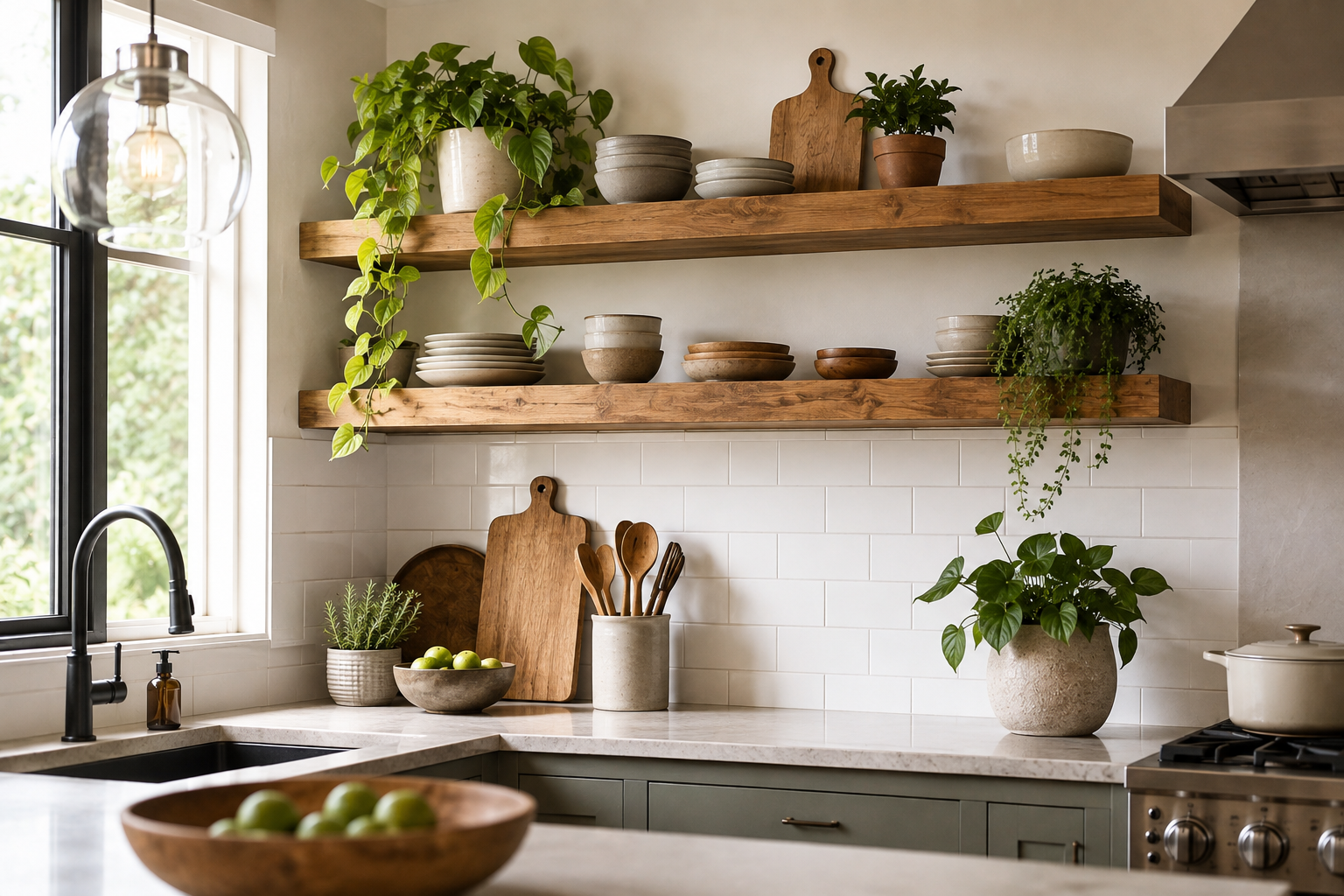
My cousin pulled every cabinet door off her kitchen last spring and never bothered reattaching them — no trial period, no “let’s see.” Gone, in one Saturday. I doubted it would hold up past the first dinner party.
Then I spent a weekend handing her screws while she leveled three oak boards above her stove, and the logic finally landed for me. Kitchen wall shelves aren’t some content-mill invention; they solve a quiet mismatch most kitchens carry for years — cupboards stuffed with half-used items while the wall above them sits blank.
Fix that mismatch and kitchen wall shelves start doing real work instead of collecting dust behind closed doors. Once you’ve seen a kitchen where open shelving actually earns its spot, a solid wall of cabinets starts feeling like it’s concealing something.
I Almost Skipped Shelves — Here’s Why I Didn’t
My gut said no before I’d even thought it through. Dust, grease, general disorder — pictures I’d apparently assembled without evidence. A friend who’s gutted and rebuilt a dozen kitchens for clients unpicked that assumption over a phone call, mostly through questions sharper than the ones I’d been asking myself.
She put it plainly: cabinets don’t erase clutter, they relocate it somewhere your eyes never land. Half of what’s tucked behind those doors goes untouched for years. Move it onto an open shelf and the choice narrows fast — use it, or watch it sit there looking unnecessary — and that quiet pressure keeps people far tidier than a closed door ever managed.
Watching her actually cook in that kitchen is what convinced me. Pan off the shelf, straight into her hand, no door swinging into her hip mid-stir. Small moment, but it repeated enough times across one week that it stopped feeling small.
That same night I grabbed a tape measure and sized up my own kitchen wall, mostly out of curiosity rather than any real plan. What I found was that my hesitation had nothing to do with shelves themselves — it was really about whether I’d stay disciplined enough to keep them looking decent, a completely separate question wearing the same disguise.
Why Kitchens Keep Circling Back to Wall Shelves
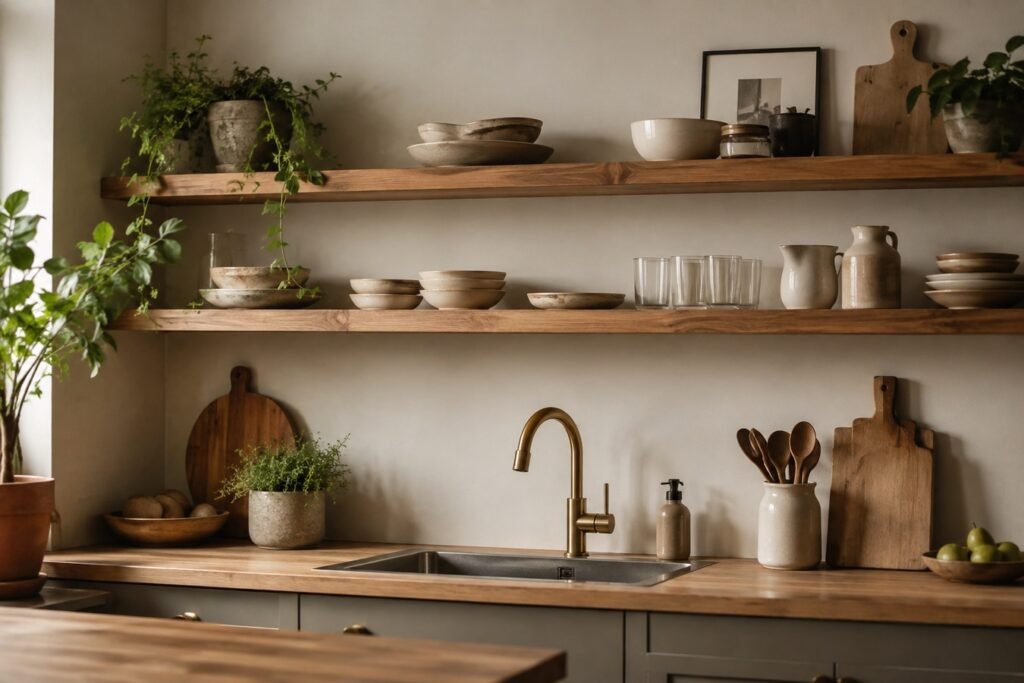
Trends drift through kitchens the way weather moves through a season — some years wet with popularity, some years bone dry. This one keeps returning anyway, and not purely for looks.
Smaller kitchens gain the most ground here, somewhat counterintuitively. One run of kitchen wall shelves can do the job an upper cabinet used to do, minus the boxed-in feeling — especially useful in older houses where ceilings already sit low. Light travels through a room differently once a bulky door stops interrupting the sightline every few feet.
There’s a functional side to this too, separate from how it looks. Mugs, bowls, cooking oil end up exactly where your hand already reaches. No more twisting a wet palm around a cabinet knob mid-recipe — you just grab.
Resale conversations bring this up more than expected. Agents have mentioned, without being asked, that a well-built kitchen wall shelf setup photographs strongly for listings, and buyers tend to read it as a recent update even when nothing else in the kitchen has changed in a decade.
There’s also a flexibility angle nobody advertises loudly. Swapping what sits on display takes minutes, not a weekend of masking tape and drop cloths, so getting bored of the look costs almost nothing to fix.
Picking Materials That Won’t Warp Near a Stove
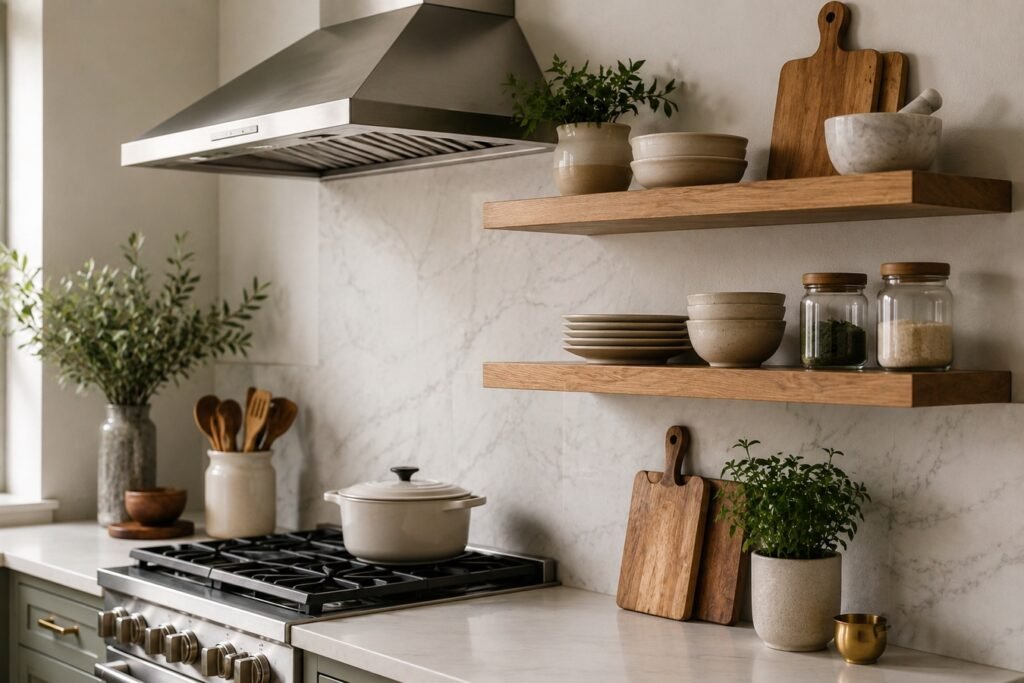
A shelf living in a kitchen absorbs more punishment than one sitting in a bedroom ever will. Steam climbs off pots constantly. Grease drifts upward without anyone noticing. Splashes happen mid-chop, every time.
Solid wood — oak, walnut, ash — ages into something better-looking when sealed correctly, rather than falling apart. Reclaimed wood carries character with it, though it can twist near heat if the boards weren’t dried the right way before milling.
Metal brackets topped with wood or stone shrug off moisture almost entirely, sidestepping the warping problem outright. Floating MDF shelves photograph well enough for a catalog shot but tend to sag under actual weight sooner than most people expect, especially past the 36-inch mark.
Sealant choice quietly outweighs most other decisions here. Matte polyurethane handles splashes without yellowing the way cheaper varnish does after a year near heat. Butcher block oil works fine too, though it wants reapplying every few months if the shelf sits close to a burner.
Bamboo barely gets a mention anywhere, which feels like an oversight. It resists moisture nearly as well as sealed hardwood, costs noticeably less, and carries a grain flexible enough to sit comfortably in both farmhouse and modern-leaning kitchens.
| Material | Moisture Resistance | Weight Capacity | Best Placement |
| Solid Oak/Walnut | Good (with sealant) | High | Away from direct steam |
| Reclaimed Wood | Moderate | Medium-High | Dry zones, dining wall |
| Powder-Coated Metal | Excellent | High | Near stove/sink |
| MDF/Laminate | Poor | Low-Medium | Light decor only |
| Floating Stone/Marble Top | Excellent | Medium | Statement wall |
Open Shelf or Closed Cabinet? A Quick Comparison
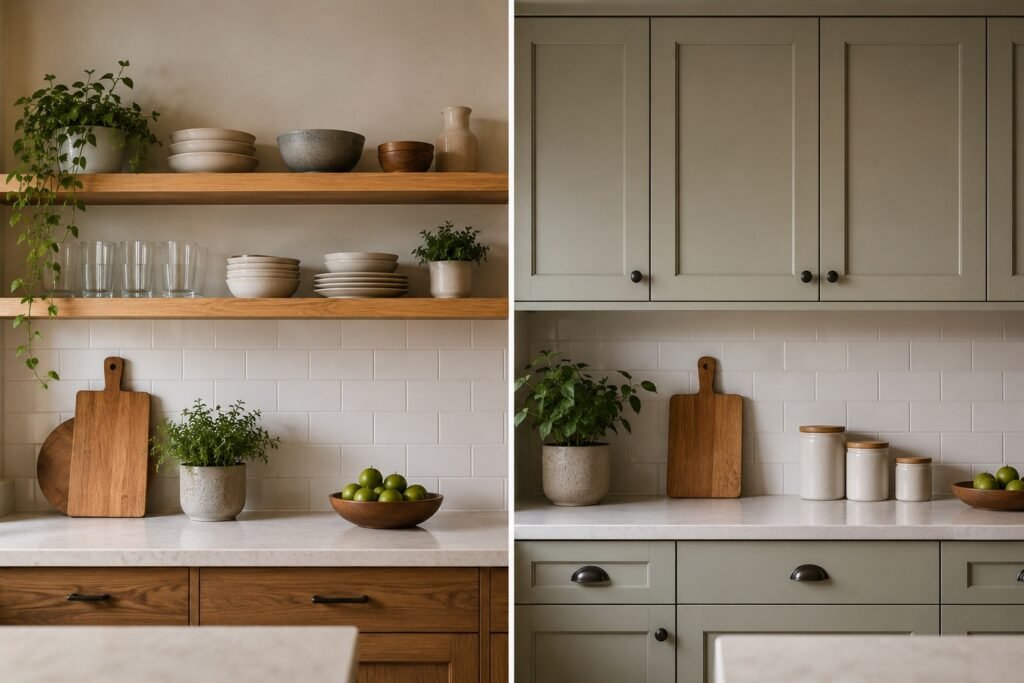
Picking one side entirely has mostly fallen out of practice. Most kitchens I’ve wandered through recently split the difference, letting shelves show off the good stuff while cabinets absorb whatever nobody wants seen.
Homes & Gardens dug into this tension in real depth, and their reporting on the tradeoffs lines up closely with what working designers told me directly: it mostly hinges on how much upkeep you’re honestly prepared to give.
Anyone still weighing a full cabinet buildout as their primary storage should look through a few traditional cabinet alternative options before locking a direction in.
Ask most designers hard enough and you’ll hear a similar verdict: neither side wins cleanly. Zero closed storage spirals into chaos fast unless you’re unusually disciplined; zero open storage can feel oddly sterile, like a showroom nobody’s ever actually cooked breakfast inside.
A ratio that surfaces again and again in real kitchens runs roughly two parts closed to one part open — enough exposed shelf to show off favorites without turning the whole room into an unused display case.
Where They Actually Work (And Where They Don’t)
Placement is the single detail that separates a shelf that works from one that becomes a chore. Get it wrong and you’ve mounted a dust magnet six feet off the ground. Get it right and the wall looks like it was always meant to hold something there.
The stretch between backsplash and upper cabinet line earns its reputation honestly — hand-height, always visible, and it never fights the sightlines running through the rest of the room.
Corners cause more trouble than any other spot. Cramming kitchen wall shelves into a shallow corner usually reads as an afterthought rather than an actual design choice. A properly deep L-shaped run can pull it off; a shallow one almost never does.
Anyone still sketching out a full wall before locking in shelf placement will find a broader decorating inspiration guide genuinely useful — seeing the whole wall at once beats staring at one isolated section of it.
The wall behind a shelf matters nearly as much as the shelf itself, a detail people forget constantly. A busy tile pattern or a heavily textured backsplash fights with whatever’s displayed, creating a cluttered feel even when the shelf itself sits perfectly clean.
Shelves mounted too close to a window end up backlit in every photo, flattening whatever sits on them, even though it’s barely noticeable standing in the room itself. Small thing, worth flagging before you commit to drilling a hole.
Installing Kitchen Wall Shelves Without Wrecking the Wall
More regret shows up at this stage than anywhere else in the whole process. Someone gets excited, drills straight into bare drywall, and three weeks later the shelf’s drooping under a stack of dinner plates.
Studs matter more here than most first-timers realize going in. This Old House covers proper anchoring in genuine detail, and the short version comes down to this: drywall alone is borrowed time for anything heavier than a candle.
When the wall doesn’t cooperate and studs land somewhere inconvenient, heavy-duty toggle anchors rated for the real load fix it — not just extra screws tossed in for reassurance, a shortcut I’ve watched more than one confident DIYer come to regret.
Styling Tricks That Don’t Look Try-Hard
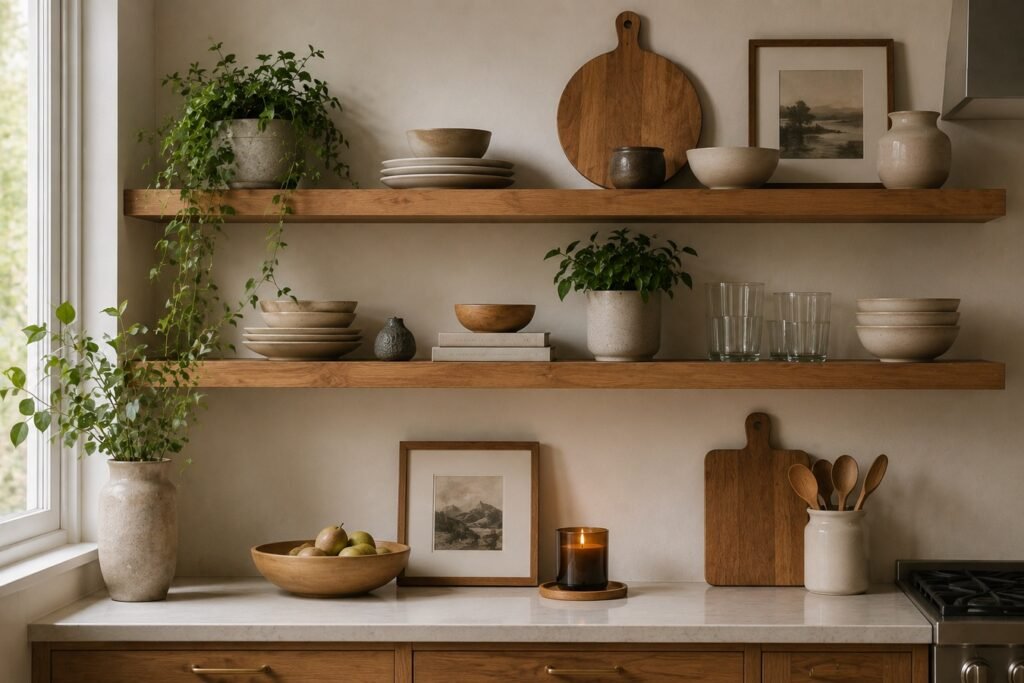
The goal is styled-but-lived-in, not staged for a photoshoot nobody actually cooks breakfast in front of.
Uneven groupings beat perfectly aligned rows almost every time. A tall vase beside a stack of bowls beside a small plant reads as gathered over years, not arranged in a single afternoon.
Color pulls more weight than people expect walking in. Matching the wall tone behind a shelf shifts the entire mood of a room, and choosing complementary paint tones can make even mismatched dishware look like a deliberate choice rather than an accident.
Texture beyond dishware does real work too. A couple of framed prints or small artwork pieces, or a woven basket tucked into the mix, breaks up the “identical ceramics on repeat” look that open shelving can slide into without anyone noticing.
Lighting Changes the Whole Feel
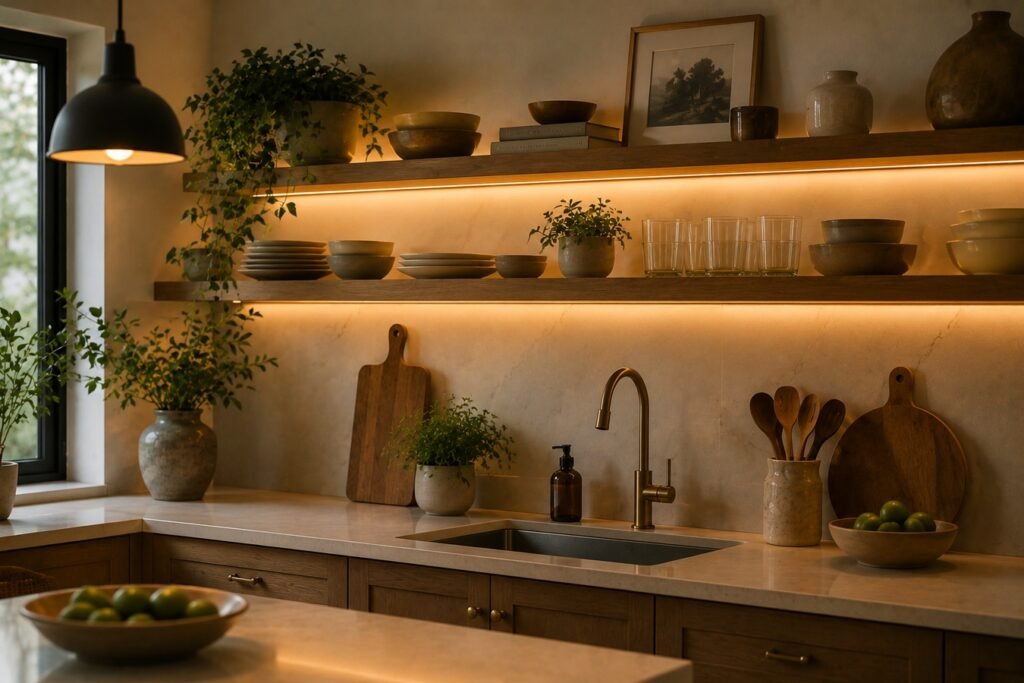
Lighting hardly comes up in these discussions, which is strange considering how much it quietly controls. A gorgeous set of dishware still falls flat under one lonely overhead bulb carrying the whole room by itself.
Small puck lights tucked underneath a shelf throw a warm glow onto the counter below, making everything on display look deliberate instead of accidental. Battery-powered strips solve this without anyone touching household wiring.
Natural light plays its own part too. A shelf angled to catch afternoon sun shows glassware off in a way no bulb quite replicates — though it does mean noticing dust sooner, since sunlight has a habit of exposing every speck.
Small Kitchen? Shelves Might Be Your Best Move
Cramped kitchens gain more from this idea than roomy ones ever will. Every inch counts harder once counter space is already scarce to begin with, and kitchen wall shelves happen to solve exactly that shortage.
Single-wall layouts especially have nowhere to hide bulky storage furniture. Vertical space becomes the only territory still unclaimed, and kitchen wall shelves make that territory usable without gutting the room entirely.
Two or three floating shelves stacked above a narrow counter hold everyday dishes without eating into walking room the way a floor cabinet inevitably would.
Renters gain something here too, somewhat unexpectedly. Landlords who’d never approve a cabinet swap will often sign off on a handful of wall-mounted shelves, since the holes left behind patch up small and fast once a lease ends.
What Kitchen Wall Shelves Actually Cost
Money spent on this swings around quite a bit, depending mostly on the material chosen and whether hired hands do the mounting or a free Saturday does.
A basic pre-made floating shelf from a hardware store runs somewhere between fifteen and forty dollars, brackets included. Solid wood versions — walnut especially — climb toward eighty or a hundred once proper anchors get factored into the total.
Hiring a carpenter for custom shelving that matches existing cabinetry costs more, unsurprisingly, often several hundred dollars for a full wall depending on region and wood species chosen. Still, that’s a fraction of what a full cabinet swap runs, which explains why so many people treat shelves as the budget-conscious middle step before a bigger renovation ever lands.
DIY installation with pre-made shelves eats up an afternoon, sometimes less if the studs cooperate on the first attempt. That alone makes it one of the lowest-commitment upgrades a kitchen can absorb.
Mistakes I Watched Friends Make
Overloading sits at the top of the list, no contest, and it’s the single fastest way to ruin an otherwise solid kitchen wall shelves setup. Twenty pounds rated, a full cast-iron collection stacked on anyway — gravity doesn’t negotiate on that arrangement.
Skipping the edit-before-you-display step ranks a close second. People haul everything straight from old cabinets onto open shelves, and suddenly the room reads cluttered instead of curated — the shelf takes the blame when the real culprit was never sorting through what actually belonged there.
Grease zones near a stove get ignored more often than they should. Shelves mounted right above a range without a hood nearby build up a sticky film faster than anyone expects, and scrubbing that off a wood finish gets tiresome quickly.
Mismatched bracket finishes trip people up too, usually without anyone noticing until much later. Pairing a brushed brass bracket with chrome faucet hardware nearby reads as an accident rather than a decision, so matching metals across the room before drilling saves a redo down the line.
Keeping Them Clean Without Losing Your Mind
A weekly once-over keeps buildup from ever getting a real foothold — microfiber handles ordinary dust fine, while a mild degreaser suits anything parked near the burners.
Rotating what stays on display helps more than people expect. Items left untouched for months gather more dust than pieces cycled through regularly, so swapping seasonal favorites in and out actually cuts total cleaning time down.
One trick that saved me real time: a thin strip of removable adhesive felt along the very back edge of each shelf catches most grease drift before it settles into the wood, and it peels away clean whenever it needs swapping out.
Frequently Asked Questions
Are kitchen wall shelves sturdy enough for everyday dishes?
Yes, provided they’re anchored into studs or rated hardware matching the weight of whatever gets stored on them.
How high above the counter should shelves be mounted?
Most kitchens land comfortably somewhere between 15 and 18 inches of clearance above the countertop surface.
Do open kitchen wall shelves make cleaning harder?
Somewhat, since dust and grease build up faster than behind a closed door, though a weekly wipe keeps it manageable.
What’s the best wood for kitchen wall shelves near a stove?
Sealed oak or walnut resists warping far better than MDF or unsealed reclaimed wood does in greasy, humid zones.
Can I mix open shelves with regular kitchen cabinets?
Absolutely — most modern kitchens already do exactly that, hiding messier items behind doors while keeping favorites visible.
How much weight can a floating kitchen shelf typically hold?
Depends heavily on bracket type and stud alignment, though most rated shelves handle 25 to 50 pounds safely.
Do kitchen wall shelves work in small apartment kitchens?
Yes, arguably better than in larger ones, since they free up floor space that cabinets would otherwise claim entirely.
Should I paint the wall behind open shelves a different color?
Many designers do this on purpose — a contrasting backdrop makes displayed items and everyday personal keepsakes stand out far more.
Conclusion
I never expected to land on the shelf side of this whole debate, yet here we are. What actually shifted my opinion wasn’t a glossy magazine spread or some influencer’s flawless countertop — it was watching a real, working kitchen lean on these shelves day after day without ever tipping into chaos.
Kitchen wall shelves solve nothing for every household, and pretending otherwise would be dishonest of me. Heavy, greasy cooking most nights, paired with a dislike of frequent wiping down? Closed cabinets will almost certainly serve better in the long run. That’s simply a tradeoff worth naming, not a failure on anyone’s part.
But for kitchens starved of breathing room, or for anyone tired of digging through cabinet after cabinet hunting for the one bowl actually used every week, shelves earn their spot on the wall honestly. Cheaper than a full remodel. Quicker than replacing cabinetry outright. Forgiving enough that changing the styling next season costs next to nothing.
Start small if any doubt lingers. One shelf, one wall, a handful of pieces genuinely liked at a glance — that’s enough to test whether the whole approach fits how a kitchen actually gets used day to day, long before committing to a bigger stretch of wall. Most people who try a single shelf end up adding a second within months anyway, once daily reaching-and-grabbing gets noticeably easier.
Material choice matters more than casual internet chatter suggests. Placement matters more than any trend photo ever shows. And restraint in styling, oddly enough, carries a room further than people assume walking in. Nail those three things, and kitchen wall shelves stop being something tried once and start becoming a fixture that keeps earning its keep for years afterward.
My cousin, for what it’s worth, still hasn’t reattached a single cabinet door. She added a second run of shelving last month along the opposite wall, and this time she skipped calling me for an opinion first — she simply built it, which honestly says more than any pros-and-cons list ever could.
If there’s one piece of advice worth carrying into a hardware store aisle, unsure which bracket to grab off the shelf, it’s this: measure the wall twice, trust studs over hope, and resist overthinking the styling on day one. Personality settles into a shelf gradually, the same slow way it settles into the rest of a kitchen.