

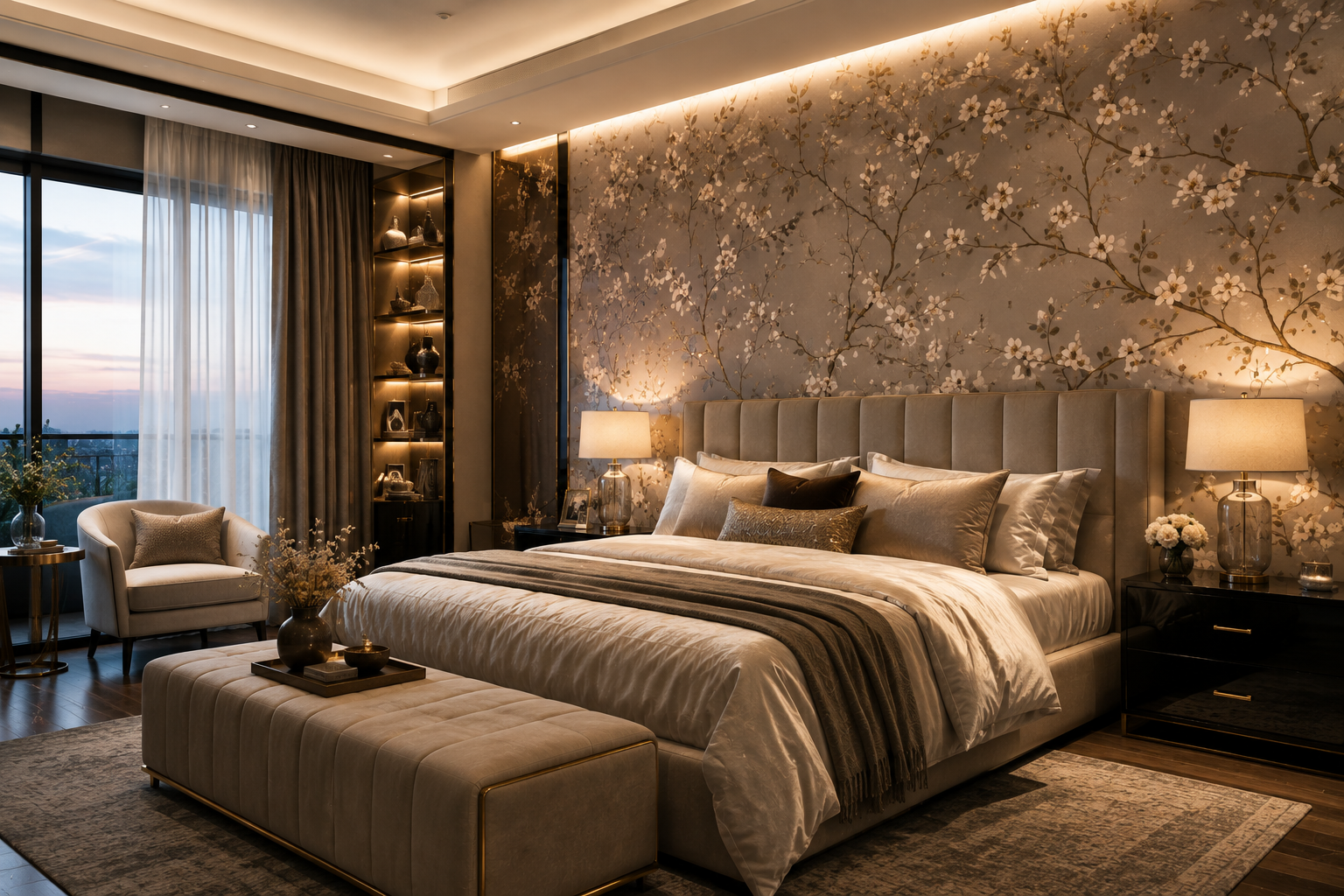
Good wallpaper ideas for bedroom walls rarely come from a mood board — they come from someone staring at the same blank wall for the hundredth night in a row. Ask ten people why they finally wallpapered their bedroom, and maybe two will say “trend.” The rest just got tired of a room that photographed fine but felt cold to live in.
That gap between looks-fine-in-photos and feels-good-in-person is exactly where a muted print or a soft grasscloth texture earns its keep. A patterned headboard wall, a warm textured strip, a quiet geometric near the reading chair — small choices, big shift in how the room sits with you at night. Not a trend chase. Closer to picking a scent for a candle: personal, a little stubborn, worth getting right.
Wallpaper Ideas for Bedroom Headboard Walls You’re Wasting
Here’s a pattern I notice constantly: someone spends real money on a great bed frame, then leaves the wall behind it completely untouched. Odd, right?
That wall sees more of your eyeline than almost anything else in the house. It’s the last thing you look at before sleep and the first thing you see waking up.
A patterned or textured paper there does more work than a dozen throw pillows ever could. It doesn’t need to be loud. It just needs to stop being nothing.
Curious what this looks like in practice? Bedroom decor inspiration has a solid rundown of headboard-wall treatments worth stealing.
Working With a Tiny Bedroom? Scale Beats Color Every Time


People blame color first when a small room feels cramped. Usually it’s not the color — it’s the print size.
Oversized florals or big bold geometrics compress a small room fast, no matter how “airy” the palette looks on the sample card. Tight, busy micro-prints do something similar, just quieter about it.
A mid-scale print in a soft, low-contrast tone tends to disappear into the room instead of fighting it. Think dusty terracotta, faded sage, chalky blue — nothing that shouts.
If square footage is genuinely tight, papering just the headboard wall (not all four) keeps the room from feeling boxed in. There’s a deeper walkthrough of this exact trick over at single-wall styling tricks.
What You’ll Actually Pay, Broken Down Honestly
Pricing pages love to bury the real numbers under vague phrases like “starting from.” Let’s skip that and just lay it out.
| Wallpaper Type | Price Range (per sq. ft.) | Typical Lifespan | Good Fit For |
| Peel-and-stick | 0.50–5 | 2–5 years | Renters, quick swaps, first-timers |
| Traditional, professionally pasted | 20–35 | 10–15+ years | Long-term homeowners |
| Textured grasscloth | 8–15 (material only) | 8–10 years | Warm, spa-like bedrooms |
| Oversized mural panels | 150–500 per panel | Varies by material | Statement walls, kids’ spaces |
Cost per roll rarely tells the full story. According to a peel-and-stick cost comparison from home services site Angi, traditional paper typically outlasts peel-and-stick by roughly three to one, so the cheaper option upfront isn’t automatically the cheaper option long-term.
Labor, not material, is usually where budgets blow up. Skip the installer and go peel-and-stick, and a weekend DIY job can cost less than a nice dinner out.
One Wall, Two Walls, or Fully Committed?
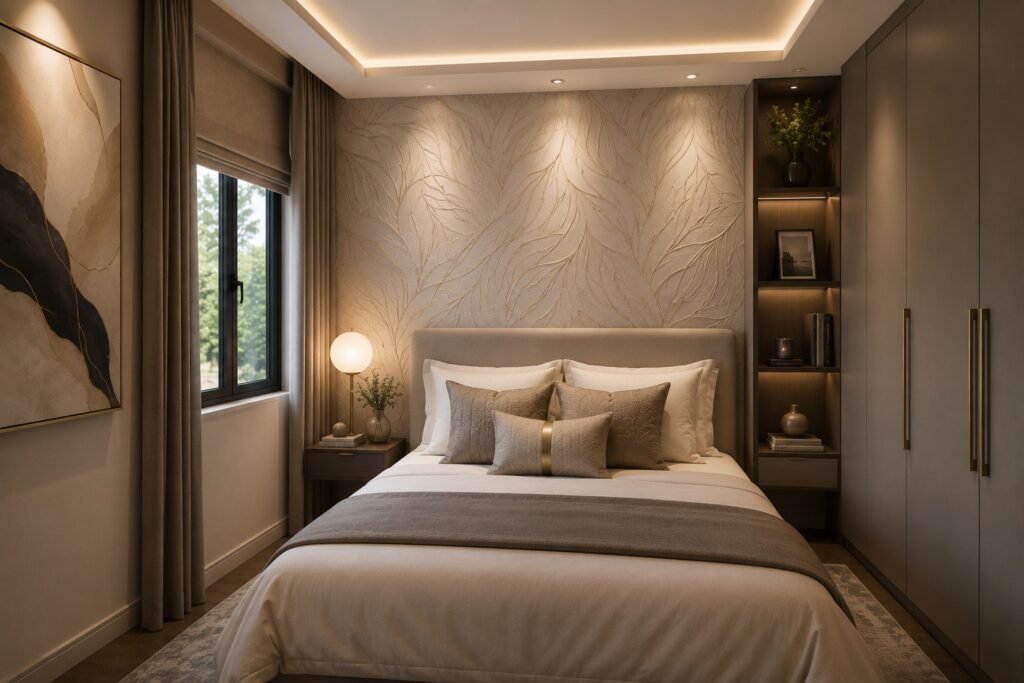
I get this question constantly, and the honest answer is: it depends on how much regret tolerance you have.
A single accent wall is the low-stakes option. Cheap, reversible, forgiving if your taste shifts in a year or two — which, statistically, it probably will.
Wrapping the entire room in pattern is a much bigger swing. Nail it, and the room feels genuinely immersive, almost boutique-hotel-adjacent. Miss, and it can start feeling closed-in fast, especially with a busy print.
My personal rule of thumb: first-timers should start with one wall. Adding a second wall later is easy. Undoing four walls of pattern you regret is a full weekend you’ll wish you had back. For real before-and-afters, check the accent wall gallery.
Where People Usually Go Wrong With This
A few missteps show up again and again, so let’s name them directly instead of dancing around it.
Sampling under bad light. Store lighting flattens everything into sameness. Tape a swatch to your actual wall and watch it under lamp light and morning sun both.
Choosing something too visually loud for sleep. Saturated reds and busy, high-contrast geometrics can genuinely fight against rest. A sleep-friendly color note from House Digest points out that overly busy patterns can keep your mind more alert right when it should be settling down — not ideal for a bedroom.
Forgetting ceiling height entirely. A massive print in a low-ceiling room reads cramped, not cozy, no matter how nice it looked online.
Skipping the physical sample. A screen render and a real swatch on your wall are two different animals. Always order the sample first.
Peel-and-Stick Versus Traditional: An Honest Verdict
Peel-and-stick built its reputation fairly. No paste, minimal mess, and it comes off clean enough that your landlord never has to know.
Traditional wallpaper asks for more patience — usually a professional installer, more prep time, higher upfront cost — but it rewards that patience with a finish that simply looks and wears better over time.
Renting, testing a bold print for the first time, or just not ready to commit? Peel-and-stick. Settled into a forever home and chasing a finish that ages well? Traditional earns the extra effort.
Ideas That Won’t Feel Childish by Next Year
Kids change their minds about everything, wallpaper included, which makes this decision trickier than almost any other room in the house.
Steer away from anything too literal — licensed characters or a specific show print ages out embarrassingly fast. Abstract shapes, botanical prints, or gentle color-blocked patterns hold up across several phases of childhood instead of just one.
Peel-and-stick is nearly always the smarter call here, purely because swapping it out later doesn’t mean a full renovation. One wall, done in something flexible, goes a long way.
For pattern ideas that actually grow alongside a kid rather than embarrassing them by age nine, browse kids room prints.
Budget-Friendly Wallpaper Ideas for Bedroom Makeovers
You don’t need a contractor-grade budget to make a bedroom feel considered and finished.
A rich, tonal peel-and-stick print does most of the visual heavy lifting on its own. Add one or two textured pieces — a woven throw, a ceramic table lamp — and the room reads far pricier than it actually was.
Spend your budget on one wall, not four. A single well-chosen wall photographs beautifully and costs a fraction of a full-room job, and frankly, most guests won’t clock the difference anyway.
Real, attainable examples of this approach live at elegant design picks.
So, Is It Actually Worth the Money?
Short version: for most people, yes — provided the choice fits their actual living situation rather than a magazine spread.
Neutral, well-executed wallpaper tends to help resale value slightly. It also just makes ordinary daily life a little nicer, which matters even if it never shows up in a home appraisal.
It stops being worth it the moment you’re chasing a trend you don’t personally love. Trends fade fast. A print you’re genuinely drawn to rarely does.
Match the choice to your timeline. Short-term renter? Peel-and-stick pays for itself within a month. Long-term owner? Traditional paper in a pattern you love is money well spent.
Quick Answers to Common Questions
Is bedroom wallpaper still trending in 2026?
Yes — designers report growing demand for bold, expressive patterns well beyond powder rooms.
How long should I expect bedroom wallpaper to last?
Traditional paper: roughly 10–15 years. Peel-and-stick: closer to 2–5 years, quality dependent.
Is it okay to wallpaper just one wall in a bedroom?
Completely normal, and often the smarter starting point for first-timers.
Will pattern make my small bedroom feel more cramped?
Not if you pick the right scale — mid-size, low-contrast prints tend to open a room up.
Is peel-and-stick sturdy enough for a house I own long-term?
It’s fine short-term, but traditional wallpaper holds up better over many years.
Which wallpaper style actually helps with sleep?
Muted, low-contrast, cool-toned prints support rest better than loud, high-energy patterns.
How many rolls does a typical accent wall need?
Most bedroom walls take 2–3 rolls, though measuring your exact wall first is essential.
Traditional or peel-and-stick for a child’s bedroom?
Peel-and-stick, almost every time, since kids’ taste shifts so quickly.
Where This Leaves You
None of this needs to be complicated. Choosing wallpaper for a bedroom really comes down to one question: will you still like this in three years, not just this weekend? That single question filters out most bad decisions before they happen.
If you’re on the fence, start small. One wall tells you more about your actual taste than an entire afternoon of scrolling inspiration boards ever will. Love it? Expand from there. Not quite right? You’ve only committed to a fraction of the room, and correcting course later is far less painful than people assume going in.
Budget deserves real consideration, but it shouldn’t be the only voice in the room. Peel-and-stick has genuinely improved — good enough now that designers use it in client homes, not just rental fixes. Traditional wallpaper still holds its ground too, especially for anyone in a forever home who wants a finish that ages with some grace over a decade or longer.
Whichever direction you lean, don’t skip the sample stage. Tape it up. Sit with it for a few days, under both lamp light and daylight, because a phone photo of a swatch will lie to you every single time.
A bedroom answers to nobody but you. So pick whatever wallpaper makes the room feel like a genuine exhale at the end of a rough day — not a trend report, not a design blog, not what’s popular this particular season. That instinct, more than anything else on this page, is the one worth trusting.
One more thing worth saying plainly: give yourself permission to change your mind later. A wall isn’t a tattoo. If a pattern that felt exciting in your twenties starts feeling loud by your thirties, that’s not a design failure — that’s just a person growing, and the wall can grow with you. Peel-and-stick exists for exactly that reason, and even traditional paper can be stripped and redone when the moment calls for it. Nothing here is permanent unless you decide it should be.