

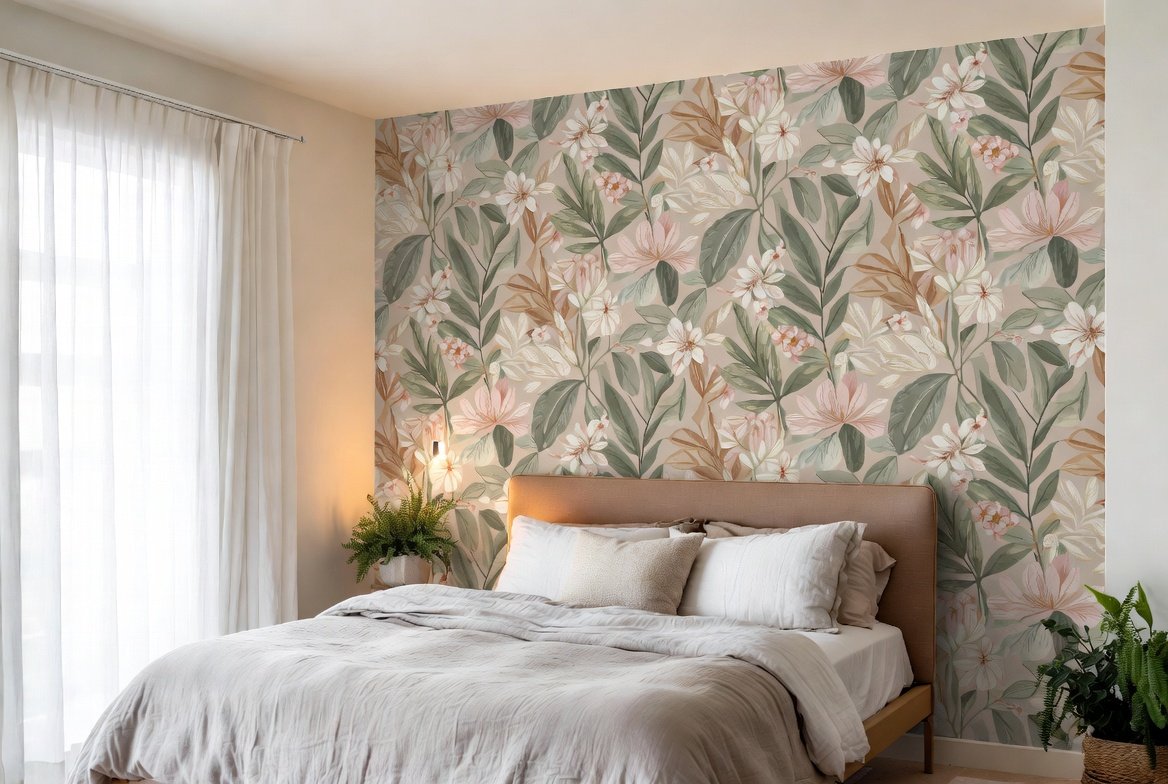
My cousin repainted her bedroom four separate times last year before she finally tried wallpaper in bedroom on one wall instead of chasing some imaginary perfect paint shade. That one switch — wallpaper in bedroom on one wall — did more for the space than all four paint cans combined. It’s not a trend some influencer invented last month. It’s a fix for a room that feels flat.
You pick a single wall, usually the one behind the headboard, and let wallpaper in bedroom on one wall carry the personality the rest of the room doesn’t have to. Cheaper than you’d guess. Forgiving too, if your first strip goes crooked.
What Is Wallpaper In Bedroom On One Wall?
Picture three walls painted plain, calm, forgettable. Then the fourth wall — almost always the one your bed leans against — gets dressed up. That’s wallpaper in bedroom on one wall, stripped down to its simplest description. No design theory degree needed.
Some people call this a feature wall. My aunt calls it “the fancy wall” and honestly that name works fine too.
The logic behind wallpaper in bedroom on one wall, rather than papering all four, comes down to restraint. Wrap a whole small room in a loud print and it can start to feel like you’re sleeping inside a gift box. One wall gives you the drama minus the sensory overload.
Quick reference on where this idea tends to land well:
| Wall Placement | Works Well? | Why |
| Behind the headboard | Yes | Bed frame breaks up pattern, natural anchor point |
| Wall facing the door | Sometimes | Strong first impression, but pattern must suit full view |
| Wall with closet or door cutouts | Rarely | Awkward breaks waste material and disrupt flow |
| Wall with large windows | Depends | Subtle patterns work; bold prints fight the light |
Why Wallpaper In Bedroom On One Wall Matters
A bedroom doesn’t need to impress guests. It needs to feel like yours — and that’s exactly why wallpaper in bedroom on one wall matters more here than almost anywhere else in the house.
Here’s something I’ve noticed after years of covering home decor: people default to “safe” paint everywhere because committing to something bold across four walls feels risky. Fair enough. That fear mostly disappears once you realize wallpaper in bedroom on one wall only asks you to commit to a single surface.
There’s a money angle too, one that rarely gets mentioned. A couple of rolls of quality paper covering four walls can cost a small fortune. Choosing wallpaper in bedroom on one wall instead cuts that bill by seventy or eighty percent, sometimes more, depending on repeat size and room dimensions.
Anyone hunting for pairing ideas around this exact approach should check this wallpaper decor for bedrooms resource — it runs through pattern and color combos that hold up nicely against plain walls.
Types And Features Worth Knowing
Not every wallpaper behaves the same once it’s stuck to your wall, and this trips up a lot of first-timers attempting wallpaper in bedroom on one wall for the first time.
Peel-and-stick vinyl. The forgiving option. No paste, minimal mess, peels off clean without wrecking drywall. Good pick if you rent, or if you’re just not sure you’ll love a bold pattern six months from now.
Traditional pasted wallpaper. Heavier. More durable. Looks a touch more expensive once it’s up on the wall. You’ll want a steady hand, or a friend who’s hung paper before.
Grasscloth and textured papers. Add depth you can feel, not just see. Trickier around outlets and light switches, so budget extra patience.
Photo murals. One giant continuous image — a forest, a skyline, whatever grabs you — stretched across the wall. No pattern-matching headaches since it’s one scene, not a repeat.
Features worth checking before buying:
- Repeat size — smaller repeats waste less on short walls
- Washability, especially near a humidifier or diffuser
- Pre-pasted versus separate adhesive needed
- Removability rating if you’re renting
Benefits Of Wallpaper In Bedroom On One Wall
People ask me constantly why not just paper the whole room. Honest answer: four walls of the same busy print can genuinely shrink how a small bedroom reads, especially under 120 square feet. Wallpaper in bedroom on one wall avoids that problem entirely.
One wall anchors a room. Your eye lands somewhere specific instead of bouncing endlessly across a repeating pattern with nowhere to rest.
There’s a resale and rental angle too. A single accent wall is far easier to explain to a future buyer, or reverse before moving out, compared to a fully wallpapered room. Landlords tend to be more relaxed about one removable wall.
Here’s something I genuinely disagree with a lot of decorating advice on — you don’t need your bedding to match your wallpaper exactly. A slight clash, done on purpose, often reads more intentional than a perfectly coordinated set pulled from the same collection.
Real Examples From Actual Bedrooms
A friend turned her cramped guest bedroom around using a deep botanical print behind a plain white bed frame. The rest stayed off-white. That single wall — one example of wallpaper in bedroom on one wall done right — made the whole room feel curated rather than thrown together, and she spent less than most people spend on a single throw pillow set.
Another case, a client from a few years back: a north-facing bedroom that barely caught sunlight. Instead of fighting the darkness with bright paint everywhere, we used a warm terracotta paper on just the headboard wall. The other three stayed pale. The room felt cozy instead of dim, which honestly surprised even me.
For mural-style or scene options built specifically for behind-the-bed placement, this scene bedroom wallpaper collection shows a decent range without going overboard on price.
Design coverage from Homes & Gardens’ feature wall guide notes that pairing two complementary tones within a single accent wall, rather than one flat color, can add depth without turning the wall busy — something I’ve seen hold true in smaller bedrooms specifically.
Tips Before You Buy A Single Roll
Measure twice. Sounds like a builder’s cliché, but wallpaper repeats waste material fast if you underestimate. Add ten to fifteen percent extra to your wall measurement.
Order a sample swatch before committing to a full roll of wallpaper in bedroom on one wall projects. Screen colors almost never match what shows up once real light hits your wall.
Think about furniture placement first. A tall dresser or a cluster of framed art can hide half your investment if you don’t plan around where the pattern’s focal point lands.
Pre-purchase checklist:
- Confirm the wall’s exact height and width
- Check pattern repeat length on the label
- Order a sample, view it morning and night
- Decide peel-and-stick versus pasted based on how long you’ll keep it up
- Block off a full weekend if hanging it yourself
Common Mistakes People Make
Choosing a pattern too small. From across a bedroom, tiny prints often just read as a slightly odd solid texture. Go bigger than feels comfortable — you’ll thank yourself later.
Ignoring ceiling height. A vertical stripe on one wall can genuinely make a low-ceiling bedroom feel taller. Skipping this is a missed opportunity more often than people expect.
Rushing wall prep. Bumps, old nail holes, uneven texture — all of it shows through thinner paper. Sand, patch, and prime before opening the roll.
Trying to match every accessory to the print. This one bugs me most, honestly. A room where every pillow and lamp shade echoes the wallpaper stops looking designed and starts looking like a showroom display.
Buying based on store lighting alone. Fluorescent showroom bulbs distort color more than people expect. Home Depot’s own accent wall ideas guide recommends checking samples under your actual home lighting before ordering — advice I’d repeat to anyone starting a wallpaper in bedroom on one wall project.
Conclusion
At the end of the day, wallpaper in bedroom on one wall isn’t complicated, even though endless swatch books and design blogs make it feel that way. Pick the wall your bed sits against, choose a pattern that makes you pause when you see it, and skip the urge to match every other object in the room to it.
The math favors this approach too. Wallpaper in bedroom on one wall costs a fraction of wrapping an entire room, and if you end up hating it a year later, you’re only redoing one section instead of tearing out a whole room’s worth of paper. That alone makes it a lower-risk way to test a bold instinct.
From experience, the bedrooms that feel most “finished” almost never have four matching walls. They have one wall doing the heavy lifting while everything else quietly supports it. Whether you go peel-and-stick for a rental or full pasted grasscloth for a forever home, choosing wallpaper in bedroom on one wall gives you room to experiment without betting the entire space on a single choice.
Start small if you’re nervous. Order one sample, tape it up, live with it a few days before deciding. Nine times out of ten, that small test convinces people faster than any mood board could.
FAQs
Does wallpaper on one wall look outdated?
Not when placement and pattern are chosen carefully. Trends shift, but a well-placed accent wall behind a headboard has stayed relevant across several design decades.
How much wallpaper do I need for one bedroom wall?
Measure height and width, multiply for square footage, then add ten to fifteen percent extra for pattern matching and trim waste.
Is peel-and-stick good enough for wallpaper in bedroom on one wall?
Yes, especially for renters or anyone wanting flexibility. Quality peel-and-stick holds up well and removes cleanly from properly prepped walls.
Which wall should I pick for bedroom wallpaper?
The wall behind your headboard usually wins, since the bed frame naturally breaks up the pattern and creates a built-in focal point.
Can I wallpaper over old paint?
Generally yes, as long as the paint is intact, free of peeling, and the surface has been cleaned and lightly sanded first.