

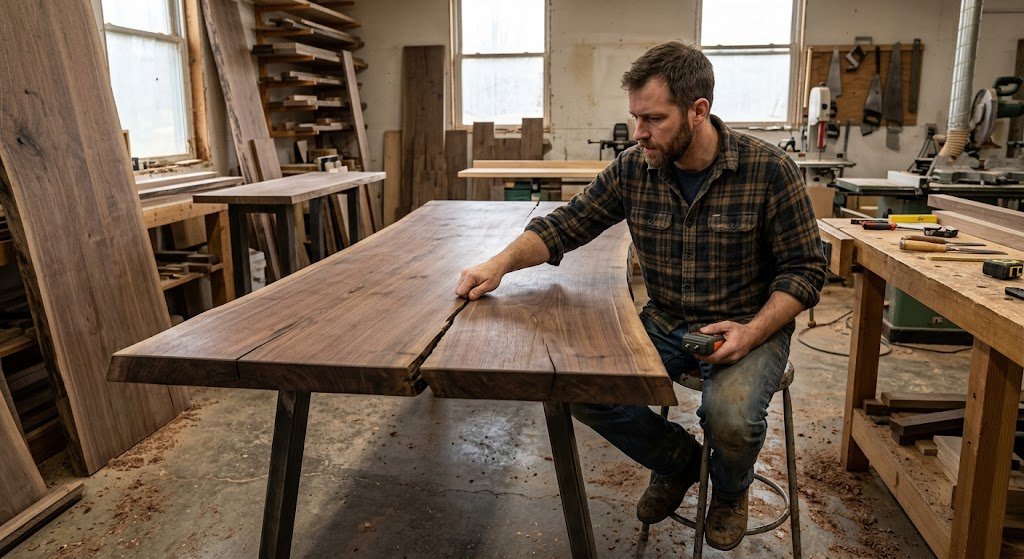
Wood doesn’t lie to you. It just doesn’t always speak up in time — which is the entire risk hiding inside every live edge walnut dining room table sold without proper drying records.
A client of mine — call her Meera, because that’s not her real name — hired me last spring to fix a live edge walnut dining room table that split clean through near one end. Gorgeous piece. Expensive piece. She’d bought it eighteen months earlier from a boutique furniture shop two towns over, no questions asked, card swiped, delivery scheduled. Nobody at that shop mentioned moisture content once during the sale.
That’s the gap. Not craftsmanship, not bad luck. Information.
I’ve been building and repairing slab furniture for about nine years now, mostly out of a shop that smells permanently like linseed oil no matter how many windows I open. Walnut’s my favorite material to work with, hands down, and also the one people misunderstand most whenever they’re shopping for a live edge walnut dining room table. So here’s what I told Meera, laid out properly this time.
Why a Live Edge Walnut Dining Room Table Beats Every Other Slab Option
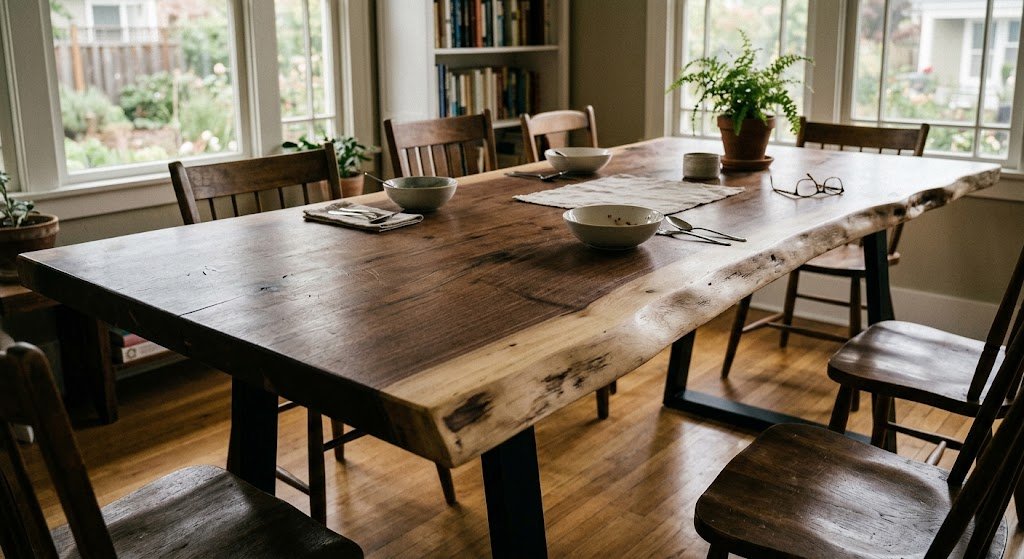
Everybody picks walnut for the same surface-level reason: it looks rich. Dark heartwood fading into that pale honey-colored sapwood edge, sometimes within inches of each other on the same board. Nothing else in the lumber yard does that quite so dramatically.
Here’s the part most people skip past, though. That pale edge strip is the reason a slab even qualifies as “live edge” in the first place — trim it off for a cleaner look and congratulations, you’ve just paid slab-lumber prices for a plain rectangular board instead of an actual live edge walnut dining room table.
Meera’s original table still had its sapwood intact, thankfully. What it didn’t have was a properly dried core.
Black walnut moves unevenly as it loses moisture — shrinking close to 7.8 percent along the growth rings and about 5.5 percent across them, numbers you can verify against the Wood Database’s species profile. Small difference, big consequence. Uneven shrinkage is basically what tears a slab apart from the inside, which is exactly what happened underneath Meera’s live edge walnut dining room table before anyone noticed.
Nobody Asked the Moisture Question, and It Cost Her
Nine years doing this work, and I’ve developed exactly one non-negotiable habit: ask for the moisture percentage before touching my wallet, not after.
A live edge walnut dining room table sitting inside a heated home needs to settle somewhere around six to eight percent moisture. Buy one wetter than that, and central heat spends its first winter yanking moisture out faster than the wood’s internal structure can adjust. Gaps show up. Joints loosen. Cracks find their opening.
Drying it outdoors, unsheltered, takes forever — figure roughly a year for every inch of slab thickness, so a three-inch piece needs the better part of three years before a kiln even makes sense. Most makers worth their reputation split the process: outdoor drying first to shed the bulk, kiln second to finish it off and kill anything living in the sapwood. Any live edge walnut dining room table skipping that second stage is a table waiting to move on you.
Don’t take my word alone on the numbers. The USDA’s Forest Products Laboratory Wood Handbook breaks the science down properly, free of charge, no sales pitch attached.
Those Bowtie Inlays Meera Thought Were Just Pretty
There was one small bowtie-shaped inlay near the far end of Meera’s live edge walnut dining room table, set in a contrasting lighter wood. She figured it was purely aesthetic — a little flourish someone added for style.
It wasn’t. It’s called a butterfly key, and its actual job is holding two sides of a crack together so the split can’t keep traveling down the grain. Her table’s one key sat near a minor surface check. The crack that eventually tore through the middle? Nowhere near it, on a section nobody had reinforced despite early warning signs already visible in the wood.
A live edge walnut dining room table with a visible fissure and zero reinforcement nearby is a gamble, plain and simple. Sometimes the wood holds. Sometimes it doesn’t.
What a Live Edge Walnut Dining Room Table Should Actually Cost
Sticker shock is normal with these tables. People assume markup. Mostly, it’s just board footage doing what board footage does.
Take a slab roughly eight feet long, forty inches wide, two-and-a-half inches thick. That works out to somewhere near ninety to a hundred board feet of material. Walnut lumber at that scale typically sells between fifteen and forty dollars per board foot, swinging based on figure quality, width, and how long the yard’s had it seasoning.
Multiply it out and you’ll see: the raw slab alone, before a single hour of finishing labor, explains most of that price tag. Book-matched sets — two slabs sliced from the same log and opened like a book to mirror their grain — cost more still, but they’re genuinely stunning across a full dining table.
The Base Does More Work Than People Give It Credit For
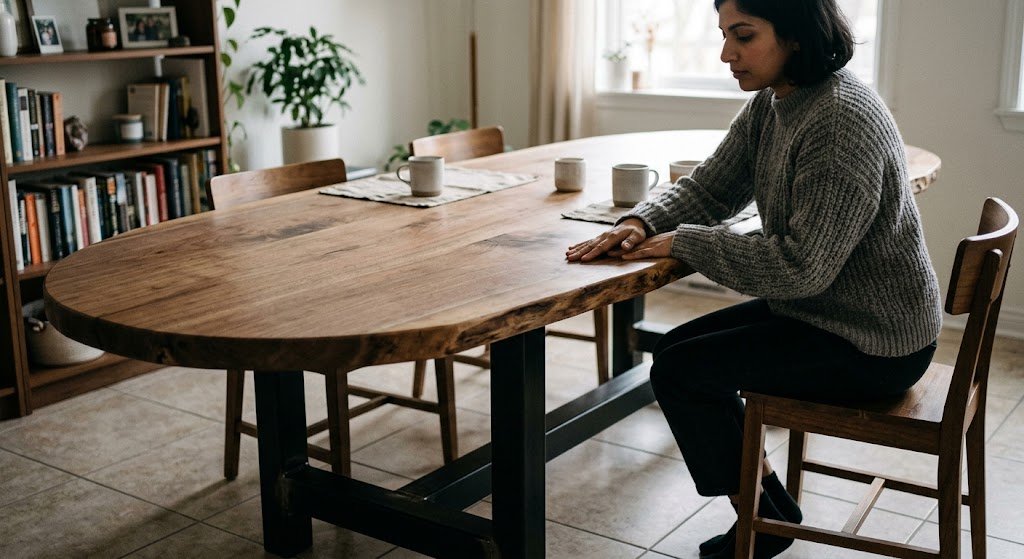
The base under Meera’s live edge walnut dining room table, credit where due, was solid steel, welded and stable. Metal doesn’t fight seasonal wood movement the way a poorly built wooden base can, since it simply doesn’t expand and contract along with the tabletop.
Going wooden instead means insisting on breadboard ends or slotted hardware, never rigid screws straight through the slab, so the top has room to shift without tearing.
Room layout matters too. Smaller dining spaces often do better with a round table and chair arrangement, while a live edge walnut dining room table genuinely wants a long rectangular or oval shape so both natural edges get to breathe. If a sixty-inch round is on your radar instead, it’s worth reading up on round dining table sizing before deciding — different design logic entirely.
Why I Told Meera to Skip Polyurethane
Hardwax oils — Rubio Monocoat, Osmo, that family of products — sink directly into the wood grain rather than forming a surface layer. Spot damage stays spot damage; you can fix a scratch without touching the rest of the table.
Polyurethane forms a hard shell on top instead. Handles spills a little better right out of the gate, sure. But chip that shell once, and there’s no localized fix — you’re sanding the whole surface down to start over.
For a live edge walnut dining room table that’s actually going to get used, oil’s the smarter call almost every time. It develops real character with age instead of that plastic-looking film poly eventually picks up.
Lighting a Live Edge Walnut Dining Room Table the Right Way
Texture this heavy needs light raking across it at an angle, not dumped straight down from a recessed can fixture overhead. Angled light catches every dip in the live edge and every twist in the grain, which is exactly why these tables photograph so well when someone bothers to light them correctly.
Because a long tabletop needs light spread evenly down its whole run rather than concentrated in one spot, a linear chandelier built for elongated dining tables usually beats a single centered pendant here.
Keeping a Live Edge Walnut Dining Room Table Around for the Long Haul
Spills get wiped up fast, full stop. Walnut resists staining better than oak, but overnight red wine will still leave its mark regardless.
Oil finish gets refreshed once or twice yearly, more often under heavy daily use. Water stops beading and starts soaking straight into the surface — that’s your signal it’s due.
Keep the table clear of heating vents and radiators. Uneven heat is still the single fastest way to warp a slab, faster than almost any other mistake owners make.
None of this takes special skill. It just takes consistency, the same kind you’d give anything meant to outlast a couple of decades rather than a couple of seasons.
Meera’s table is back in one piece now, with a fresh butterfly key spanning the repaired section. Took about three weeks and a few hundred dollars. She tells people now that she asks about moisture content before she asks about price.
FAQs
How much should a live edge walnut dining room table realistically cost?
Most run between $2,500 and $9,000-plus, with slab size, thickness, and grain figure driving the bulk of that range.
Will mine keep cracking after delivery?
Properly dried slabs with butterfly keys placed at existing checks tend to stay stable. Minor seasonal movement is normal — that’s not damage, that’s wood staying alive.
How often should I redo the finish?
Hardwax oil generally needs refreshing once or twice a year. Water no longer beading on the surface is the clearest sign it’s time.
Can walnut handle a busy household?
It’s softer than oak, yes, but it holds up fine under daily use, and its darker tone conceals minor scuffs better than lighter species do.
Round or rectangular for a live edge slab?
Rectangular or oval lets both natural edges run visibly along the sides — the actual reason anyone chooses a live edge walnut dining room table over a standard one. Round shapes sacrifice most of that effect.