


My coffee hasn’t even cooled down yet, but I wanted to get this written up — four different people asked me almost the exact same question about linear chandeliers for dining room spaces this month alone. It usually starts the same way: someone stumbles across a picture of a long, low fixture stretched over a dining table, gets hooked on it instantly, and then starts worrying it won’t translate to their own room. Most of the time, it will. Linear chandeliers for dining room tables solve a proportion problem people can’t always name but definitely feel — that odd, floating look a round pendant gives a long table.
Let’s get into the actual questions people ask me about linear chandeliers for dining room setups. Size. Height. Whether it only works on rectangular tables. I’ll go through them the way I would if you were standing in my kitchen with a tape measure, not the way a catalog would explain it.
Why Rectangular Tables Love This Shape
Round fixture, long table — it just doesn’t work visually, and most people can’t articulate why until someone walks them through it. Something about it feels off, and nine times out of ten, the homeowner can’t put a finger on what, not until it’s pointed out. The shape mismatch is really the whole issue. This is exactly why linear chandeliers for dining room tables have taken over in so many renovations lately — once the fixture mirrors the table’s line instead of contradicting it, the room reads as one finished thought instead of two furniture decisions bumping into each other.
Case in point: a client last year, 96-inch reclaimed wood table, round drum pendant dead center. Looked tacked on. We hung a five-light bar fixture along the table’s length instead, and her husband — who apparently notices nothing — asked what changed in the room. Nothing else had.
There’s a practical side too, beyond looks. Round pendants pool light in the middle of a table and leave the ends dim. Fine for a small table. Miserable for a big one, especially if you’re hosting eight people and half of them can’t see their food properly. That even, edge-to-edge spread is honestly one of the strongest arguments for choosing linear chandeliers for dining room tables over anything round.
Sizing Linear Chandeliers for Dining Room Tables


Almost everyone gets the sizing wrong the first go-round. Go too small and the fixture just reads as lost up there. Go too big, and it blocks every sightline across the table, turning dinner into a weird game of leaning around a light fixture to make eye contact.
A Simple Formula That Works
The formula that actually works: fixture length should run about a third to two-thirds of your table’s length. Say your table’s 72 inches — you’d want something between 24 and 48 inches long. Given the choice, I nearly always push toward the larger number, since a smaller fixture tends to disappear once there’s a centerpiece and full place settings competing for attention on the table. This is one area where sizing linear chandeliers for dining room tables correctly makes or breaks the whole room.
A handful of things worth knowing before you buy:
- The fixture width should stay inside the table’s edges, leaving space on either side.
- Size to your table’s everyday length, not the extended-with-the-leaf holiday length.
- If the room’s open to a living area, err bigger — it needs to read from a distance too.
- Tall ceilings can make an otherwise well-sized fixture look small once the room’s fully furnished.
Learned the sizing thing the hard way, honestly. Put a 36-inch fixture over a table nearly 100 inches long once. It looked like a stray bar someone forgot to finish installing. Never again — and it’s the first mistake I now warn people about with linear chandeliers for dining room installs.
Hanging Height, No Guesswork
Aim to hang it between 30 and 36 inches over the table’s surface, going by the fixture’s lowest point — that’s assuming a typical eight-foot ceiling. Add roughly three inches of drop for every extra foot of ceiling height. Getting this height right matters just as much for linear chandeliers for dining room use as getting the length right.
People overthink the head-bumping risk. At that height, nobody’s head comes close to it — you’d have to be standing on the table. If your dining space also functions as a walkway, or the fixture has exposed bulbs instead of shades, go toward the taller end of that range just for comfort’s sake.
Since most of these come with adjustable rods or chains, you’ll typically get a chance to adjust the drop after it’s hung, once you can finally stand back and eyeball it in the actual room. This flexibility is one reason linear chandeliers for dining room installs are fairly forgiving once you’re in the ballpark range.
Does It Work Over a Round Table?

Yes. People assume this style is rectangular-only, and that’s just wrong. Keep the fixture a bit shorter than the table’s diameter, same one-third to two-thirds math, and it works fine. Linear chandeliers for dining room tables that are round aren’t as rare a combination as people assume.
I did this myself, actually, hanging one over a round table paired with a set of upholstered chairs. Straight lines above, curves below — there’s a tension to it I genuinely like. A lot of designers do this on purpose now, since it keeps a round-table room from feeling overly soft.
With a 60-inch round table, something in the 24-to-30-inch range works best. This particular pairing makes people nervous for no real reason — it’s actually turned into one of my go-to combinations. If you’re working with a 60-inch round dining table, that sizing math holds up whether you go rectangular or opt for a shorter linear bar, and linear chandeliers for dining room tables of this size still deliver that even light spread.
Comparing the Alternatives
Round chandelier, pendant cluster, flush mount — clients ask me to weigh these constantly against linear chandeliers for dining room options. Here’s the honest comparison:
| Fixture Type | Best For | Light Spread | Typical Cost Range |
| Linear/Elongated Chandelier | Rectangular or long oval tables | Even, edge-to-edge | $150 – $1,200+ |
| Round Chandelier | Round or square tables | Concentrated in center | $100 – $900+ |
| Pendant Cluster (2-4) | Kitchen islands, narrow tables | Uneven, spotty | $80 – $600+ |
| Flush Mount | Low ceilings, minimalist spaces | Broad but flat | $60 – $400+ |
No single winner here. But for a table people actually use — homework, dinner, bills spread out on a Sunday — that even light spread is exactly why linear chandeliers for dining room tables keep winning this comparison for me.
Cost, Roughly Speaking
You can get something decent under $200. Some mid-range pieces honestly look close to fixtures priced four times higher. The extra money at the top end usually buys better metal finishing, dimmer-friendly sockets, and a frame that won’t sag in five years. Pricing on linear chandeliers for dining room fixtures varies more by build quality than by brand name, in my experience.
Ballpark numbers I give people:
- $150–$300 gets you something solid and unremarkable, which is fine.
- $300–$700 buys better materials and a more intentional look.
- $700+ if you want a real statement — mixed metals, handblown glass.
Check bulb type before buying, too. LEDs cost less to run and stay cooler, which matters more than you’d think on something hanging that close to where people sit for two hours at dinner. ENERGY STAR’s bulb guide is a decent place to compare efficiency numbers before purchasing, especially since linear chandeliers for dining room use often run several bulbs at once.
Finish Choices, and Why I Have Opinions

Matte black and aged brass have owned this category for a few years now. Deservedly — they age well, unlike chrome, which starts looking dated embarrassingly fast. Most linear chandeliers for dining room fixtures I install these days come in one of these two finishes for exactly that reason.
Don’t just match the fixture finish to your cabinet hardware and stop thinking about it. It’s the safe move. It’s also a little boring. I like mixing metals a bit — brass fixture, black window frames, that kind of contrast. Keeps a room from feeling like a staged listing photo.
Shade choice changes the whole feel of a room:
- Exposed bulbs read industrial, good with brick or loft-style spaces.
- Fabric or linen shades soften everything, better for traditional rooms.
- Glass globes sit in the middle, work almost anywhere.
- Caged metal shades lean farmhouse.
Bulbs and Brightness
Three to eight sockets is typical for this style. More sockets doesn’t automatically mean better light, though — total lumen output is what actually matters, not the number stamped on the box. This trips people up constantly when they’re comparing linear chandeliers for dining room listings online.
For a dining room, aim for 3,000 to 6,000 total lumens, adjusted for room size and any other light sources in play, like sconces. Nearly every install I’ve done in this category ends up on a dimmer. No real exceptions. Dinner light and homework light are two different needs entirely, and a dimmer handles both without a second fixture. It’s a small add-on that makes a huge difference with linear chandeliers for dining room installs specifically.
One more thing — if you’re hardwiring anything new rather than just changing a bulb, call an electrician. Don’t wing it. The CPSC’s electrical safety guidance is worth a quick read if you’re tempted to DIY this part.
The Usual Mistakes
Same errors, project after project, when it comes to installing linear chandeliers for dining room spaces:
- Centering the fixture on the room instead of the table.
- Matching the ceiling’s centerline instead of the table’s.
- Sizing down because a bigger option “felt like too much” in the store.
- Skipping the dimmer, then regretting it at every dinner after.
- Not checking ceiling clearance before the order ships.
That first one trips up older homes constantly, since the junction box was often wired for a completely different table layout decades ago. Either get an electrician to relocate the box, or use a longer rod that can hang at a slight angle — some brands build fixtures specifically for that fix now, which makes retrofitting linear chandeliers for dining room spaces in older houses a lot less painful.
Ceiling Height Actually Matters Here
More than people expect. Standard eight-foot ceilings keep the math simple. Vaulted or tall ceilings throw off the whole visual balance, and a fixture that looked right in a showroom photo can suddenly look small once it’s hanging twelve feet up in a real room.
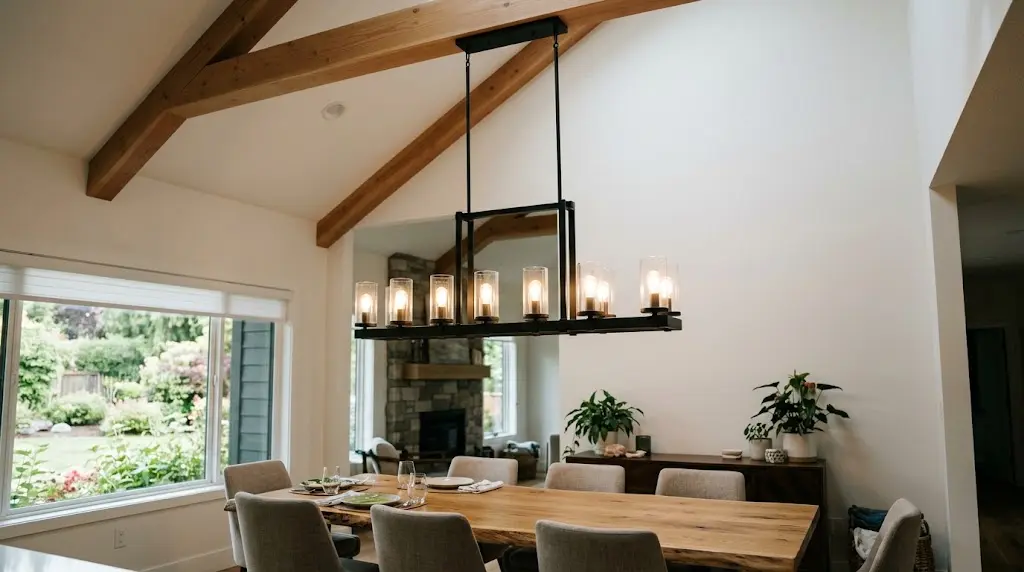
For ceilings past nine feet, size up a bit or pick a design with rod extensions instead of a chain — chains start looking flimsy over longer drops. Small detail. Changes how substantial linear chandeliers for dining room installs feel from across the room.
A Word on Materials
Finishes wear differently depending on the environment. Powder-coated black steel, for instance, holds up in damp climates and hides fingerprints far better than a polished brass surface would. Brass develops a patina over time — some people love that look, others end up asking for a lacquer coat to stop it.
With glass shades, shipping damage is the bigger risk — chipping, not scratching — so it’s worth reading the return policy before buying online. Fabric shades, meanwhile, collect dust surprisingly fast simply because they hang closer to eye level than a flush-mounted piece would. This is worth factoring in before ordering linear chandeliers for dining room fixtures with fabric elements.
Frequently Asked Questions
Can I install a linear chandelier over a square dining table?
Yes — just keep the fixture length under about two-thirds of the table’s width so it doesn’t overhang awkwardly.
Do linear chandeliers need special mounting hardware?
Heavier fixtures sometimes need extra ceiling support beyond a standard junction box, so check the weight specs before installing.
Are linear chandeliers going out of style?
Unlikely, from what I’ve seen. It’s not really about fashion — the shape addresses an actual layout problem that round fixtures can’t.
How many bulbs do I need for a 6-person table?
Usually 4 to 6, assuming standard LED equivalents and a dimmer switch.
Can I use one in a small dining room?
Yes — size down and pick a slim, single-tier design so it doesn’t overwhelm the space.
Final Thoughts
Three things matter most with linear chandeliers for dining room installs: correct sizing, a hanging height of 30 to 36 inches, and a dimmer on the switch. Almost every mistake I run into traces back to skipping one of those. Out of every dining-room update I’ve done, switching to linear chandeliers for dining room tables tends to shift the room’s whole feel more than almost anything else — and it costs less than most people expect walking in. Go measure your table. You’ll know the right fixture the second you picture it hanging there.