

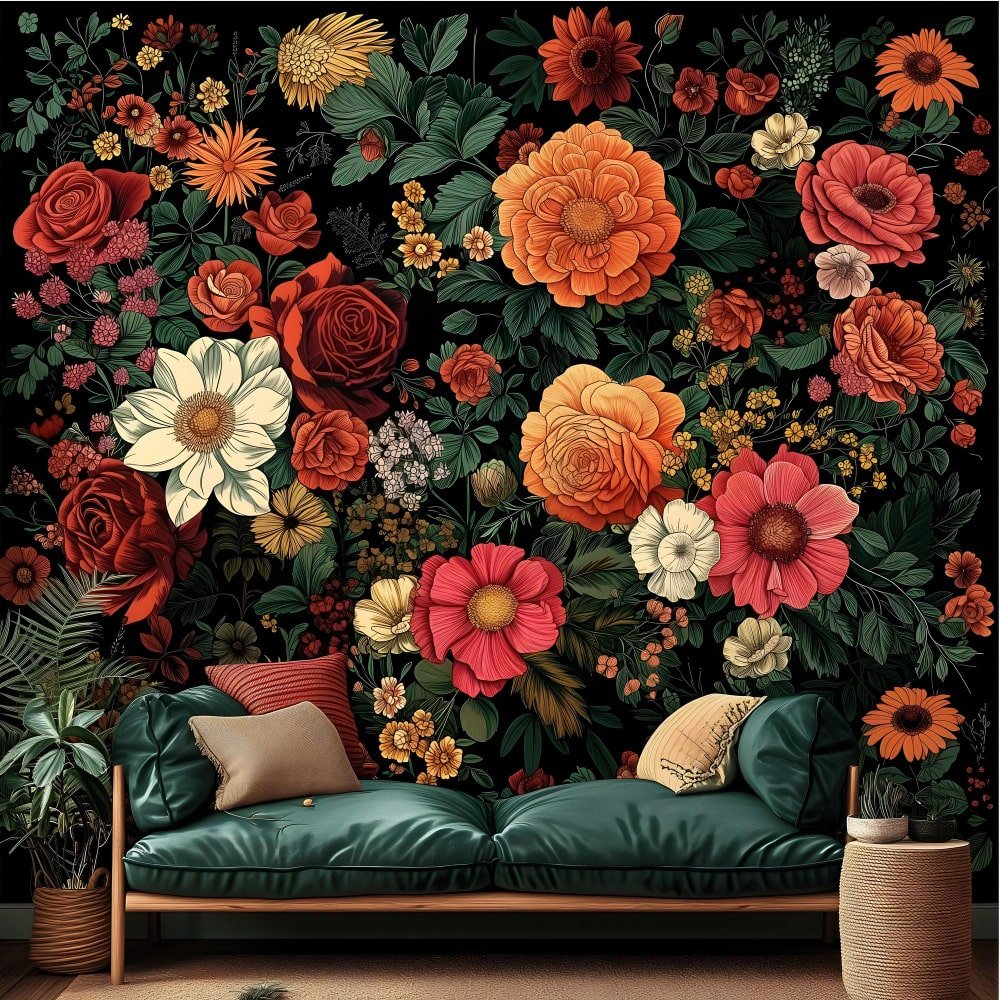
Floral wallpaper flowers can transform a dull room or ruin it fast. Here’s an honest, experience-based breakdown of what actually works and what doesn’t.
I’ve hung enough rolls over the years, sometimes at 11pm with a friend holding a flashlight, to know the product photo almost never matches what lands on the wall. So before we get into styles, let’s rank three real product pages people keep sending me.
Worst first: black peel-and-stick wallpaper. Striking in a photo, unforgiving in person. Dark backgrounds turn every seam and trapped air bubble into a visible flaw, and most walls just aren’t flat enough to hide from that.
Next: stick and peel wallpaper. Easier to handle during install, more room for error while you’re smoothing it out. The catch is inconsistency — adhesive grip changes from batch to batch, so it’s worth checking recent buyer feedback before ordering.
Best of the three, especially if floral wallpaper flowers is what you’re actually shopping for, is best peel and stick wallpaper. The print holds up over time and doesn’t have that slightly cheap, temporary look once it’s applied.
Three things decide whether any of this works: how big the pattern repeats, how the material finishes once it’s stuck down, and how much room for error you get while a non-professional is doing the hanging.
What Is Floral Wallpaper Flowers
Floral wallpaper flowers isn’t a single product — it’s a broad label. Traditional paste rolls, pre-pasted sheets, and peel-and-stick versions all fall under it, as long as a flower pattern is printed on top. Some designs pack in dense, vintage clusters. Others strip things down to one repeated stem on a bare background.
The common thread is intent, not technique. A blank wall doesn’t ask anything of you, and that’s exactly the problem. Floral wallpaper flowers gives a room something to look at twice, which a coat of paint, however nice the color, rarely manages on its own.
Most people don’t land on this search term out of idle curiosity. By the time they’re typing it, there’s usually already a specific patch of drywall in mind — a nursery corner, a cramped powder room, the stretch behind a headboard — one they’ve stared at long enough to want it different. The real question isn’t which patterns exist. It’s whether the one they’ve already fallen for will hold up once it’s actually stuck to that wall.
For anyone torn between removable and traditional options, peel and stick wallpaper for bathroom spaces covers that specific decision well. Humidity is the wildcard here, and it’s the reason a lot of floral prints don’t last past year one.
Why Floral Wallpaper Flowers Matter
Paint plays it safe. Floral wallpaper flowers doesn’t — and that’s the whole point. You get depth on a wall that would otherwise sit flat, without buying a single new piece of furniture.
It also buys you a focal point you’re not locked into forever. Renters and anyone in a smaller home benefit from that most, since a full remodel usually isn’t on the table anyway.
There’s a reason florals in particular tend to land well: organic shapes read as calming to most people, almost without them noticing why. Put up a wall of floral wallpaper flowers and the room’s mood shifts a little, purely based on which colors you picked.
Styles Worth Knowing
Floral wallpaper flowers isn’t one look — treating it like one is exactly how people end up ordering the wrong roll.
Vintage florals lean dense and heavily detailed. Dining rooms and studies tend to suit them.
Oversized botanical prints crowd a small room fast — give them height and window light, or skip them entirely.
Blush, sage, and soft blue don’t shout for attention, which is exactly why bedrooms and nurseries keep coming back to that palette.
Dark, moody florals with saturated blooms skip delicate entirely and go straight for dramatic. Brass fixtures and warm lamp light suit them, but a small dim room can feel heavier with one on the wall.
Tropical florals — bright colors, bold shapes — belong more in sunrooms and casual spaces than anywhere formal.
How Room Conditions Change the Result
A phone screen lies to you a little. Something that looks lush and layered in a product photo can turn claustrophobic once it’s on four walls of an actual small room with a low ceiling — I’ve seen it happen more than once.
The fix, more often than not, is going smaller. A print with more open background between the blooms breathes better than one that covers every inch.
Light temperature matters too. Rooms facing north stay cool and a bit dim year-round, and pastel florals can go a little lifeless in that kind of light instead of staying soft.
Rooms facing south get more daylight to work with, so bolder, saturated florals don’t fight the space the way they might under grayer light.
Interior designers tracking wallpaper trend patterns have noted that botanical prints tend to hold up better stylistically when they skip the overly sweet look in favor of something moodier or more painterly. That lines up with what I’ve seen too — a softer, less literal floral usually ages better on a wall than a bright, picture-perfect one.
Before a full roll gets ordered, tape one printed sample up and just leave it there for a day. Watch what the light does to it from morning to evening.
Real Examples From Real Rooms
A friend of mine papered a single wall in a narrow hallway with a small vintage floral. It worked specifically because there were no windows pulling attention elsewhere — the pattern became the one thing worth noticing in an otherwise forgettable stretch of house.
A different client went bold: a large, dark botanical print in a small home office with just one window. The room read smaller almost immediately. She swapped it out a few months later for something lighter and smaller in scale.
Bathrooms play by different rules entirely. Steam exposure means floral wallpaper flowers needs to be vinyl-coated or specifically humidity-rated, full stop. I’ve watched a genuinely beautiful bathroom wall start bubbling at the seams within a year, purely because the wrong material went up in the wrong room.
Nurseries are probably my most frequent request. Soft botanical prints fit that space naturally. The downside — a very literal, theme-heavy floral can feel dated within a few years, while a simpler, more abstract botanical pattern tends to hold up longer.
Benefits Worth Knowing

Texture and color that flat paint can’t produce — that’s the baseline benefit of floral wallpaper flowers, and it’s the one most people already know.
Peel-and-stick versions come off cleanly, which means a renter can commit to something loud on the wall without worrying about the security deposit.
Minor wall imperfections also hide better under a pattern than under a fresh coat of paint. The eye follows the print, not the dent behind it.
There’s a resale angle worth mentioning too, though it gets overstated online. One tasteful accent wall photographs well in a listing. An entire room wrapped floor to ceiling is a bigger gamble — it can just as easily turn off a buyer in a market that leans neutral.
Common Mistakes to Avoid
Not ordering a sample tops the list, hands down. A pattern catches someone’s eye in a tiny thumbnail, they buy enough rolls to cover a whole wall, and the actual color under their own lightbulbs never gets checked until it’s already up.
Ignoring pattern matching comes in a close second. Floral repeats have to line up at the seams, and a lower-quality print can throw that alignment off in a way that’s obvious the moment it’s up.
Going oversized in a small room trips people up constantly. So does skipping the moisture question entirely — bathrooms and kitchens need steam-rated material, not a standard paper-backed roll that was never built for that environment.
And wall prep, the boring part, gets skipped constantly. Every old nail hole, every dried drip of paint, shows straight through floral wallpaper flowers if the wall underneath wasn’t sanded down and wiped clean first.
Expert Tips
Get a sample swatch before you order anything else. It feels like an unnecessary extra step right up until it saves you from a full-room mistake.
Size the pattern to the actual room, not to whatever’s trending in photos. Confirm the moisture rating if there’s any humidity involved. Honestly, a cheap level and a tape measure have saved me more grief on wallpaper jobs than any fancier tool I own.
Frequently Asked Questions
- Does floral wallpaper flowers work in small rooms? Sometimes, if you’re careful about scale. Once a room shrinks past a certain point, oversized dense florals start eating up the space instead of decorating it.
- Is floral wallpaper flowers hard to remove? Depends on the type you picked. Peel-and-stick pulls away without disturbing the paint underneath, while old-school pasted rolls usually put up more of a fight and need steam.
- Can floral wallpaper flowers be used in a bathroom? Not unless it’s built for humidity — vinyl-coated or otherwise rated for it. A plain paper-backed roll will start bubbling the first time the shower runs long.
- How long does floral wallpaper flowers last? A decent peel-and-stick roll usually lasts three to five years before it starts looking tired. Pasted wallpaper can outlast that by a decade or more, but only in a room that stays consistently dry.
Final Thoughts
I don’t think floral wallpaper flowers is going out of style anytime soon, and honestly, it shouldn’t. There’s a warmth a good botanical print gives a wall that paint, all by itself, just never quite manages.
Picking the pattern, though, is only step one. Step two is being honest about the room it’s going into — how much sun hits it, how tight the space actually is, how much moisture the walls deal with on a normal week.
I’ve seen the print-online-regret-later story play out more times than I can count, and it’s almost never about taste. It’s the skipped swatch, the rushed prep. On the flip side, I’ve watched someone who swore they’d never do wallpaper try one small hallway wall, floral, nothing dramatic, and end up kicking themselves for waiting so long.
Preparation makes that difference, not taste.
If you’re still unsure, keep it small. One wall. A print on the smaller side. Material actually rated for the room it’s going in. You’ll learn more from that one wall than from scrolling a hundred more photos.
If it doesn’t work out, that’s fine too — that’s the whole reason removable options exist. Nothing here has to be permanent.
Done with a bit of thought, floral wallpaper flowers turns a room from “recently repainted” into something that actually feels like someone lives there on purpose. Worth the same care you’d put into any other part of the house.