

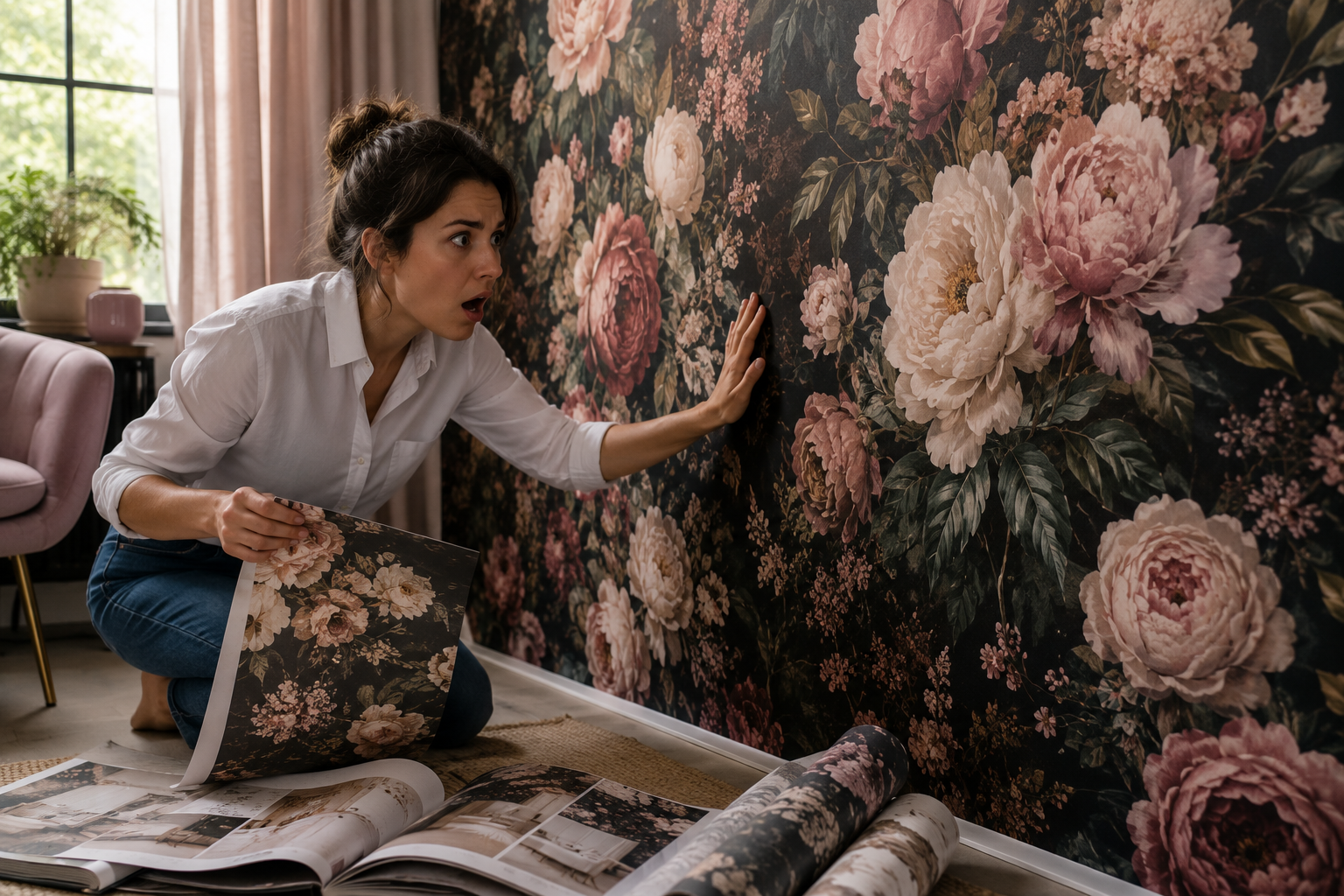
Most people treat floral wallpaper flowers like an all-or-nothing bet — full statement room or nothing at all. That mindset kills more good ideas than any actual design flaw does.
Here’s the part that gets skipped in most guides: floral wallpaper flowers works just as well in a small dose as a big one, and the backing material matters more than the pattern itself. A gorgeous print on the wrong material still bubbles, fades unevenly, or lifts at the corners within a year — no matter how good it looked in the catalog. A modest pattern on the right material can outlast a paint job by a decade.
So before getting into styles, it helps to look at the three main material types side by side, since this is where most buying decisions actually go wrong.
| Wallpaper Type | Best For | Average Lifespan | Humidity Handling |
| Peel-and-Stick | Renters, accent walls, quick updates | 3–5 years | Moderate (varies by brand) |
| Traditional Pasted | Long-term homes, full rooms | 10–15 years | Low unless vinyl-coated |
| Pre-Pasted | DIY installs, budget projects | 5–8 years | Low to moderate |
Peel-and-stick tends to be where beginners land first, and it’s the option most people are picturing when they look up stick and peel wallpaper online. Traditional pasted rolls outlast everything else but ask for more patience and a steadier hand. Pre-pasted splits the difference — cheaper than a full custom paste job, though it won’t survive decades the way traditional paper can.
Breaking Down What This Term Really Covers
There isn’t one single product hiding behind this phrase. Floral wallpaper flowers is really an umbrella term for any wall covering — paste, pre-pasted, or removable — that carries a flower-based print.
Some prints go dense and vintage, layering roses or peonies until the background barely shows. Others strip everything down to a single repeated stem on plain paper. Both count.
What people are usually really asking, underneath the search, is narrower than the phrase suggests. They already have a wall in mind — a nursery, a stairwell, the space behind a bed — and they want to know if the specific pattern they like will hold up there.
The Real Payoff of Choosing Floral Prints
A flat, painted wall doesn’t do much for a room beyond covering drywall. Floral wallpaper flowers gives that same wall a reason to be looked at.
It also solves a problem paint can’t: commitment. A pattern applied to one accent wall creates a strong visual anchor without demanding new furniture or a full redesign.
There’s a psychological piece too. According to Homes & Gardens, a home’s strongest sense of style comes from personality and practicality rather than chasing trends — and wallpaper is one of the most direct ways people signal that personal taste in a room. That tracks — a printed pattern simply carries more visual information, more texture and rhythm, than any single flat color ever will.
Sorting Through the Different Floral Styles
Vintage florals go dense, detailed, and layered — think dining rooms, studies, or anywhere a bit of formality is welcome.
A big, sprawling botanical needs room to stretch out, plain and simple. Cram one into a tight room with a low ceiling and instead of anchoring the space, it starts elbowing the furniture for attention.
Blush, sage, a faded-out blue — these colors don’t compete for the spotlight, and that’s exactly why they end up on so many bedroom and nursery walls. Nothing loud, nothing that argues with the crib or the curtains.
Then there’s the opposite camp — florals that go straight for drama instead of easing into it. Saturated blooms against black or deep green backgrounds suit rooms with warm lamp light and brass fixtures, though they can weigh down a small, dim space fast.
Tropical florals go bold and bright — big leaves, saturated color — and suit sunrooms or casual spaces more than anywhere formal.
Recent reporting from Livingetc’s design desk has flagged botanical and floral prints as having a real moment again — particularly the versions that lean moody or painterly instead of sweet. That matches what’s actually turning up in real installs lately.
Why Pattern Size Makes or Breaks the Room
Pattern scale is where most floral wallpaper flowers projects succeed or fail, and it has nothing to do with taste. It’s about the room’s actual dimensions.
A print that looks rich and layered in a product photo can feel tight and cluttered once it’s on four walls of a small, low-ceilinged room. In that case, going smaller — more visible background between the blooms — almost always reads better.
A solid rule from residential design guides is to weigh room dimensions, how the room actually gets used, and the visual heft of existing furniture before locking in a pattern size — rather than choosing based on how a swatch looks on a screen. Skip that step and you’ve got the single most common reason people end up unhappy with a wallpaper choice.
Light shifts things too. Face a room north and the light stays weak and grayish most of the day — pastels tend to lose their glow under that, going a bit muddy instead of soft. Face it south, and there’s enough sun coming in to let a saturated, high-contrast print hold its own without taking over the whole room.
Lessons From Actual Homes I’ve Seen
A friend of mine wallpapered a single wall in a narrow hallway using a small vintage floral. It worked because there were no competing windows — the pattern became the one thing worth noticing in an otherwise forgettable space.
A different client tried a large, dark botanical print in a small home office with one window. The room read smaller almost immediately, and she swapped it for a lighter, smaller-scale version a few months later.
Bathrooms follow their own rules entirely. Steam means floral wallpaper flowers needs to be vinyl-coated or humidity-rated — no exceptions. For anyone weighing options there, peel and stick wallpaper for bathroom spaces is worth reviewing before ordering anything.
Nurseries end up being my most frequent request, honestly. Soft botanical prints suit that room type without much convincing needed — the risk is picking something so literal and theme-heavy that it feels dated by the time the kid starts school, whereas a simpler pattern tends to keep working for longer.
What You Actually Gain by Going Floral
Color and texture flat paint simply doesn’t have — that part’s obvious, and it’s why most people start looking at floral wallpaper flowers in the first place.
Peel-and-stick versions lift off without a trace, so a renter can go bold on a wall without worrying about the deposit.
Small wall flaws also disappear better under a busy print than under fresh paint, since the eye tracks the pattern instead of the dent hiding under it.
Resale gets brought up a lot too, though people stretch the point further than it deserves. One good accent wall photographs nicely for a listing. An entire room wrapped floor to ceiling is riskier — in a market that skews neutral, it can just as easily push a buyer away.
Where Most People Go Wrong
Ordering without a sample is, by far, the mistake I see most. Someone spots a pattern in a tiny thumbnail, buys enough for the whole wall, and only sees how the actual color behaves under their own light after it’s already stuck up.
Ignoring pattern matching runs a close second. Every seam has to line up, stem to stem, petal to petal — and a cheap print will drift off just enough that anyone standing near the wall notices immediately.
Going oversized in a small room is another recurring one, right alongside skipping the moisture check in bathrooms and kitchens. And rushed wall prep quietly ruins more installs than people realize — every old nail hole and paint drip shows through if the wall wasn’t sanded and wiped down first.
A Few Things I Always Tell Clients
Get a sample swatch before spending on anything else. Sounds like busywork right up until it’s the one thing standing between you and redoing a whole wall from scratch.
Size the print to the room sitting in front of you, not the one from the trending photo on your phone, and double-check how the material handles steam if there’s any splashing nearby. My beat-up tape measure and a five-dollar level have bailed me out of more crooked installs than any expensive gadget ever has.
Quick Answers to Common Questions
Does floral wallpaper flowers work in small rooms?
It can, if the print doesn’t overreach. A tighter, lighter-scale repeat behaves better than a sprawling, dense floral the second a room starts feeling cramped.
Is floral wallpaper flowers difficult to remove?
Depends on the type. Peel-and-stick lifts away cleanly without disturbing the paint underneath, while traditional pasted rolls usually need steam and more patience.
Can floral wallpaper flowers go in a bathroom?
Only the vinyl-coated or humidity-rated kind. A regular paper-backed print will start bubbling the first time steam builds up.
How long does floral wallpaper flowers actually last?
Peel-and-stick usually looks worn out somewhere between year three and year five. Traditional pasted rolls can go a decade past that easily, but only in a room that never really deals with dampness.
Where This Leaves You
Floral wallpaper flowers isn’t fading out, and calling it a fad sells short what one good wall of it can do to a boring room. A well-chosen botanical print carries a warmth that no can of paint, however perfectly color-matched, quite manages to reach on its own.
Picking the print is only step one. Step two is being honest about the room it’s headed for — how much light hits it, how big it really is, and how much moisture the walls put up with on an average week. Skip that part and even a gorgeous pattern can end up as a letdown.
I’ve watched people fall for a print online and regret the whole thing within a year, almost always because they skipped the swatch or rushed the prep. I’ve also watched the opposite happen — someone hesitant about wallpaper altogether tries one small wall of floral wallpaper flowers, and ends up wondering why they waited so long.
Preparation is what separates those two outcomes. Not taste.
Not sure yet? Go small first. One wall, nothing bigger.
That one wall will teach you more about whether floral wallpaper flowers fits your home than scrolling through another hundred photos ever could.
And if it flops, that’s the entire point of removable options existing in the first place. Nothing here locks you in for good. Done thoughtfully, floral wallpaper flowers can turn a plain room into one that feels deliberately put together — and that’s worth the extra bit of care it takes to get right.