

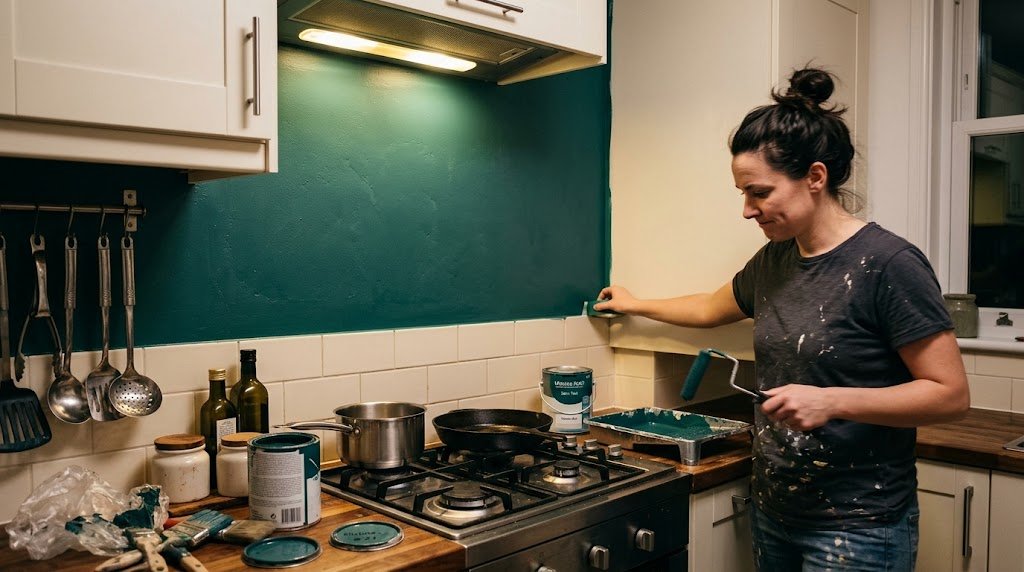
Three times. That’s how many times I repainted the wall behind my stove before it finally worked. Twice, the swatch lied to me — looked rich and warm in the store, then went strange and orange under my kitchen’s yellow-tinted overhead light. Round three, I got lucky. Or maybe I just finally paid attention to the lighting instead of the paint chip. It’s been four years since, no complaints.
So when someone tells me a kitchen accent wall is a weekend paint job and nothing more, I push back a little. It can be. But kitchens throw curveballs other rooms don’t — steam, grease splatter, three different light sources fighting each other, cabinets and counters and backsplash all needing to somehow agree with whatever color lands on that one wall. Done well, the room clicks into place. Done poorly, it just looks like a leftover can of paint got used up.
What follows isn’t a scroll-through of pretty photos. It’s the stuff that actually decides whether this works: picking the right wall, weighing paint against wallpaper, figuring out which colors hold their looks past year one, what it costs once you count the parts nobody mentions, and the mistakes that show up in kitchen after kitchen.
Pick the Wall Before You Pick the Color
Most people start with color. Wrong order. Start with the wall.
Here’s my test: does this wall actually have nothing else going on? If it’s covered in upper cabinets, skip it — you’ll end up with a strip of exposed color above the counters that reads as unfinished rather than deliberate. Same story with a wall that’s mostly window glass. For a kitchen accent wall to register as an actual design decision, you need something like 60 to 70 percent of it clear and uninterrupted.
Walls that tend to work:
- The far end wall in a galley setup or one-wall kitchen — especially one you see immediately walking in
- A wall behind open shelving rather than closed cabinetry
- A peninsula or half-wall that faces into the dining area
- The wall an island backs against, assuming it isn’t floating free in the room
Open floor plans throw in a complication. Your accent wall might spill into view from the living room, meaning it has to hold up against two rooms’ worth of furniture and light instead of one. Anyone dealing with that overlap should take a look at how accent walls in living rooms get approached — the underlying sightline problem is nearly the same.
One thing I’ll say flatly: the sink wall is usually the wrong pick, even though it feels central and obvious. You’re staring at it constantly while you’re at the sink, sure. But it also absorbs more steam and splash than any other surface in the room. I’ll get back to that.
Paint or Wallpaper, and Why It’s Not Really a Style Question
The choice between paint and wallpaper on a kitchen accent wall isn’t about which looks nicer. It’s about which wall you’re dealing with and what it has to survive.
Paint wins on cost and flexibility. A gallon of solid kitchen-grade paint costs somewhere between $35 and $70, and a single wall rarely uses the whole can. Stick with satin or semi-gloss, though — not matte. Matte and eggshell look beautiful for about a month, then start soaking up grease like a paper towel. Semi-gloss just wipes clean.
Wallpaper does something paint can’t: it hides flaws. Old wall texture, minor dings, uneven patching — a busy enough pattern covers all of it. It also tends to look more deliberate, more “designed.” A geometric print or botanical pattern on a kitchen accent wall says something a flat color doesn’t. Downside is durability near heat sources. Regular paper near a stove eventually curls and lifts as grease and steam get under the edges. If wallpaper is the plan, look for vinyl-coated or kitchen-rated options, and even then keep it clear of direct splash zones. There’s a solid rundown of kitchen wallpaper materials that actually hold up if you want the specifics.
Peel-and-stick has come a long way, honestly. A few years back it felt like a rental-apartment compromise. Now some of the better vinyl versions perform close to pasted paper, and pulling them down later won’t tear up your drywall. If commitment is the thing holding you back from doing a kitchen accent wall at all, peel-and-stick wallpaper takes a lot of that risk off the table.
My rule of thumb: paint near heat or water, wallpaper on the wall that never sees a splash.
Which Colors Actually Last
This is where most kitchen accent walls go sideways, and it’s rarely a taste problem. It’s a lighting problem.
Kitchens run on mixed light — daylight through a window, warm undercabinet strips, maybe a cool overhead fixture thrown in. Put those together and colors behave unpredictably. A green that reads as calm sage on the paint chip can turn muddy or vaguely olive once your actual bulbs hit it. Learned that one the hard way on my own stove wall, where terracotta went full brick-orange under fluorescent light.
| Color Family | Ages Well | Dates Fast |
| Blue | Muted navy, slate | Bright cobalt, teal |
| Green | Sage, hunter | Mint, neon lime |
| Neutral | Warm greige, terracotta | Stark cool gray |
| Red | Brick, muted rust | Bright cherry |
| Dark | Charcoal, forest | True black — shows dust badly |
Both Sherwin-Williams and Benjamin Moore release yearly trend forecasts, and I’d glance at them — not to copy them exactly, but to see which undertones are getting overused so your kitchen accent wall doesn’t feel dated in three years. Sherwin-Williams’ current color of the year leans warm this cycle, which lines up with a broader shift I’ve noticed away from the cool-gray wave of the 2010s.
For a deeper list sorted by undertone and cabinet pairing, there’s a kitchen wall colors breakdown worth checking — undertone matters more here than people assume. Pick the wrong one against warm wood cabinets and your accent wall fights the room instead of joining it.
Small detail people miss: sheen changes perceived saturation. Same exact paint color looks like two different shades in matte versus semi-gloss, especially wherever direct sunlight hits it during part of the day.
What This Actually Costs, Line by Line
Paint or paper themselves are the cheap part. Prep is where budgets blow up, especially in older houses.
If your home predates 1978, sanding or scraping existing paint triggers EPA lead-safe work requirements — this isn’t optional, and it’s worth knowing before you start. The EPA’s renovation guidance lays it out. If a contractor’s doing the prep, ask directly whether they’re certified for it.
Ballpark numbers for a standard 10×10 wall:
- DIY paint, materials only: $40 to $90, primer included
- Professional paint job, labor and materials combined: $200 to $450 per wall
- Standard wallpaper, materials: $60 to $180 depending on pattern
- Professional wallpaper install: $150 to $400 per wall, more for pattern matching
- Peel-and-stick, DIY, materials: $50 to $150
Tile changes the math considerably — a textured or dimensional treatment instead of paint or paper can run $500 to $1,200 for one wall depending on the material. Natural stone especially needs sealing, which adds both cost and upkeep down the line. Worth reading through kitchen wall tile options before deciding.
There’s also a cost nobody puts in these articles: wasted time. My two failed attempts cost about a weekend and $60 in paint. Not devastating. Still annoying.
The Sink Wall Fails Differently Than the Range Wall
I said earlier the sink wall is a bad pick, and here’s the reasoning, because it surprises people.
Everyone assumes the range wall is riskier — heat, smoke, that kind of thing. Fair concern, but manageable. Semi-gloss paint or a sealed material shrugs it off fine, and most range walls already have partial tile or a hood covering the worst of it anyway.
The sink wall’s problem is different. Not heat — moisture. Constant small splashes from washing dishes, condensation off a nearby dishwasher, humidity that just sits there. Over months, that steady low-grade dampness does more damage to a painted or papered kitchen accent wall than occasional grease near a stove ever does. Wallpaper suffers worst here. The adhesive gives up at the edges closest to water first, curling before you even notice staining.
If the sink wall really is your only option, go fully sealed and high-gloss, and think seriously about tiling the lower two feet instead of relying on paint or paper alone.
Small Kitchens Follow a Different Set of Rules
Everything above assumes reasonable wall space. Small kitchens flip the math.
In a narrow galley layout, a bold kitchen accent wall can make the space feel warm and intentional — or cramped and closed in. The difference usually comes down to value, meaning how light or dark the color sits, not the actual hue.
What’s worked for me: keep the accent color within one or two shades of your cabinets rather than chasing hard contrast. High contrast reads dramatic in a big kitchen. In a small one it just slices the room into visual chunks and drops the ceiling — visually, anyway.
And don’t put the accent wall directly opposite the entry in a tight kitchen. Walking in and immediately facing a bold wall a few feet away can make the whole room feel like it’s closing in on you. A side wall you catch peripherally tends to read as warmth instead of confrontation.
Mistakes I See Over and Over
- Not actually testing the sample. Everyone tapes up a swatch. Almost nobody checks it more than once. Kitchen light shifts hard between morning, midday, and evening with the overheads switched on — check the sample at all three before committing to a full wall.
- Letting the wall match the backsplash instead of complementing it. A kitchen accent wall too close in tone to an adjacent tile backsplash reads as a mismatch, not a matched set. They shouldn’t be identical — one should lead, the other support.
- Picking a trend color without checking cabinet undertone first. Warm wood clashes with cool blues and grays more often than people expect. Benjamin Moore’s color trend forecasts are useful here — less for copying the exact picks, more for spotting which undertones are saturating the market before you commit a whole wall to one.
There’s a fourth, smaller one worth mentioning: forgetting to seal grout or tile edges near the new paint. Moisture works its way in at the seams months later. Small mistake. Annoying fix.
Timeline: How Long This Actually Eats Up
Paint, on a wall in decent shape, goes fast. Prep and prime one evening, paint the next day, a light second coat if the color needs it. One weekend, dry time included.
Wallpaper eats more time than people plan for — especially patterns needing seam matching. Budget a full day for a single wall if it’s your first time hanging paper. Pros move quicker, though intricate pattern-matched jobs can still take half a day even for someone experienced.
If lead-safe prep applies to your home, add time for containment setup and cleanup afterward. Not a step to skip.
Combinations That Keep Holding Up
A handful of pairings show up again and again in kitchens that still look good five years later:
- Deep sage with white or cream cabinets and brass hardware
- Warm terracotta against light oak cabinetry
- Charcoal or navy with white subway tile and matte black fixtures
- Dusty rose or soft clay in a farmhouse kitchen with open wood shelving
Nothing revolutionary here. Just the pairings that don’t feel stuck in a specific year once time passes.
FAQs
Does the accent wall need to match the rest of the house?
Not exactly — it should relate in tone, though. A wildly unrelated color feels disconnected, especially in open layouts.
Can I just use my cabinet color on the wall?
You can, but the effect is subtler than expected. A slightly deeper shade in the same family usually reads better than an identical match.
Is wallpaper harder to remove later than paint?
Depends on the type. Traditional pasted paper can tear up drywall coming down; peel-and-stick usually pulls clean, which explains its popularity.
Should the range hood match the accent wall?
Not required — a contrasting hood, metal especially, often works better at anchoring the wall as a focal point.
How do I know if my kitchen has enough light for a dark color?
Watch the wall across a full day. If it’s still dim by mid-afternoon with lights off, go with a mid-tone instead — a very dark kitchen accent wall can feel heavier than you expected.
Final Thoughts
A kitchen accent wall either pulls a room together or makes it look like an unfinished thought. Neither outcome has much to do with taste — it comes down to the wall you pick, matching the material to what that spot actually endures, and testing the color under your real lighting before committing a full weekend.
If you’re stuck, start small. One gallon, one wall, and give yourself permission to redo it. That’s exactly what I did — three times — before it finally stuck.