

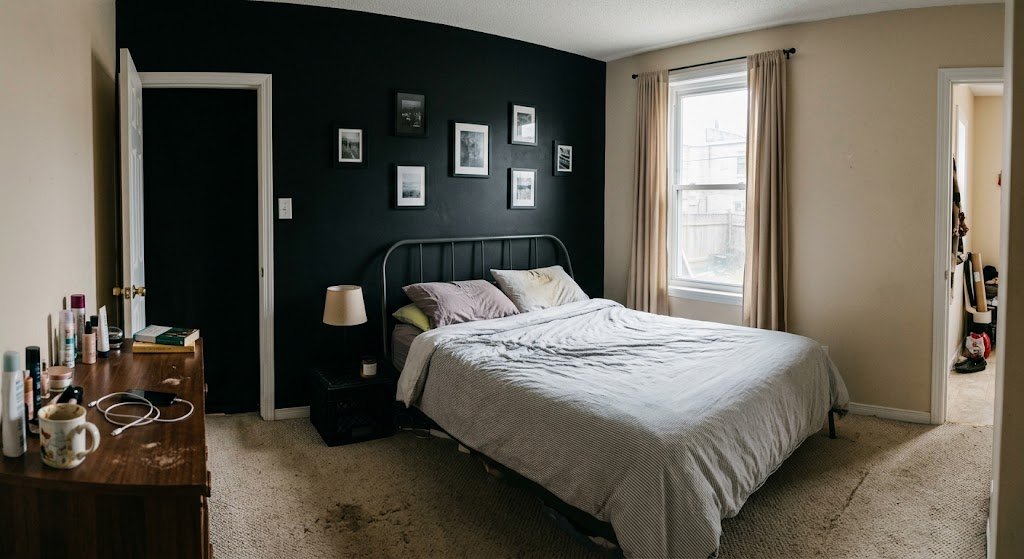
My first attempt at a black accent wall bedroom happened on a random Sunday, and I remember feeling pretty pleased with myself while the roller was still wet. Two days later, walking in after work, the room read more like an unused storage unit than the moody retreat I’d pictured. The color wasn’t the issue. It never was. What went wrong sat entirely in the decisions I made around that color, and I managed to repeat nearly every version of that mistake before finally sorting out what works.
Chances are, if you’re weighing a black accent wall bedroom right now, there’s a specific image in your head: something layered, a bit dramatic, still restful enough to actually sleep in. That image is entirely reachable. But one particular misstep derails more of these projects than any shade of black ever could, and almost nobody mentions it before the paint gets bought.
Below, I’m covering that misstep in detail, plus wall placement, finish choice, lighting, how room orientation changes things, styling, pricing, and whether a black accent wall bedroom ages well or just becomes something you repaint in a couple of years.
One thing worth saying upfront: I still like black walls. My current bedroom has one right now, and given the choice again, I’d paint it the same way. This isn’t an argument against the idea. It’s a rundown of what to check first so you skip the weekend I lost figuring it out. And if you’re still torn on paint at all, browsing a few master bedroom wallpaper ideas first isn’t a bad way to sanity-check the direction before you buy anything.
The real mistake almost everyone makes with a black accent wall bedroom
The part nobody warns you about has nothing to do with which black you pick. It’s committing an entire wall to the color before watching how that specific black behaves in your specific room, across an actual day.
Black paint doesn’t behave like a single, fixed color. Depending on undertone, pigment quality, and whatever light happens to be hitting it, the same can produce wildly different results wall to wall. A shade that looked deep and warm under showroom lighting can turn cold, flat, or oddly purplish once it’s dried on your bedroom wall at nine at night with a lamp on. Mine did exactly that. There was a faint blue undertone hiding in the paint that I never caught on the tiny sample card, and under my bulbs it shifted toward navy after dark and toward gray by afternoon. Not unattractive, exactly — just not what I’d signed up for.
Getting a black accent wall bedroom right means sampling it properly first. Skip the two-inch paint chip entirely. Paint an actual swatch, two feet across at minimum, and leave it on the wall a full day. Look at it at sunrise. Look again at midday. Then look once more after dark with your lamps running. Shortcut that step and you’re not choosing a color anymore — you’re rolling dice.
There’s a second layer to this same mistake, tied directly to the first: picking a wall that was never suited to carrying that much darkness in the first place. Someone skips the sample, paints whichever wall was closest or most convenient, and ends up convinced black itself was a bad call — when really, two separate oversights stacked on top of each other.
If committing a full wall to solid black still feels like too big a leap, there’s a lower-stakes way to test the same effect. A wallpaper accent wall can deliver a similar dramatic feel in a black accent wall bedroom without the multi-coat commitment, and it comes down far more easily if you end up changing your mind.
Helping friends fix this exact problem in their own homes, I’ve noticed it’s almost never a full do-over. Sometimes better lighting solves it entirely. Sometimes the undertone really was wrong and a repaint is needed. Either way, a black accent wall bedroom that feels “off” usually isn’t a verdict against the whole concept — it’s a sign that one or two specific checks got skipped along the way.
Season matters here too, and it’s the piece people forget most often. Paint your black accent wall bedroom in June, when daylight floods in for most of the afternoon, and by December, with a fraction of that same light, the wall can look like an entirely different color. If you’re painting during a bright season, force yourself to check the wall with lamps on well before dusk — that’s a much closer preview of what a winter evening will actually look like.
Picking the right wall changes everything
Every wall in a bedroom isn’t a fair candidate for black. This is where people trip a second time, and it connects straight back to the mistake above.
Behind the headboard tends to win out more often than any other option for a black accent wall bedroom. Instead of becoming something you’re forced to look at all day, it turns into a backdrop, framing the bed the same way a mat frames artwork. Step into the room and your eye lands on the bed first, with the wall quietly doing its job behind it.
A few walls deserve a second thought before committing a black accent wall bedroom to them:
- Whichever wall holds the room’s only window. Black there can choke off the light source entirely, leaving the room reading darker than you intended even at noon.
- The wall facing the doorway. Since it’s the very first thing anyone sees on entry, it can register as heavy rather than inviting, particularly in a smaller footprint.
- Any wall crowded with a closet door, an outlet, and a radiator. Black doesn’t hide interruptions the way lighter colors do — it draws attention to them. A cleaner, uninterrupted stretch of wall almost always looks better both in person and in photos.
Compact bedrooms aren’t ruled out by default. Done on the right wall, a black accent wall bedroom in a small space can actually feel more deliberate, almost cocoon-like, rather than cramped. I’ve watched a room barely bigger than ten by eleven pull this off beautifully, while a much larger primary suite ended up feeling boxed in — purely because the wrong wall got the paint. If you’re still deciding between a bold paint moment and something with more built-in texture, it’s worth flipping through a few wall colour combinations side by side before you settle on one direction.
Ceiling height matters more than most people expect going in. At eight feet, a fully committed black accent wall bedroom can occasionally feel like it’s pressing down slightly, especially paired with a stark-white ceiling. Softening the trim or crown molding to an off-white rather than bright white eases that transition considerably. Taller ceilings mostly make this a non-issue — there’s simply more room for the eye to travel, and the black reads as a choice rather than a weight.
Angled or L-shaped rooms need their own logic. A slanted ceiling, an awkward nook, or a jog in the wall changes which surface actually works. Look for the flattest, least interrupted stretch you’ve got. A black accent wall bedroom fighting for attention against too many competing angles ends up looking cluttered instead of confident.
Paint isn’t your only option
The assumption that a black accent wall bedroom must involve a roller and an open paint can isn’t quite accurate, and it’s often not even the smartest route.
Peel-and-stick materials have improved considerably over the past few years. They come off cleanly, which matters a great deal if you’re renting, and they bring texture that flat paint simply can’t replicate. A black peel-and-stick wallpaper can land a similar mood without the primer, the multiple coats, or the wait between them.
Textured wallpaper offers a separate advantage — it tends to disguise the small surface flaws that flat black paint tends to expose instead. If your wall carries old patch marks, uneven texture, or leftover nail holes from a prior gallery arrangement, wallpaper often forgives more than paint would in that same spot.
Neither route wins outright for a black accent wall bedroom. It comes down to whether permanence or flexibility matters more to you, and how much prep work you’re willing to put in. Paint delivers the richest, most unbroken black available. Wallpaper trades some of that depth for speed and texture. Either can leave you with a black accent wall bedroom that looks deliberate rather than accidental.
Upkeep differs sharply between the two. A scuff on painted black is a five-minute fix with a small touch-up can. A damaged section of peel-and-stick usually means replacing that panel outright, since seams get harder to blend the longer they’ve been down. Households with kids, pets, or frequent furniture rearranging should weigh that difference before deciding which route fits their own black accent wall bedroom.
Sheen changes the entire mood of a black accent wall bedroom
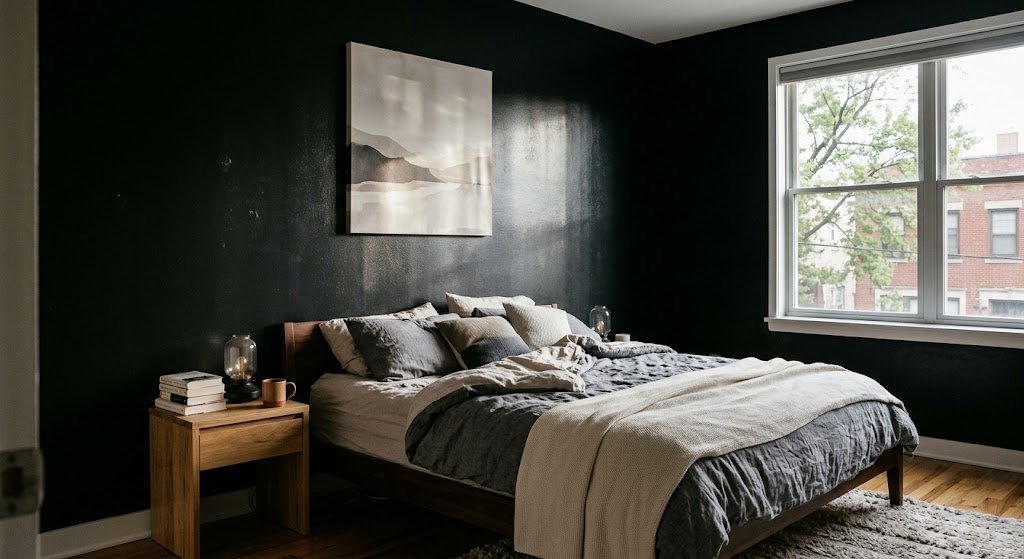
This is the step almost everyone skips, and it shouldn’t be skipped, because finish shapes how black reads nearly as much as the shade you land on.
Go flat or matte and the wall pulls light in rather than bouncing it back, giving a soft, almost fabric-like depth. Small surface flaws disappear under it. The tradeoff shows up over time, though — fingerprints and scuffs sit right on the surface, a real concern if the wall backs up against a headboard people lean on regularly.
Step up to satin or eggshell and a touch more light reflects off the wall. That small shift can be the difference between a black accent wall bedroom feeling grounded versus feeling like it’s swallowing the room, particularly somewhere without much natural light to begin with — and cleanup gets noticeably easier. What you give up is forgiveness for wall texture; bumps and old patch jobs show through more than they would under matte.
Semi-gloss rarely belongs on a full accent wall in a bedroom setting. Across that much surface area it starts to resemble trim paint, verging on plasticky. Where it does work nicely is as a small counterpoint — trim or molding catching a bit of shine against an otherwise matte wall.
| Finish | How it reads | Where it fits best | What it takes to maintain |
| Flat / Matte | Deep, fabric-like, pulls light in | Bedrooms already getting solid ambient light | Marks up easily, tougher to wipe down |
| Eggshell | A whisper of sheen, still soft-edged | The default pick for most black accent wall bedroom builds | Wipes clean without much effort |
| Satin | Visible glow without shouting | Rooms starved for natural daylight | Holds up well, but flaws show through |
| Semi-gloss | Sharp, reflective | Trim and small details, not full walls | Extremely durable, unforgiving on imperfections |
Sherwin-Williams breaks this down room by room in more depth if you want the fuller picture — their official paint sheen guide is worth a few minutes before you commit to a can.
Across most projects I’ve watched or helped with, eggshell lands as the safest middle ground for a black accent wall bedroom. Soft enough to feel intentional, durable enough to survive daily use.
One more wrinkle: sheen names aren’t standardized across brands. What one manufacturer labels “eggshell,” another might call “low luster” or “satin,” and the actual gloss level behind those names can differ. If you’re cross-shopping brands, ask to see physical sheen samples side by side instead of trusting the label. Skip that comparison and you might end up with a finish noticeably shinier or flatter than what you pictured once it’s dry.
Lighting is where black bedrooms usually fall apart
Nail the wall, nail the finish, and the whole black accent wall bedroom can still disappoint if your lighting setup stays frozen in place from before the paint went up.
Black pulls light in rather than throwing it back — that’s simple physics, not a design preference — which means a black accent wall bedroom relying on the same lone overhead fixture it had before almost always ends up feeling smaller and dimmer than planned. This is the single complaint I hear most from people unhappy with their black wall, and the wall itself is rarely the actual culprit.
A handful of fixes consistently solve it:
- Bring in at least two additional light sources beyond the ceiling fixture — bedside lamps, a floor lamp, wall sconces flanking the headboard.
- Choose bulbs in the 2700K to 3000K range rather than anything cooler. Cool-toned light against black paint reads clinical instead of comforting.
- Introduce one reflective element — a mirror, a metallic frame — placed where it can catch and redistribute available light.
- Favor lighter, sheer window treatments wherever possible, so daytime light isn’t already working against the wall before evening even arrives.
I rewired my own lighting setup roughly three weeks after painting, once it clicked that the paint was never the problem — my single overhead light was. Two lamps later, the room finally matched what I’d been chasing from those reference photos all along. Small fix, disproportionately large payoff.
Does the direction your room faces actually matter?
It genuinely does, and it’s a factor most people planning a black accent wall bedroom never think to check.
South- or west-facing rooms tend to pull in stronger, warmer light for longer portions of the day. Black holds up well here — there’s enough natural light bouncing around that the wall rarely feels like it’s absorbing the whole room, and by evening, the shift between daylight and lamp glow can look genuinely dramatic in a good way.
North-facing rooms, or anything heavily shaded, play by different rules. Light tends to arrive cooler and flatter, so a black accent wall bedroom in that setup leans much harder on finish and artificial lighting to feel finished rather than flat. This is precisely where satin over matte, warm bulbs over cool, and at least one reflective surface stop being extras and start being necessary.
I’ve walked into north-facing black bedrooms that felt genuinely inviting, and others that landed closer to a windowless basement with a mattress in it. The gap between the two almost never traced back to the paint color itself — it traced back to whether anyone thought about which way the windows faced before reaching for a brush.
Styling around it without turning the room into a cave
Once the wall and lighting are settled, styling is what pushes a black accent wall bedroom from “recently painted” into “actually finished.”
Contrast carries most of the weight here. Pale bedding, a light or natural-wood headboard, and neutral floor coverings keep the room from tipping into something too heavy. There’s no requirement to go fully stark — creams, muted grays, and unfinished wood tones all sit comfortably next to black and generally feel more lived-in than a strict black-and-white split.
Metallic touches earn their place too. Brass hardware, gold frames, even matte black fixtures against the dark wall introduce shine without disrupting the calm. A plant or two near the wall softens the hard edge nicely — live ones if you’ve got the patience, faux ones if you don’t, and neither choice needs an apology.
This look flexes across whatever style you’re already working within, which explains part of its staying power. Pair it with clean lines and minimal bedding in a modern room and it just works. In something more traditional, it sits comfortably behind a wood headboard with brass lamps and a patterned rug, provided the surrounding palette stays warm. Even boho-leaning rooms make it work, usually by leaning on texture — woven hangings, rattan, layered wood tones set against that dark backdrop.
If you’re mapping the color palette for the entire room rather than a single wall, it’s worth thinking through how the black interacts with everything else in the space before locking in the paint, since the accent wall is really only one piece of a larger decision.
For decor on the wall itself, less tends to work better. One or two pieces, maybe a single mirror, beats a crowded gallery arrangement competing with the depth the black is already contributing. A black accent wall bedroom generally reads best when it’s given room to be the statement, with everything else stepping back to support it. For more finishing ideas, there’s a useful collection of bedroom wall decor directions worth scanning before you go shopping.
Cost, timeline, and whether it’s actually worth it
Out of every option I’ve tested for changing how a bedroom feels, painting one wall stays the cheapest by a wide margin, which is probably the real reason it hasn’t gone out of style.
Paint-wise, plan on one gallon for a typical wall, occasionally two if you’re covering a pale existing color and need full opacity. Primer becomes necessary when you’re going from light to black, since skipping it often forces an unplanned third coat later. Most people can handle prep, primer, and paint on a single wall over one weekend, though darker colors tend to need more patience between coats than lighter ones do.
Hiring the job out keeps costs relatively contained too — a lone accent wall is typically among the cheaper quotes a painter offers, since it demands far less labor than an entire room. It’s still worth collecting a couple of local estimates before assuming DIY automatically wins, once you factor in tools, primer, and that inevitable extra run to the hardware store.
On the resale question: dark tones have actually been climbing in real estate value data recently, not fading. Zillow’s newest paint color research found that deep, saturated bedroom colors consistently pulled higher offer prices than pale neutrals, with charcoal and similarly rich shades performing strongly across several rooms in the home. The full breakdown sits in Zillow’s 2025 paint color research if resale value factors into your decision alongside personal taste.
Still, a fully black bedroom and a single black accent wall bedroom carry very different levels of risk. One wall repaints easily if your taste shifts or a sale comes up. Committing all four walls asks for more nerve, and honestly, more follow-through.
Longevity gets overlooked in most of these conversations. Prepped and sealed properly, a black accent wall bedroom can go five to ten years without needing attention, assuming ordinary wear and no direct sun bleaching the pigment over time. Touch-ups stay simple with a small can of the matching color on hand for scuffs. The real risk isn’t the paint failing — it’s taste moving faster than the wall does. Choose it because you genuinely want it, not because it’s trending this season, and it tends to hold up on both fronts.
Before locking anything in, it helps to see the whole set of decisions side by side rather than scattered across several sections.
Quick reference before you commit
| Decision | Safer choice | Riskier choice |
| Which wall | Behind the headboard | Wall with the only window |
| Finish | Eggshell or satin | Full flat matte in a dim room |
| Lighting | Add 2+ warm light sources | Keep the single overhead fixture |
| Commitment | One accent wall | All four walls |
| Method | Paint (permanent, richest color) | Removable wallpaper (flexible, textured) |
Frequently Asked Questions
Does a black accent wall bedroom make the room look smaller?
In my experience, not if it’s on a wall that actually supports the darkness and gets enough backup light. When a room does feel smaller after painting, the wall choice or the lighting is almost always the real cause.
What color pairs best with a black accent wall bedroom?
I keep coming back to cream, soft gray, and raw wood tones — they take the edge off without watering down the drama the black wall is there to create.
Is a black accent wall bedroom difficult to repaint down the line?
Expect two or three coats of primer before your new color goes on. It’s more labor than repainting a pale wall, but still manageable over a single weekend.
Should the ceiling go black too in a black accent wall bedroom?
Only worth it in a room with strong daylight and decent height. In smaller or dimmer spaces, it tends to feel confining rather than dramatic.
What does a black accent wall bedroom generally cost?
DIY usually stays under $100 once paint, primer, and supplies are covered. A painter handling just one wall typically quotes among their cheaper jobs.
Final Thoughts
Done right, a black accent wall bedroom can be one of the better calls you make for that room — but the outcome hinges on details most people rush past. Test the color under real light before you commit to it. Choose a wall built to support that much darkness rather than working against it. Fix your lighting plan before writing off the color as a mistake. Handle those three things and the misstep that derails most of these projects simply won’t touch yours.