

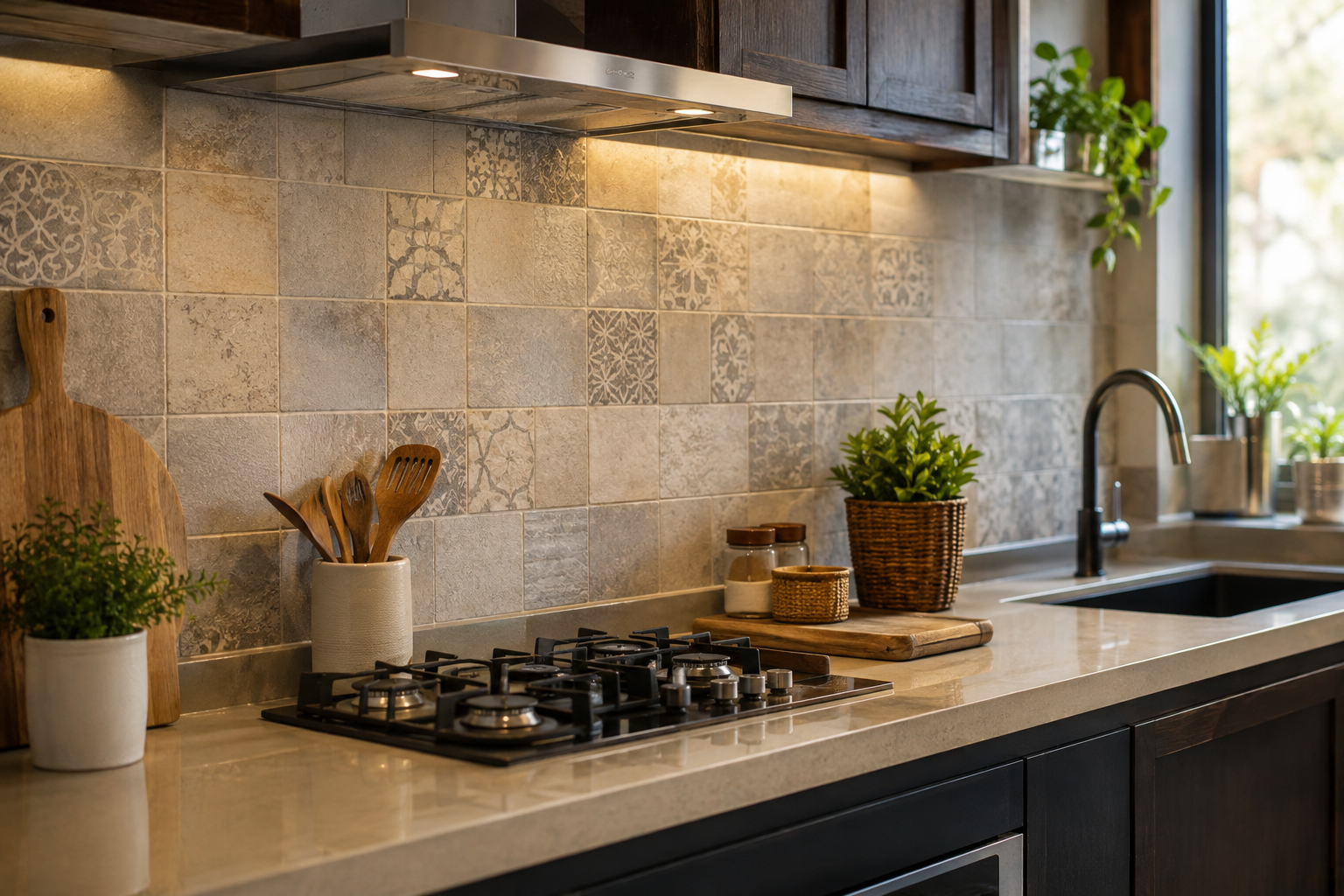
I still remember standing in a tile showroom at nine in the morning, coffee going cold in my hand, staring at forty shades of white and thinking — this shouldn’t be this hard. But it is. Picking wall tiles for kitchen spaces trips up more people than any other part of a renovation, and honestly, I get why. You’re not just choosing a color. You’re choosing something that has to survive grease splatters, humidity, five years of trends, and your own changing taste.
So here’s the thing. This isn’t going to be one of those articles that lists forty options and calls it a day. I’ve spent enough years around kitchens — my own, clients’, friends’ disaster projects I got called in to fix — that I’ve got actual opinions now. Some of them might annoy the tile salesperson at your local showroom. That’s fine.
We’ll get into materials, sizes, grout (yes, grout deserves its own section, don’t skip it), budget numbers that are actually realistic, and a handful of combinations I’d put my own money behind. If you’re here because you typed “wall tiles for kitchen” into a search bar at midnight while browsing Pinterest, welcome — you’re in good company, that’s basically how most of my clients start too. Let’s go.
What People Actually Mean When They Say Kitchen Wall Tile
Ask five people what “kitchen tile” means and you’ll get five different answers. Some picture a backsplash — that four-to-six-inch strip behind the stove. Others mean floor-to-ceiling coverage, which honestly looks stunning in the right kitchen but terrifying in the wrong one. And then there’s the in-between crowd who wants tile climbing up to the underside of open shelving and stopping there.
None of these are wrong. But they cost wildly different amounts and require wildly different planning, so figure out which camp you’re in before you fall in love with a tile that only makes sense at full-wall scale.
A quick reality check on scope
If you’re renovating on a budget, a standard backsplash run — say 30 square feet — is a completely different project than tiling three full walls. I’ve seen people fall for a $22-per-square-foot handmade tile assuming it’s “just the backsplash,” then realize their contractor quoted them for the whole kitchen. Ask early. Ask twice.
And here’s something that took me embarrassingly long to figure out myself: wall tiles for kitchen spaces don’t have to be uniform across the whole room. You can run one material behind the range, something calmer along the sink wall, and skip tile entirely on a wall that’s mostly cabinetry anyway. Nobody tells you this is allowed. It absolutely is, and it’s often the smarter, cheaper move.
Why the Wall Even Matters This Much

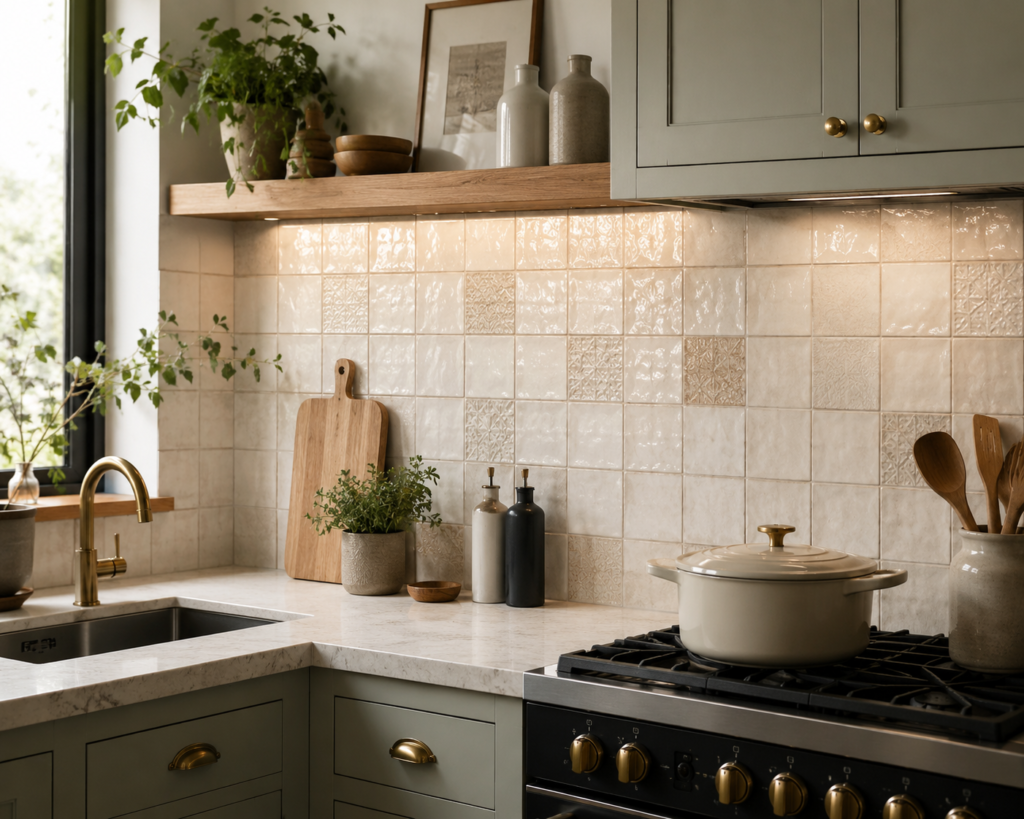
Kitchens get more visual attention per square foot than almost any other room in a house, and the walls are doing most of that work. Cabinets sit low, counters sit low, appliances are boxy and mostly neutral — so whatever’s happening on the wall between counter and cabinet ends up being the thing your eye actually lands on. That’s why getting wall tiles for kitchen spaces right carries so much more weight than, say, picking a hallway tile.
I’ve walked into kitchens with gorgeous cabinetry and a genuinely great layout that still felt flat, off, forgettable — and nine times out of ten, the tile was the reason. Not because it was ugly. Usually because it was just… safe. Forgettable-safe, not intentional-safe. There’s a difference, and once you start noticing it you can’t unsee it.
Choosing a Material Without Losing Your Mind
This is where most of the decision paralysis happens, and I don’t blame anyone for it. There are more tile materials on the market right now than there were flavors at my college dining hall.
Ceramic — the reliable one
Ceramic is what most kitchens end up with, and there’s a reason for that beyond just cost. It’s forgiving. It’s easy to cut, easy to install, and if one tile cracks, replacing it isn’t a whole ordeal. The tradeoff is that ceramic scratches a little easier than porcelain and it’s more porous, so sealing matters more here than people realize.
Porcelain — the workhorse
Porcelain is denser, harder, and honestly just tougher than ceramic in almost every measurable way. It costs a bit more up front. I keep telling clients that the price difference evens out over a decade because you’re not re-grouting or replacing chipped tiles nearly as often. If your kitchen sees real cooking — not just reheating takeout — porcelain earns its keep.
Glass and zellige — the ones that get compliments
Glass tile catches light in a way ceramic just can’t, and it’s a genuinely great pick behind a stove where you want something that wipes clean in one swipe. Zellige, the handmade Moroccan clay tile that’s everywhere on design blogs right now, has this uneven, glossy, almost watery texture that photographs beautifully. Here’s my honest take though — it’s not for everyone. The irregularity that makes it charming in photos can look messy in a very geometric, modern kitchen. Match the tile to the room’s personality, not just the trend.
Natural stone — gorgeous, but read this first
Marble, travertine, slate — they’re stunning, no argument. But stone near a stove is a maintenance relationship, not a one-time purchase. It needs sealing, it stains if you look at it wrong with a splash of red wine sauce, and it’s genuinely one of the higher-regret choices I’ve watched people make. If you love the look, consider it only in low-splash zones, away from direct cooking heat and grease.
There’s a solid rundown of how HGTV breaks down flooring-grade material options, and while that piece is aimed at floors, the material logic — porcelain versus ceramic versus stone — carries over almost exactly to walls.
Metal and terracotta — the underrated pair
Metal tile doesn’t come up in conversation nearly enough, in my opinion. Brushed stainless or copper-finish tile behind a range gives a kitchen an almost industrial, restaurant-grade look, and it handles heat beautifully. It’s not cheap, and it shows fingerprints if you touch it constantly, but used sparingly — say, just behind the cooktop — it’s a genuinely striking move that almost nobody else on your street will have done.
Terracotta, on the other hand, brings warmth that porcelain just can’t fake. It’s more porous, so it needs sealing more often, and it’s not the toughest option on this list. But there’s a rustic, lived-in quality to it that a lot of the newer, ultra-polished kitchen trends are missing right now. If your kitchen leans farmhouse or Mediterranean, don’t skip past it just because it’s less popular than porcelain.
Sustainability, if that’s part of your decision
More people are asking about this than they used to, so it’s worth a mention. Recycled glass tile is one of the more genuinely eco-conscious choices on the market — it’s made largely from post-consumer glass, performs almost identically to standard glass tile, and tends to carry a similar price point. Reclaimed or salvaged terracotta and ceramic, sourced from architectural salvage yards, is another route, though availability varies a lot depending on where you live. I wouldn’t let sustainability alone dictate the whole decision, but if two materials are otherwise tied for you, it’s a reasonable tiebreaker.
Size and Shape Decisions Nobody Warns You About
Small format vs large format
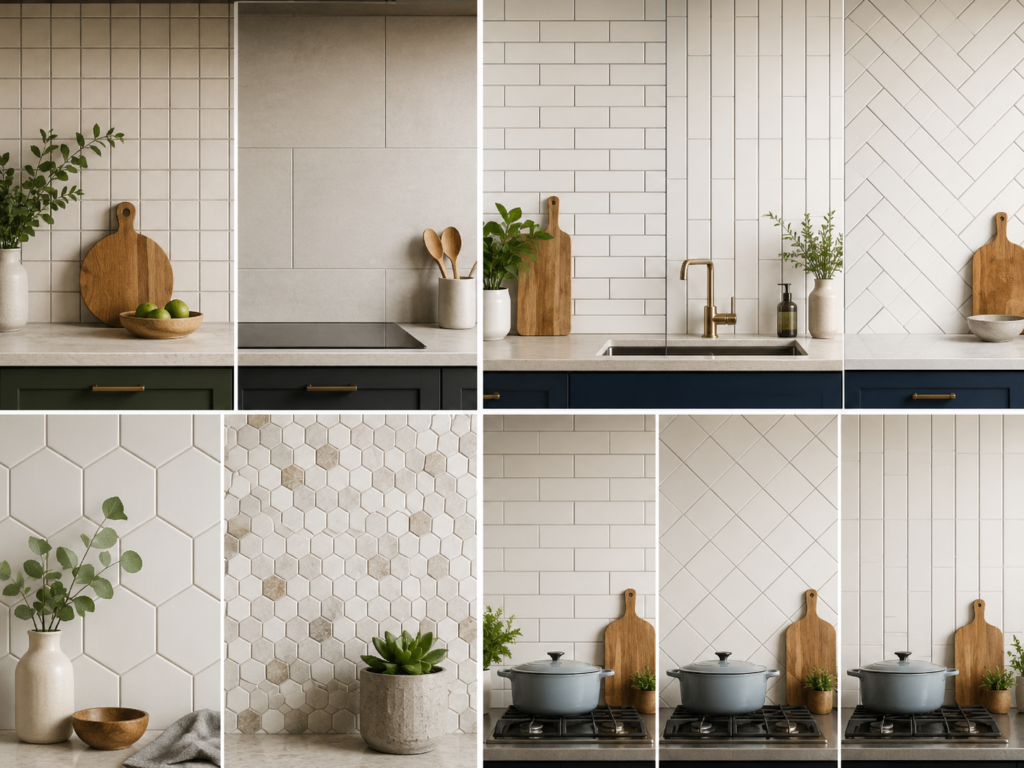
Small tiles mean more grout lines, and more grout lines mean more cleaning down the road — that’s just math. But small format also gives you more design flexibility: herringbone, chevron, stacked, offset. Large format tile, on the other hand, reads as sleek and modern almost instantly, with fewer seams to worry about, but it’s less forgiving if your wall isn’t perfectly flat. I’ve watched installers curse under their breath at uneven drywall more than once because of this exact issue.
Subway tile — overused, still works
I know, I know. Subway tile gets called basic in every design forum. But there’s a reason it’s stuck around for over a century — it just works, in almost any kitchen style, at almost any budget. The trick to making it feel less generic is the layout: skip the standard brick pattern and try a vertical stack or herringbone instead. Same tile, completely different personality.
Hexagons and mosaics
Hex tile brings texture without going loud, and mosaic sheets are genuinely one of the more forgiving DIY options because they come pre-mounted on mesh backing. That said, mosaic grout maintenance is real — all those extra lines add up to more scrubbing later. Worth knowing before you commit.
Orientation and layout tricks
Most people default to a straight horizontal grid because it’s what they’ve always seen, but there are easy ways to make even a plain rectangular tile feel considered. Running it vertically instead of horizontally draws the eye upward, which genuinely helps kitchens with lower ceilings feel taller. A 45-degree diagonal grid adds movement without introducing a new tile shape at all — same tile, same grout, completely different energy. I’d say this is the single cheapest way to make wall tiles for kitchen walls feel custom without paying custom-tile prices.
How Lighting Changes the Way Tile Actually Reads
Nobody plans lighting and tile together, and it shows constantly. Under-cabinet LED strips hit tile at a steep, close angle, which means glossy tile can throw back a genuinely distracting glare right at eye level while you’re cooking. Matte or slightly textured tile diffuses that same light instead of bouncing it straight back at you.
Warm-temperature bulbs — the ones closer to 2700K — pull out amber and gold undertones in tile, even tile that looked perfectly neutral gray under the cool fluorescent lights of a showroom. Cooler bulbs, up around 4000K and beyond, do the opposite; they can make a warm cream tile look almost sterile. If you can, ask your showroom for a sample you can take home and look at under your actual kitchen’s bulbs before you place a full order. It’s a five-minute step that saves people from a lot of regret.
Color and Pattern Choices That Actually Hold Up Over Time
Trends move fast in kitchens. Faster than almost any other room, honestly, because kitchens get photographed constantly for resale listings and social feeds. Here’s my rule of thumb: neutral tile, bold accessories. Swap out a runner rug or a set of pendant lights in five years — swapping tile is a full renovation.
That doesn’t mean go boring. A soft sage, warm terracotta, or deep charcoal can still read as neutral-adjacent while giving the room actual character. What I’d steer people away from is a hyper-saturated statement color across a huge surface area, unless you genuinely plan to redo the kitchen again within the decade. HGTV’s roundup of backsplash design ideas is a decent visual reference if you want to see how different colors actually read in finished spaces rather than on a sample chip.
Pattern-wise, I’d say pick one moment of visual interest and let everything else calm down around it. A patterned tile behind the range with plain subway everywhere else does more for a kitchen than pattern wall-to-wall ever will.
A trend I’m genuinely skeptical of
I’ll say this even though it might annoy some readers — the ultra-high-contrast black-and-white checkerboard tile that’s flooded design feeds lately worries me a little, purely from a resale standpoint. It photographs incredibly well. It also dates a kitchen almost instantly to “whatever year this trend peaked,” the same way certain granite countertops now scream late 1990s. If you love it and you’re not planning to sell for a decade, go for it, genuinely. If resale is even a small part of your thinking, I’d keep bold pattern to a smaller accent zone rather than the whole wall.
Grout — The Detail That Quietly Makes or Ruins Everything
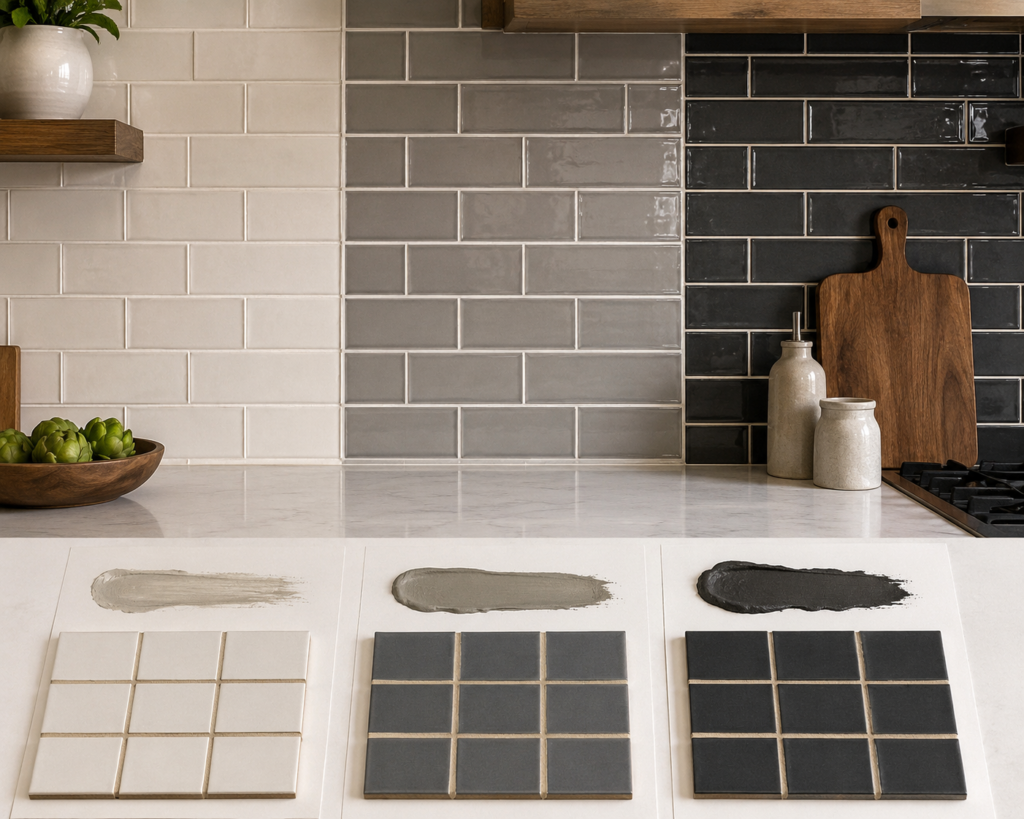
People spend weeks agonizing over tile color and thirty seconds picking grout. That’s backwards, in my experience. Grout color changes how a tile reads more dramatically than people expect.
Matching grout to tile creates a seamless, almost monolithic look — great for large-format modern kitchens. Contrasting grout, on the other hand, highlights the pattern and grid, which works beautifully with subway or hex layouts. There’s no universally right answer here, but there is a wrong one: light grout in a heavy-cooking kitchen without a sealed, stain-resistant formula. You’ll regret that within a year, guaranteed.
There are also different grout types worth knowing about beyond just color. Sanded grout is more common for wider joints and handles shrinkage better, while unsanded grout suits narrower lines and delicate tile like polished glass, which can scratch under sanded grout’s texture. Epoxy grout costs more and takes more skill to apply, but it’s practically stain-proof, which makes it a genuinely smart choice for the wall directly behind a busy stove.
Rough Budget Numbers, Because Everyone Skips This Part
I’m not going to pretend I know your exact zip code’s labor rates. But as a general range: ceramic tile tends to run somewhere in the low single digits per square foot, porcelain a bit above that, and handmade or imported options like zellige can climb into the twenties or higher, before installation. Labor typically adds a comparable amount again, sometimes more if there’s intricate pattern work involved.
Here’s the thing most people miss — it’s not just the tile. Backer board, thinset, grout, sealant, and trim pieces all add up, and a lot of online calculators conveniently leave those out. Budget an extra 15 to 20 percent buffer over whatever number you land on. It’s saved more than one client from an awkward mid-project phone call to me.
If you’re weighing a full remodel against just refreshing wall tiles for kitchen walls specifically, the tile-only route is almost always the faster win. A backsplash swap can happen over a long weekend and still change how the entire kitchen feels, whereas cabinets, counters, and layout changes are a whole different scale of project, budget, and timeline. When money’s tight, tile is often the highest-impact-per-dollar move available to you.
Where people overspend without realizing it
Custom cut pieces around outlets, corners, and windows eat into a budget fast, especially with patterned or handmade tile where every cut needs to line up with the design. Ask your installer for a cut-piece estimate upfront rather than finding out afterward. I’d also gently push back on the instinct to upgrade grout color as an afterthought add-on — some specialty grout colors carry a real premium, and it’s easy to nod along to a small-sounding upcharge that adds up more than expected across a whole kitchen.
Layout Matters More Than People Assume
Small or galley kitchens
Tile can genuinely open up a tight kitchen, but only if you keep the palette light and the grout lines minimal. Dark, heavily-patterned tile in a small space tends to close things in rather than add character.
Open-concept and single-wall layouts
If your kitchen leans toward that increasingly popular single-wall setup, tile actually becomes even more important, because that one wall is doing all the visual work in the room. If that’s your situation, it’s worth looking at how a well-designed single-wall kitchen handles the balance between storage, tile, and negative space — the tile choice there carries a lot more weight than in a kitchen with four walls to spread interest across.
Kitchens with kids and pets
I get this question constantly and it deserves its own note. Lower walls near a kid’s height take more scuffing and sticky-hand contact than people expect, so matte finishes that hide fingerprints and smudges tend to age better than glossy ones in family-heavy kitchens. Pet water bowls near a tiled wall also mean more splash exposure at floor level, so if that’s your setup, push your grout sealing schedule up a bit — every twelve months instead of the usual eighteen to twenty-four.
How Tile Talks to Your Cabinets and Counters
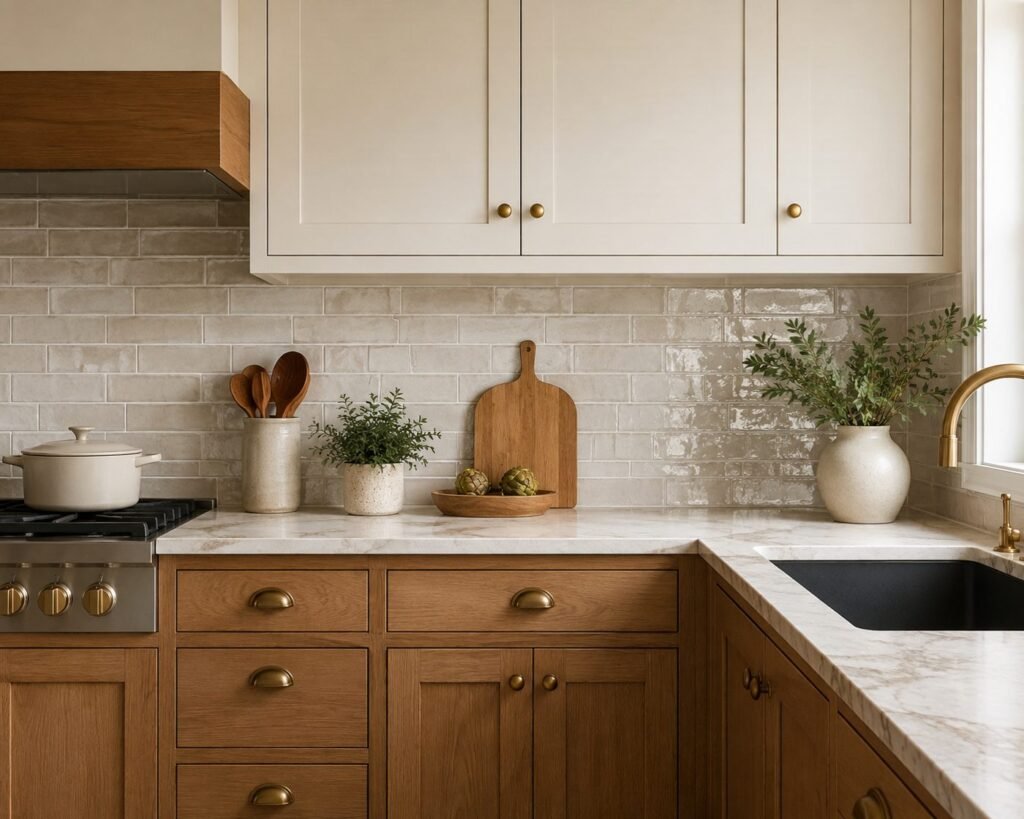
This is where a lot of otherwise good tile choices go sideways — not because the tile itself is bad, but because nobody thought about how it sits next to the cabinetry. Warm wood cabinets tend to clash with cool blue-gray tile more than people expect when they’re standing in a showroom holding a single sample.
I always tell people to physically hold the tile sample against their actual cabinet door, in their actual kitchen lighting, before ordering anything. Showroom lighting lies. If you’re still finalizing your cabinet direction, it’s worth reading up on kitchen wall cabinet styles first, since the cabinet finish really should come before the tile decision, not after — trust me on this one, I’ve had to tell people to return tile more than once.
What Happens Above the Tile Line
Tile rarely covers an entire wall from counter to ceiling — usually there’s a transition point where paint, wallpaper, or open shelving takes over. That transition zone matters more than people give it credit for.
If you’re going with paint above the tile, coordinate the undertone carefully. A warm-toned tile under a cool gray wall paint can look like two separate design decisions that never spoke to each other. There’s a helpful breakdown of kitchen wall color pairing worth a look if you’re trying to land on something that actually complements rather than fights your tile choice.
Open shelving above tile is another option I’m genuinely fond of — it breaks up a solid tile expanse and gives you somewhere to show off actual dishes instead of decorative ones nobody uses. If that’s the direction you’re leaning, it helps to plan bracket spacing around your tile’s grout lines from the start; retrofitting shelf brackets into finished tile is a headache nobody enjoys. Worth reading through some kitchen wall shelf layouts before you finalize your tile height, honestly, since the two decisions really do need to happen together.
Don’t Forget the Faucet
This one gets overlooked constantly. If you’re doing a wall-mounted setup at your sink, the tile has to be planned around the exact plumbing rough-in height — and that measurement needs to happen before, not after, the tile goes up. I’ve seen a beautifully tiled wall get a sloppy cut-out patch job because someone measured the faucet placement as an afterthought. If a wall-mounted kitchen faucet is part of your plan, loop your tile installer and plumber into the same conversation early. It sounds obvious written down. It gets skipped constantly in practice.
Tile vs Wallpaper: An Honest Comparison
I get asked this a lot, usually by people trying to save money. Wallpaper is cheaper, faster to install, and easier to change later — genuine advantages. But it doesn’t hold up to grease and steam the way tile does, even the supposedly kitchen-rated vinyl varieties. My honest recommendation: tile the true splash zones — behind the stove, around the sink — and consider kitchen wallpaper for the walls that are further from heat and moisture, like a dining nook or a pantry wall. You get the personality of pattern without asking wallpaper to do a job it’s not built for.
Installing It Yourself, or Handing It Off
Simple backsplash runs with standard subway tile are genuinely doable as a weekend DIY project if you’re reasonably patient and don’t mind a slightly imperfect result on your first attempt. I’ve done it myself, badly, the first time. Large-format tile, intricate patterns, or anything involving a wall-mounted faucet cutout — hire someone. The tile itself usually isn’t the expensive part of a bad DIY job; the repair afterward is.
Keeping It Clean Without Losing a Weekend to It
Maintenance is the part nobody thinks about at the showroom and everybody thinks about eighteen months later. Sealed grout, wiped down regularly, stays manageable. Neglected grout turns into a genuine chore. A simple weekly wipe with warm water and mild soap prevents most of the buildup that eventually requires serious scrubbing — and there’s a decent rundown of grout cleaning methods from Homes & Gardens if you’re already past the prevention stage and need to rescue grout that’s gone gray.
Glossy tile, glass especially, is genuinely low-effort — one wipe usually does it. Textured or matte tile holds onto grease more stubbornly, something worth weighing if you cook often and don’t love scrubbing.
Mistakes I See Over and Over
Ordering the exact square footage with zero waste allowance is a classic one — tile breaks in transit, cuts get miscalculated, and you end up short at the worst possible moment. Add 10 percent minimum.
Another one: choosing tile before finalizing lighting. Under-cabinet lighting changes how a glossy tile reflects dramatically, and what looked perfect in the showroom can look almost mirror-like once real task lighting hits it at an angle.
And the big one — picking tile purely off a small sample chip instead of a larger board. Tile patterns, especially natural stone and zellige, vary piece to piece. A four-inch sample tells you almost nothing about how a full wall will actually read.
One more I’d add, because it comes up so often it deserves a spot on this list: rushing the grout color decision until the very last day of installation, then picking whatever the installer has on the truck. It’s such a small line item in the whole budget, yet it changes the entire finished look. Sample it early, alongside the tile, not after.
Renting? Here’s What Still Makes Sense
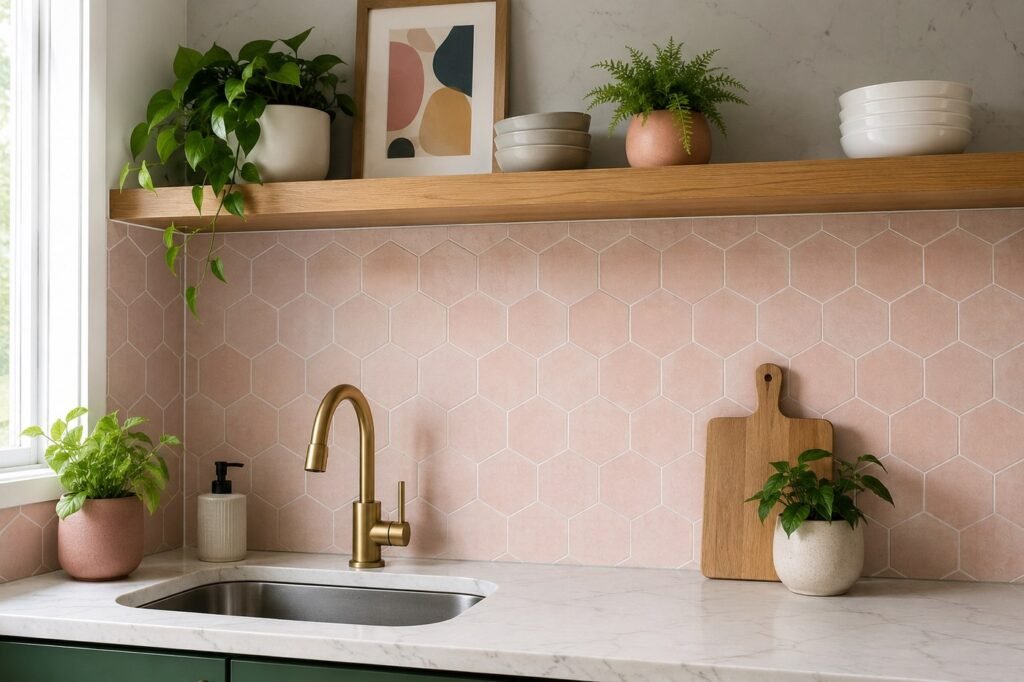
If you’re in a rental, full tile installation obviously isn’t realistic — you’re not ripping into someone else’s wall. But there are still ways to get some of the same visual payoff. Peel-and-stick tile has gotten genuinely better in the last few years, both in texture and in how convincingly it photographs. It won’t survive direct high heat the way real ceramic or porcelain does, so keep it away from the immediate stove zone, but for a rental sink wall or a small accent strip, it’s a reasonable stand-in until you own the walls you’re decorating.
A Few Combinations Worth Considering
If I had to hand someone three safe-but-not-boring starting points, it’d be these: warm white subway tile in a herringbone layout with a slightly darker contrasting grout; a soft sage green zellige behind the range paired with brass fixtures; or a large-format matte porcelain in a warm gray, run floor to ceiling on a single accent wall, left completely plain everywhere else. All three age well. None of them scream “renovated in 2026” the way some trendier choices might in a few years.
A fourth I’d throw in for anyone leaning traditional: a soft cream ceramic in a classic brick-lay pattern, paired with unlacquered brass hardware and a warm white grout. It’s about as close to timeless as wall tiles for kitchen spaces get, and it plays nicely with almost any cabinet color you throw at it, which is more than I can say for most of the trendier picks on this list.
Humidity, Climate, and Why It Actually Matters
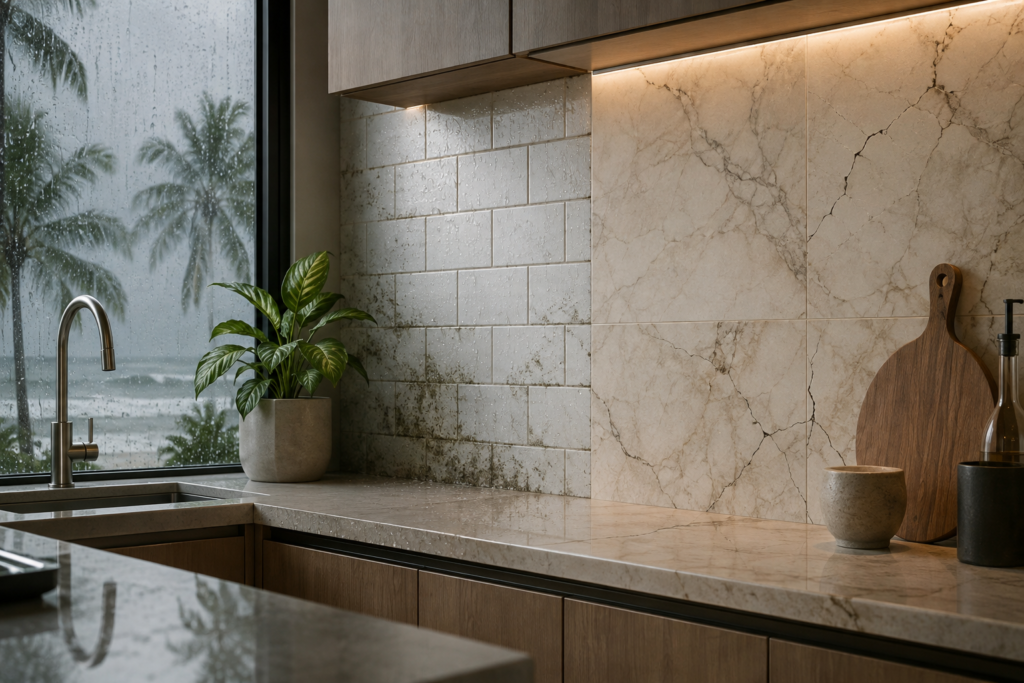
This one’s underrated. If you live somewhere genuinely humid — coastal, tropical, that kind of climate — porous tile and unsealed grout struggle more than they would in a dry climate, and mildew along grout lines shows up faster than people expect. Porcelain, being denser and less absorbent, handles humid kitchens noticeably better than ceramic or natural stone over the long run.
On the flip side, in very dry climates, some natural stone options can develop hairline cracking over years as they expand and contract with seasonal humidity swings in the house. It’s a smaller risk than the mildew issue, but worth mentioning if you’re set on marble or travertine and live somewhere with big seasonal shifts.
Frequently Asked Questions
What’s the most durable wall tile for a kitchen?
Porcelain generally holds up best against scratches, moisture, and daily wear. It costs a little more upfront than ceramic, but it needs less maintenance and rarely chips, which tends to even out the price difference over several years.
How high should kitchen wall tile go?
A standard backsplash usually runs 4 to 6 inches behind counters, though many kitchens now extend tile to the underside of upper cabinets or, in open layouts, all the way to the ceiling. It really depends on your budget and how much visual weight you want the tile to carry.
Is subway tile too outdated for a kitchen wall?
Not at all — it’s stayed popular for over a hundred years for a reason. Changing the layout, like herringbone or vertical stacking, or using an unexpected grout color, keeps it from reading as generic while still benefiting from its timeless shape.
Can I install wall tile over existing tile?
Sometimes, if the existing tile is flat, secure, and in good condition, but it does add thickness that can affect outlet covers, trim, and transitions. Most professionals will recommend removing the old layer first for a cleaner, longer-lasting result, especially if the original installation shows any cracking or hollow-sounding spots.
How do I stop kitchen tile grout from staining so fast?
Sealing the grout properly at installation and reapplying sealant every year or two makes the biggest difference. Wiping up grease and sauce splatters soon after they happen, rather than letting them sit, also goes a long way toward keeping grout lines looking fresh.
Final Thoughts
If there’s one thing I’d want someone to walk away with after reading all this, it’s that wall tiles for kitchen spaces aren’t a decision to rush through in a single showroom visit. Live with a sample in your actual lighting for a few days. Think about how it talks to your cabinets, your counters, your faucet placement, even your grout color — because all of it works together or it quietly doesn’t.
Take your time, ask your installer the annoying questions, and don’t be afraid to pick something a little unexpected if it genuinely fits your kitchen’s personality. That’s usually where the best results come from anyway. Good luck with the remodel — and maybe grab a stronger coffee before your next showroom trip. You’ll need it.