

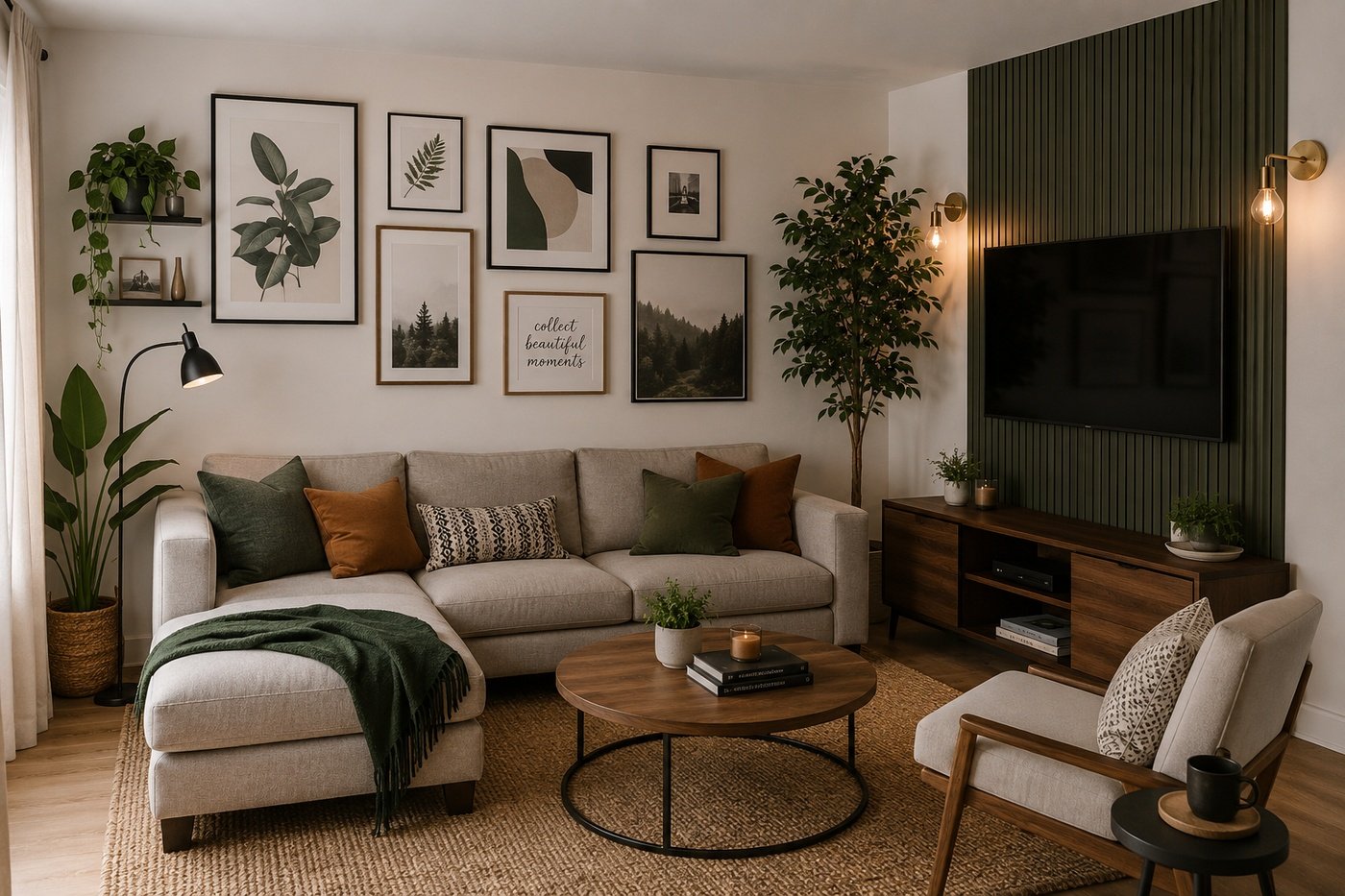
Living room wall decor sits on most people’s to-do list for years, right next to “organize the garage,” until one day a guest asks “did you just move in?” and it stings a little because you moved in four years ago.
I’ve hung, rehung, and torn down enough frames — mine and my sister’s, and one particularly stubborn cousin’s — to know exactly where the whole thing usually goes sideways. It’s never about owning more wall art or more wallpaper rolls.
Two or three pieces done right, a gallery wall here, a proper accent wall there, the correct wallpaper pattern in the correct spot, and a room stops looking unfinished. That’s the entire trick behind living room wall decor once you strip away the noise.
Where Living Room Wall Decor Actually Starts
Here’s a habit nobody warns you about: every wall in a living room does not deserve equal effort. One wall carries the room. The rest are supporting cast, and treating them like the lead just spreads your energy thin.
Try this instead of overthinking it — stand at the entrance to the room and notice which wall your eyes land on without trying. That’s your lead wall, almost every time.
My cousin spent an entire Saturday fussing over an eight-inch gap next to her bookshelf. Meanwhile the enormous wall behind her sofa sat untouched for another five months. Wrong priority, every time.
Once that main wall is handled, momentum does most of the remaining work. The narrow hallway strip, the awkward corner by the window, the space above the side table — those can sit and wait their turn.
If I had to hand someone a checklist: lead wall, then whatever faces it, then the leftovers whenever there’s time and cash. Nobody’s handing out trophies for finishing all four walls in one exhausting weekend.
Picking Wallpaper Without Overthinking It
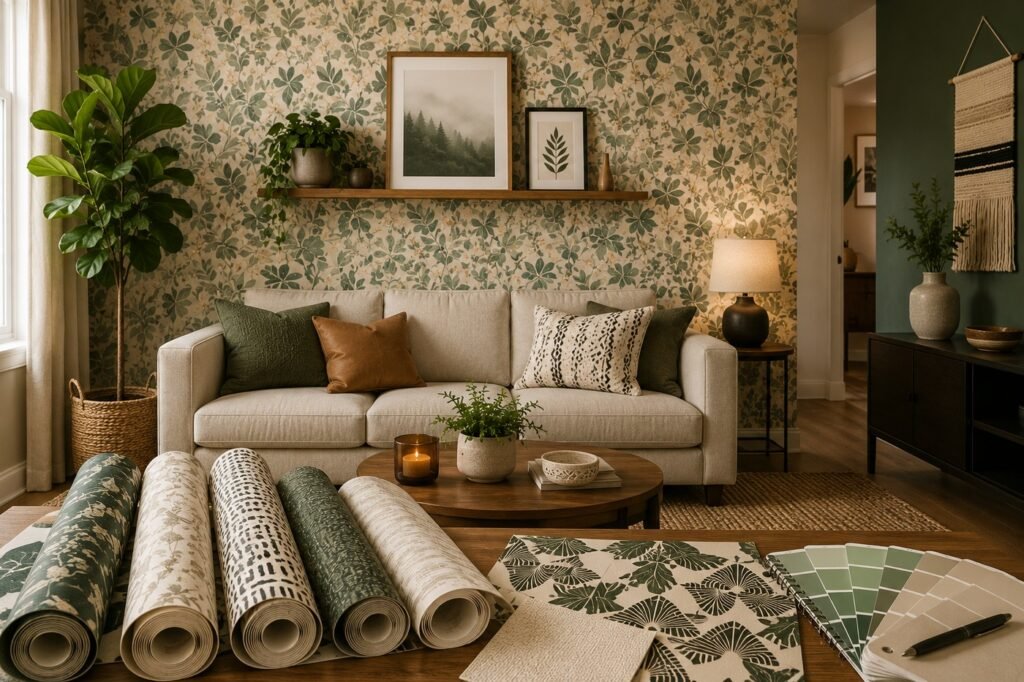
Wallpaper carries baggage it doesn’t deserve anymore. Somewhere in the last decade it picked up a reputation for being expensive, messy, and basically permanent — none of which holds up the way it used to.
Peel-and-stick rolls changed the math entirely. Slap a loud pattern on one wall, live beside it for a month, peel it off if it’s not clicking — zero plaster damage, zero drawn-out regret.
Standing frozen between five different patterns is completely normal, by the way. Pattern choice rattles people more than paint choice ever does, probably because a color feels reversible in a way a print somehow doesn’t.
For anyone still wobbling on the fundamentals, this breakdown on picking the perfect wallpaper covers scale and repeat spacing in plain terms, before you commit money to a roll you might regret.
The Accent Wall Question Nobody Answers Simply
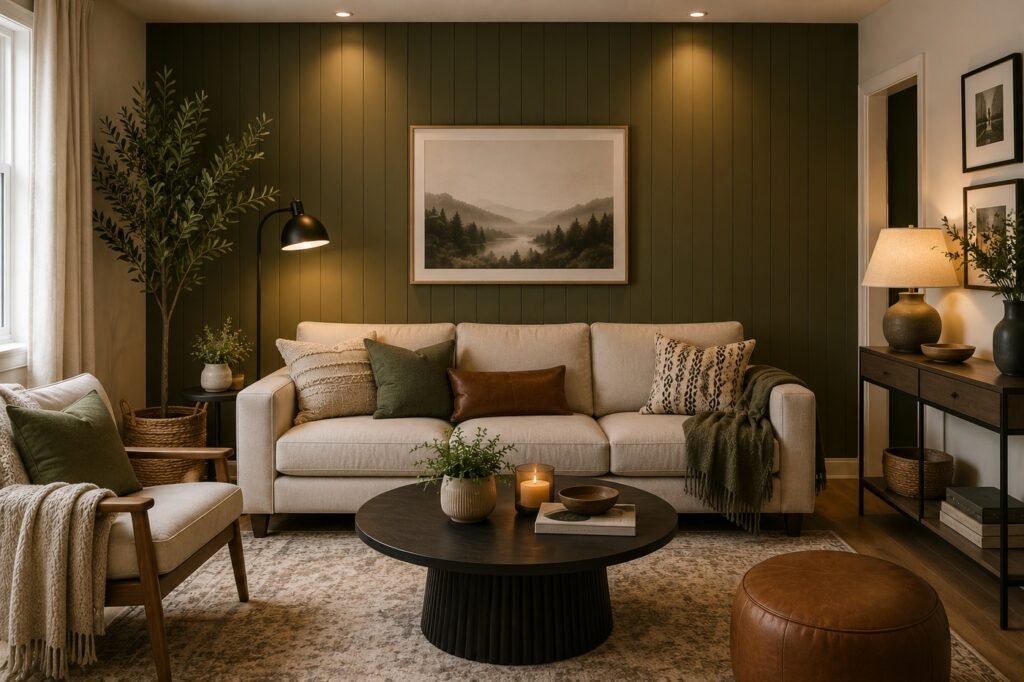
The same question comes up every single time: which wall gets the color treatment? The honest answer is “depends on your seating,” but here’s a shortcut that rarely fails — pick the wall your couch faces, not the wall your couch backs into.
An accent wall directly behind the sofa gets stared at by exactly nobody sitting on that sofa. Flip it around, and suddenly it’s the thing everyone’s eyes rest on during a lazy Sunday movie.
Texture changes the entire conversation here too. Wallpaper on an accent wall reads nothing like paint in the identical shade — paper carries a depth that flat color simply can’t fake, particularly once evening lamps kick on.
Want specifics on turning one wall into the room’s focal point without tipping into showroom territory? There’s a solid rundown on one bold feature wall worth a read before any tape goes up.
Wall Colors That Do the Heavy Lifting
Paint remains the fastest, cheapest lever anyone can pull. Ninety dollars and a free afternoon can erase years of a room feeling stale and forgettable.
Warm neutrals forgive mistakes. Bold, saturated shades punish bad lighting instantly. Buy the biggest swatch you can find — not the tiny paint chip — and watch it on the actual wall across morning, afternoon, and night before signing off on anything.
Sherwin-Williams lays this whole process out clearly in their official paint shade guidance, including a color-wheel trick for finding a complementary shade instead of guessing blindly.
Once a direction feels settled, this piece on color pairing cheat sheet combinations lines up nicely with whatever art or wallpaper you’re layering on top down the road.
Gallery Walls, Frames, and the Height Everyone Gets Wrong
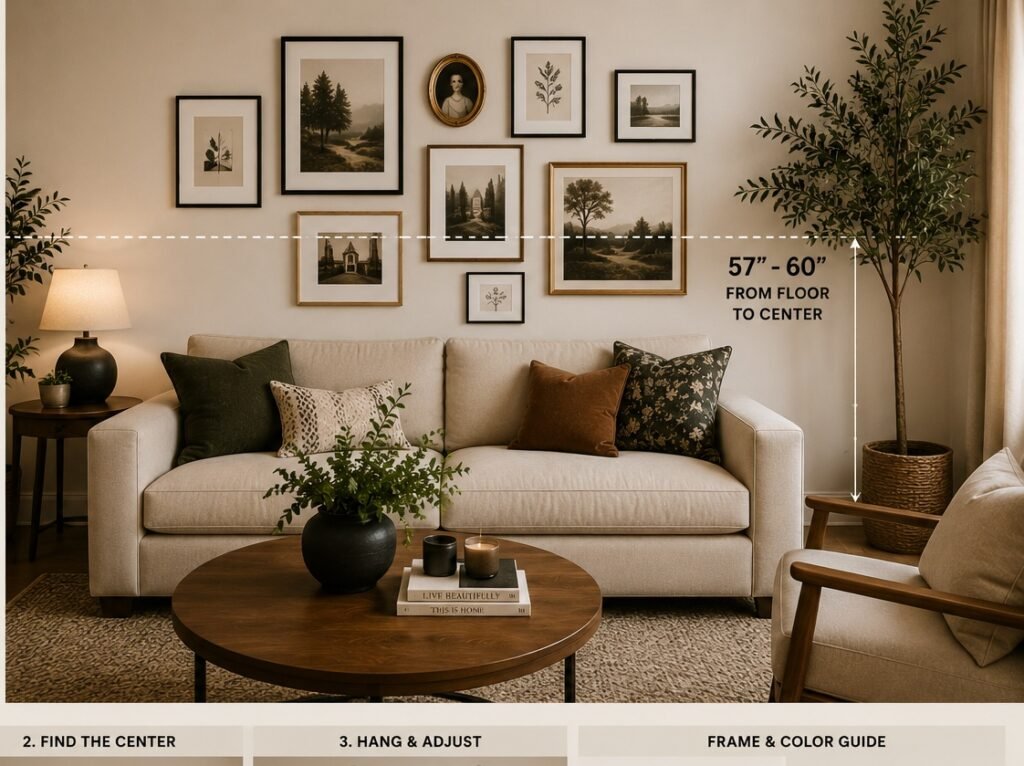
Photos make gallery walls look effortless. They are not effortless. The unspoken trick: lay every frame out on the floor first, shuffle it, snap a photo, shuffle again.
Height ruins more gallery walls than anything else. Hang too high and the whole grouping floats, disconnected from the sofa underneath. Hang too low and it reads like a leftover, jammed into whatever gap was available.
There’s a widely used expert hanging height rule most designers swear by — center everything around 57 to 60 inches off the floor — and honestly it holds up in nearly any room, single frame or full cluster.
Mixed frame finishes are fine. A rainbow of unrelated colors is not. Choose one dominant tone and build everything else around it, or the wall tips from curated into cluttered fast.
Sophisticated Wallpaper Patterns Worth a Second Look
Loud isn’t the only option. Some of the strongest wall choices I’ve seen recently whisper instead — soft tonal stripes, muted botanicals, textures you notice only up close.
Oversized patterns behave unexpectedly in tight rooms. A busy little print can shrink a small wall visually, while a calmer, larger motif actually opens things up. Backward from what most people assume.
Grasscloth and textured vinyl keep showing up in every project I look at lately, and there’s a reason for that. Depth without shouting suits people who want texture without a full-blown design statement.
Take a look through this collection of sophisticated pattern inspiration list options if elegant, not trendy, is the target — trends age badly, elegant mostly doesn’t.
Shelves, Mirrors, and Texture Beyond Paint
Living room wall decor isn’t only flat art and paper. Floating shelves, a sculptural mirror, a woven hanging — dimension a painted wall on its own simply cannot fake, no matter the shade.
A big mirror hung across from a window pulls double duty most people never think about — it bounces available daylight clear across the room, which matters enormously in living rooms lit from only one side.
A quick side-by-side, since cost and effort swing wildly between these options:
| Decor Type | Typical Cost | Effort Level | Best For |
| Peel-and-stick wallpaper | $$ | Low | Renters, quick refreshes |
| Traditional wallpaper | $$$ | High | Long-term homes, statement walls |
| Gallery wall (mixed frames) | $ to $$ | Medium | Personal, evolving collections |
| Large mirror | $$ | Low | Small or dim living rooms |
| Floating shelves | $$ | Medium | Displaying objects, not just art |
| Accent wall paint | $ | Low to Medium | Fast, reversible drama |
Three or four objects arranged on a single shelf — a plant, one small print, something with real texture — routinely beats a whole wall crowded with frames. Fewer things, chosen carefully, tends to win.
How Lighting Changes What You Hang
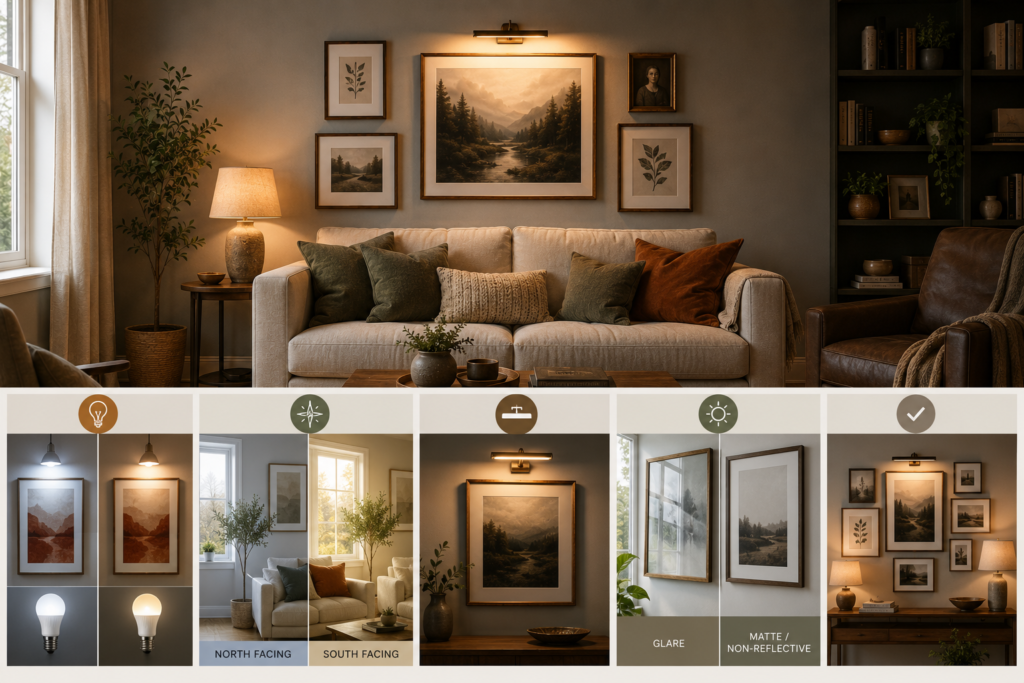
Lighting rarely enters the conversation until a print already looks wrong on the wall. Something rich and warm under a store’s bulbs can turn flat and gray at home, and that gap surprises more people than it should.
Cool LED bulbs drain warmth out of reds, oranges, and browns fast. Before assuming a piece just doesn’t work, try swapping to a warmer bulb temperature — half the time that solves it completely.
A room facing north stays cooler and flatter through most of the day. A room facing south runs brighter and warmer. That one fact quietly decides which wall colors and which pieces will actually behave the way you picture them.
Small picture lights are worth the modest cost for anything genuinely loved. One well-aimed light does more for a wall’s finished feel than another hour of rearranging frames ever will.
Big windows facing glossy frames create glare nobody enjoys dealing with. Swap to matte finishes or non-reflective glass and the problem disappears — a fix so simple most people never think to ask.
Living Room Wall Decor on a Tight Budget
A tight budget doesn’t have to mean a half-finished wall. Some of the best rooms I’ve ever walked into cost under two hundred dollars from start to finish.
Thrifted frames, painted the same single color, suddenly read as a matched set — even pulled from five unrelated garage sales. That one move solves most of the mismatched-clutter problem budget gallery walls run into.
Removable wallpaper on one small wall — a reading nook, the space behind a console — delivers the pattern payoff without the cost of papering an entire room.
Print something you shot yourself. A well-framed, properly matted photo you took often carries more personality than a store-bought canvas triple the price.
Estate sales and secondhand marketplaces are wildly underused for this. Frames, mirrors, occasionally real art turn up for pennies on the dollar, and a slightly worn finish often suits a living room better than something fresh off a shelf. A light sand and a fresh coat of paint, and the fifteen-dollar origin stays your secret.
Small Mistakes That Quietly Wreck the Look
Hanging things too high tops the list by a wide margin. Ask any designer what goes wrong first, and this is usually the very first answer out of their mouth.
In living room wall decor, scale gets ignored constantly. A small frame lost on a massive wall just looks lonely, regardless of how nice the piece is up close. Bigger walls ask for bigger gestures.
My aunt’s living room is proof that too-neat backfires. Every frame identical, every gap measured with a ruler — it looks like a hotel lobby, not somewhere she actually lives. A little unevenness would’ve helped.
There’s also the step almost nobody bothers with: walking to the couch, sitting down, and actually looking up. Standing three inches from the wall while hanging things tells you nothing about how the room feels once you’re relaxing in it.
This broader decorating idea roundup page rounds up a few more angles worth reading before any money leaves your pocket.
Frequently Asked Questions
Best wall decor for a small living room — what actually works?
Go big instead of many. One oversized mirror or a single statement piece beats five scattered small frames every time in a tight space — clutter shrinks a room faster than color ever does.
Where exactly should art hang above a sofa?
Six to eight inches above the sofa back, measuring from the frame’s bottom edge — the go-to spacing for living room wall decor above seating. Go higher than that and the piece stops feeling connected to the furniture underneath it.
Does wallpaper still make sense in a living room right now?
It does, and peel-and-stick versions removed most of the old hesitation. Renters especially lean on it since nothing gets damaged when a lease ends.
How many frames make a gallery wall look intentional instead of random?
Five to nine is the sweet spot most of the time. Fewer feels thin, more than nine needs real planning or it turns into visual noise fast.
Is it okay to mix wallpaper with plain painted walls?
Common combo, actually. Keep one wall papered as the statement and let the rest stay calm — pattern overload happens when every surface competes at once.
Cheapest way to handle one massive empty wall?
Thrifted frames in one matching paint color, or a single big print instead of a bunch of small ones. Either route skips the cost of commissioned art entirely.
Do dark paint colors make a living room look tighter?
Not on their own — bad lighting does that job, not the color. A dark wall with proper lamps can feel cozier, not smaller, contrary to what most people assume.
Roughly how often does living room wall decor need updating?
No set timeline exists. If a wall’s gone five-plus years without catching your own eye, that’s usually the real signal it’s time.
Conclusion
Living room wall decor doesn’t need to turn into some drawn-out design puzzle only professionals can crack. Most of it boils down to a handful of decisions tackled in a sensible order — settle the lead wall first, give it one strong element, then work outward instead of trying to fix every surface at once.
Wallpaper, paint, gallery walls, mirrors, floating shelves — none of these compete against each other. The best-looking living rooms I’ve walked through usually blend two or three, held together with enough restraint that nothing shouts over anything else.
The mistakes repeat themselves too, oddly consistent across every room I’ve seen go wrong. Hung too high. Matched too perfectly. Skipped the moment of stepping back to actually look at the wall from the couch. Fix those three habits, and most of that nagging “why doesn’t this room feel done” feeling fades on its own.
Money isn’t the obstacle people assume it is, either. Some of the most convincing wall setups I’ve come across started with thrifted frames, a single can of paint, or removable wallpaper on one modest wall — not a full-room renovation. Intention beats budget almost every time.
Pick one wall. Not the whole room, not a five-year master plan — just whichever wall gets looked at most right now. Get that one right, sit with it a few weeks, and the rest of the room tends to point toward what comes next on its own. Strip away the overthinking, and that’s really the entire approach.