

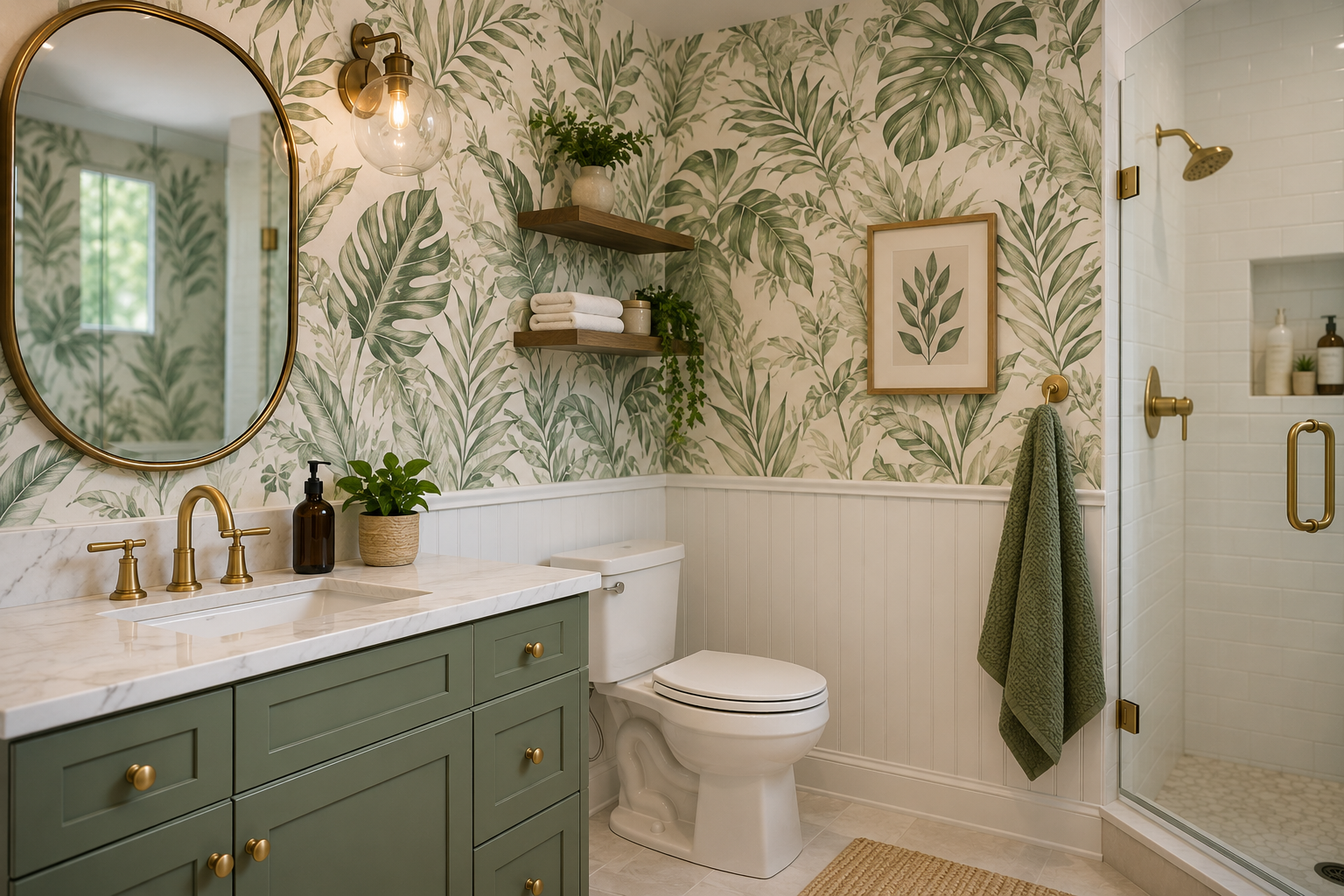
Twelve years hanging wallpaper for a living taught me one thing about vinyl wallpaper for bathroom walls: everyone asks the wrong first question. They want to know about patterns and colors before they’ve even checked if their exhaust fan works. Wrong order, every time.
Get the humidity handling sorted first, and the pretty stuff takes care of itself. A shower runs hot for eight minutes, the room fills with steam like a sauna, and vinyl just sits there unbothered while cheaper materials would already be curling at the edges. That’s really the entire pitch for vinyl wallpaper for bathroom projects — durability first, decoration second, in that exact order.
Why Vinyl Wallpaper for Bathroom Walls Actually Holds Up
Strip away the marketing language and here’s what’s really happening: a printed pattern gets sealed under a layer of solid plastic. Nothing porous stays exposed to the air. Compare that to old wood-pulp paper, which behaves like a sponge left on a wet counter — it grabs moisture and holds onto it until something goes wrong.
Humidity in a bathroom doesn’t creep up gradually. It jumps. One long, hot shower and the room can hit numbers close to 90 percent within a few minutes, then fall back down once the door opens and steam escapes. Vinyl rides through those swings because there’s no fibrous layer underneath capable of soaking anything in.
Contractors who’ve installed hundreds of rolls tend to circle back to one point above everything else: airflow beats material choice. Check the EPA’s steam control advice on running bathroom exhaust properly — that single habit protects vinyl wallpaper for bathroom walls better than upgrading to a fancier PVC-coated roll ever will.
The Steam Problem Nobody Talks About
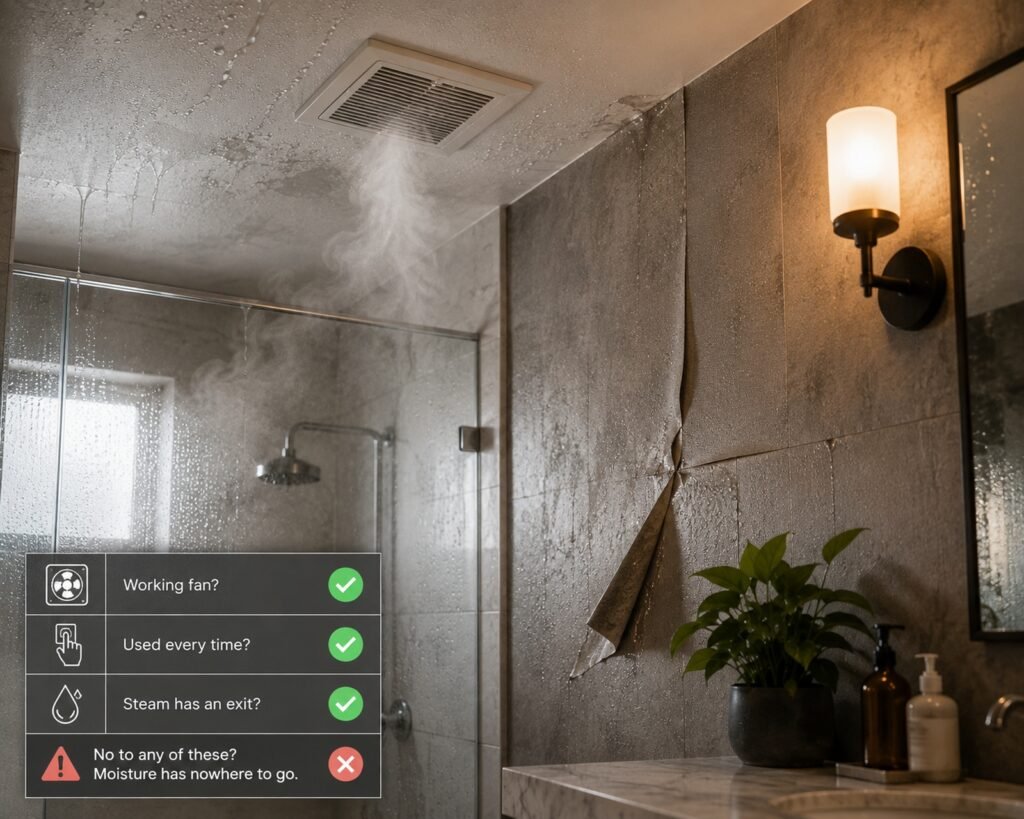
Here’s a distinction worth making: steam by itself does nothing harmful. Steam with no exit route is the actual problem. A bathroom with a broken fan, or a working fan nobody bothers switching on, forces that moisture to land somewhere uninvited — usually the ceiling first, then whatever’s covering the walls.
Seams take the worst of it, consistently. A vinyl sheet handles direct water contact just fine across its flat surface. The trouble starts where two strips meet, if the glue job was rushed or the wall underneath wasn’t properly cleaned beforehand. That lifted edge people complain about almost never means the material failed — it means somebody skipped a step during install.
Before buying anything, answer one question honestly: does the bathroom fan actually run, and does anyone use it? A no to either half of that question matters more than any product spec sheet you’ll read afterward.
Vinyl vs Other Bathroom Wall Coverings
This question comes up in almost every job walkthrough I do — how vinyl stacks against tile, paint, and plain old paper. Here’s roughly how that conversation goes, laid out plainly.
| Material | Moisture Handling | Install Difficulty | Typical Lifespan |
| Vinyl wallpaper | Excellent | Moderate | 8–15 years |
| Standard paper wallpaper | Poor | Moderate | 2–4 years in humid rooms |
| Ceramic tile | Excellent | High (often pro job) | 20+ years |
| Bathroom-grade paint | Good | Low | 3–5 years before touch-ups |
| Peel-and-stick vinyl | Very Good | Low (DIY-friendly) | 3–7 years |
Tile outlasts everything else on this list, and I’ve never had a reason to argue otherwise. What tile demands in exchange is a bigger budget and a longer timeline than most people plan for. Vinyl wallpaper for bathroom projects trade away some of that lifespan but keep both the cost and the calendar reasonable.
What Vinyl Wallpaper for a Bathroom Actually Costs
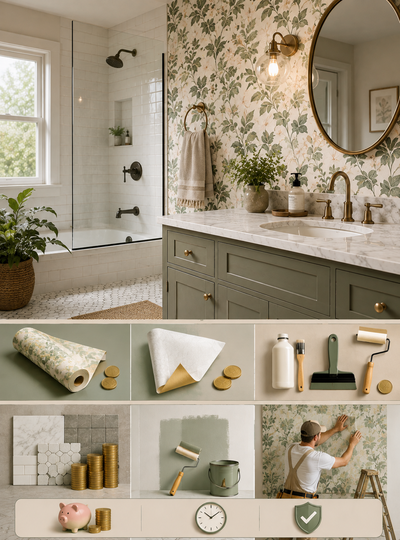
People ask about durability first, money second, so here’s the money part with real figures attached. A single roll of solid vinyl typically runs somewhere between thirty and ninety dollars, brand name and pattern complexity swinging that number up or down, and a small bathroom rarely eats through more than two or three rolls total.
Going the peel-and-stick route usually saves a bit — think twenty-five to sixty dollars a roll — though you’re giving up some long-term staying power for a much friendlier install process. Add a bottle of primer, paste if it’s not a paste-the-wall product, a smoothing tool, and a seam roller into the shopping cart, and a full DIY powder room job tends to land somewhere in the one-fifty to three-hundred-dollar neighborhood, give or take.
Tile burns through that entire budget just on materials, before any contractor labor gets factored in. That gap alone explains why so many homeowners land on wallpaper without much internal debate.
Hiring someone to hang it professionally typically runs $200 to $500, climbing based on region and how many awkward corners or windows the room includes. A plain rectangular layout finishes noticeably cheaper than a bathroom stuffed with odd angles and trim.
Stretched across several years, vinyl wallpaper for bathroom projects usually come out ahead of tile financially, mostly because tile eats so much more time between the first measurement and a finished grout line. Plain paint edges it out on day-one cost, sure, but a coat of paint alone doesn’t hold up particularly well in a room that deals with real steam every single day.
What Actually Sets Vinyl Wallpaper for Bathroom Walls Apart
Buyers get tripped up assuming every roll in this category behaves identically — it doesn’t, and that’s exactly where vinyl wallpaper for bathroom shopping mistakes happen most. Three loose camps split the market: solid vinyl, vinyl-coated paper, and paste-the-wall types, and solid vinyl carries the heaviest build of the three, the one worth pointing someone toward near a tub.
Thickness rarely gets the attention it deserves in product listings. A thin roll can photograph gorgeously and still bubble inside a year, simply because that flimsy backing can’t survive repeated humidity cycling. Whenever a weight rating is actually published, reading it before checkout pays off.
Renting the place, or hesitant about a permanent commitment? A peel-and-stick shortcut option handles lower-splash zones reasonably well — around a vanity, mainly. It won’t last as long as solid vinyl, but given the price and minimal effort involved, that tradeoff often makes sense.
Anyone weighing peel-and-stick specifically should check a self-adhesive roll guide before deciding — quality swings between brands more than most shoppers expect walking in.
Deciding on a print matters far more than most shopping guides let on. A loud, high-contrast pattern hides small seams and minor wall flaws in a way that flat, muted color simply can’t manage. Anyone hanging their first roll ought to lean toward bold rather than cautious.
Installing It Without Regret Later
Prep work is tedious and unglamorous, and it’s also responsible for most of whether this project ages well. Clean the walls properly, patch anything uneven, let everything dry completely — cutting corners here shows up as failure within the first year almost every time.
Skipping primer to save twenty minutes tends to resurface eight months later as peeling corners. A wallpaper-rated primer improves adhesive grip immediately and makes future removal considerably less painful.
First-timers tackling this alone should look at This Old House’s install walkthrough — it covers the genuinely fiddly parts, outlets and trim and tight corners, with more patience than most manufacturer instructions bother offering.
Give the finished wall real time to cure before a hot shower tests it, typically twenty-four to forty-eight hours. Rush past that window and an otherwise solid install can start showing trouble fast.
Tools matter more than most people assume going in. A cheap plastic smoother often leaves streak marks across glossy finishes, so a felt-edged version is worth the small extra cost whenever a pattern has any shine.
Handle outlet covers and switch plates before starting anything else. Work the paper carefully around each box, and cut with a genuinely sharp blade — a dull one tears vinyl instead of slicing it cleanly, and torn seams are nearly impossible to disguise afterward.
Does a Loud Pattern Work in a Tiny Bathroom?
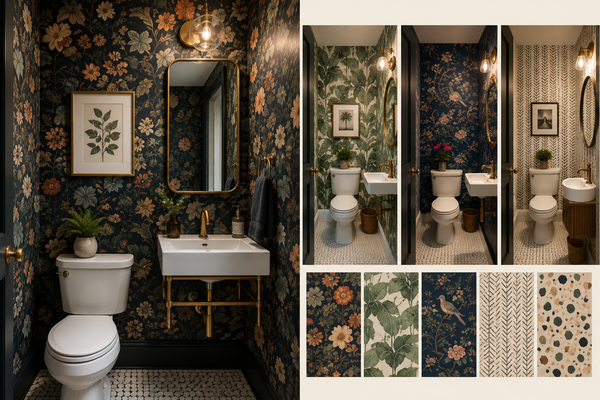
More often than not, yes — and by a wider margin than most people guess. Cramped bathrooms are exactly where wallpaper pays for itself fastest, since there’s simply less surface area to cover while the visual punch scales up out of proportion to that small footprint.
Load a tiny powder room up with something dark and saturated, and the effect reads as cozy and intentional rather than claustrophobic. That catches a lot of homeowners off guard, since the instinct is usually to keep small spaces pale and restrained. I’ve had more than one client end up calling their boldest, smallest room the favorite spot in the whole house.
Torn on which direction to go? Scrolling through a broader pattern selection before locking anything in is genuinely useful — laying a few options side by side turns “is this too loud” into an easy call.
Keeping It Looking Good Long-Term
Keeping vinyl looking decent takes almost no real effort, which explains a good chunk of its popularity. Run a soft rag under warm water, add a touch of mild soap, and most everyday marks disappear; reserve anything stronger for a stain that flat-out refuses to lift.
Skip abrasive scrubbers entirely — they dull the printed surface gradually even without physically tearing through the material. Gentle, circular wiping consistently beats aggressive scrubbing in every side-by-side test I’ve run myself.
Check seams every couple of months, particularly anything near the shower. Catching a lifting edge early turns into a five-minute repair with seam adhesive rather than replacing an entire strip down the road.
Mistakes I’ve Watched People Make
Skipping ventilation upgrades because “the wallpaper’s already waterproof anyway” ranks at the top of the list. Waterproof material still sits over a wall that traps humidity underneath whenever a room genuinely never gets fresh air.
Installing directly inside a shower enclosure or wrapping it around a tub ranks close behind. Even the toughest solid vinyl wasn’t built for constant standing water contact — that job stays firmly with tile, not wallpaper.
Prep time gets shortchanged constantly, usually under a self-imposed weekend deadline that leaves zero margin for error. That single shortcut explains most installs that look sharp for a month and rough by month six.
There’s a subtler trap, too: locking in a pattern decision from nothing more than a tiny thumbnail photo on a shopping site. Real lighting, actual room humidity, and the way vinyl catches light all shift what a print looks like once it’s genuinely hanging on drywall. Ask for a physical swatch whenever one’s offered — cheap insurance against cutting into a full roll and immediately regretting the choice.
Trim work near the baseboard and ceiling gets overlooked too often. A sloppy cut along either edge is usually the very first flaw anyone notices walking into a freshly wallpapered bathroom, no matter how clean the rest of the install looks.
What actually causes a failure is skipping a step that felt unimportant at the moment — and turned out, later, to matter quite a bit.
A Few Quick Answers
Is vinyl wallpaper actually safe for a bathroom?
For the most part, yes. Solid vinyl shrugs off steam and light splashing without complaint, as long as it isn’t taking direct shower spray head-on and the room gets ventilated with any regularity.
Will vinyl wallpaper peel in high humidity?
Only when the install was rushed to begin with. Seams tend to be where trouble starts — weak glue, skipped prep — rather than the vinyl sheet itself losing a fight against humidity.
Can I put vinyl wallpaper inside a shower stall?
Skip that idea. Nonstop standing water asks something different of a material than passing steam does, and purpose-built options like tile or waterproof panel handle that particular job far better.
How long does vinyl wallpaper last in a bathroom?
Give a properly hung, decent-quality roll good airflow and it can realistically run eight to fifteen years before needing replacement — a cheap product or sloppy install shortens that window considerably.
Is peel-and-stick vinyl as durable as pasted vinyl?
Not quite, though it’s not far off either. Figure three to seven years, and keep it confined to drier zones like a vanity wall rather than anywhere hugging a tub.
Do I need a special primer before hanging vinyl wallpaper?
Yes — this isn’t a step worth cutting. A bathroom-rated primer grips the wall better, resists mildew far better than raw drywall alone, and makes stripping the paper off down the road noticeably less of a chore.
Can vinyl wallpaper go over old tile?
Better off avoiding that combination. Grout lines and an uneven tile surface fight against a smooth, bubble-free finish, so a flat wall gives far better odds of success.
Is vinyl wallpaper for bathroom walls worth the cost compared to paint?
When moisture protection is genuinely the priority, yes. Paint is the cheaper upfront pick, no question, but it can’t match how vinyl handles years of repeated steam and humidity swings without constant repainting.
Wrapping This Up
Anyone doubting this material a decade ago wasn’t necessarily wrong to feel that way back then. Vinyl wallpaper for bathroom walls has narrowed most of the gap that used to make it a gamble in a steamy, splash-heavy room. Peeling and bubbling within a single season used to be the norm; a patient install in a room that actually breathes now holds together for years instead.
Almost every failure I’ve personally run across boils down to one of three things: skipped primer, rushed prep, or a fan that technically works but never actually gets used. Nail those three details and vinyl wallpaper for bathroom walls turns into one of the more forgiving, higher-payoff projects a small room can get.
Direct water still belongs to tile — inside a tub surround, along a shower wall, anywhere water hits constantly rather than briefly. That’s simply not a fight vinyl needs to pick, and no amount of careful prep changes that particular math. Everywhere else in the room, though, vinyl holds its own without much trouble. It costs less than tile, goes up faster, and stays far easier to swap out down the road if taste shifts.
Take a second and think about your specific bathroom instead of applying some blanket rule to every vinyl wallpaper for bathroom decision out there. Does it clear out fast after a short shower, or does steam linger because a fan’s been acting up for months? That single detail says more about how this project turns out than any spec sheet ever could. Good airflow makes for forgiving ground when it comes to vinyl. Weak airflow means fixing the fan comes first, wallpaper decision aside.
If this whole question has been sitting unresolved for a while, here’s a direct answer: it’s worth doing, provided ventilation and proper prep both get taken seriously rather than treated as afterthoughts. Handle those two pieces correctly, choose a solid-vinyl product with a reasonable weight rating, and there’s a genuinely strong chance the wall still looks sharp a full decade from now — a solid outcome for one weekend’s work and the cost of a single roll.