

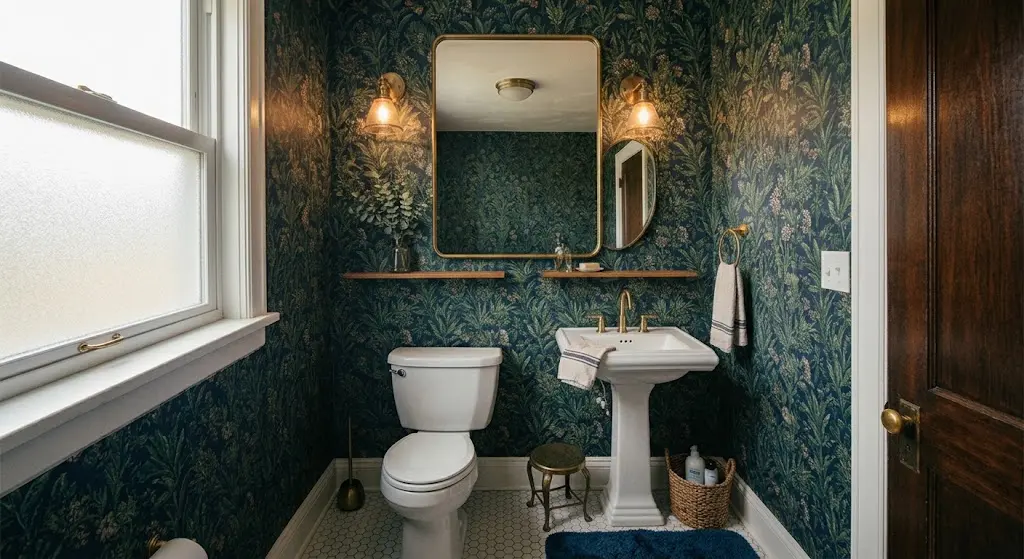
I’ve redone more powder rooms and cramped guest baths than I can count at this point, and here’s the thing nobody tells you upfront: small bathroom wallpaper is honestly one of the easiest wins in the whole house. Not the kitchen, not the entryway. The tiny bathroom. It’s a small enough space that a bold print won’t wreck your budget, and the payoff is disproportionately huge compared to how little wall you’re actually covering.
Once you’ve settled on small bathroom wallpaper as the plan, the decisions get more specific fast — but the instinct itself is right almost every time.
I still remember the first time a client pushed back on this. She had a five-by-seven half bath, barely room to turn around, and she was convinced wallpaper would make it feel like a closet. We went with a dark botanical print anyway, floor to ceiling, no accent wall nonsense. Guests started asking who did her bathroom. That’s when I stopped hedging on this topic and started recommending small bathroom wallpaper as a default, not a maybe.
This isn’t a design theory piece, though. I want to walk through the actual decisions — material, pattern, install method, the steam problem nobody warns you about — so you’re not guessing your way through it.
And I want to be upfront about something: not every small bathroom wallpaper choice is right for every bathroom. A powder room with no shower behaves completely differently than a full bath with daily hot showers, and treating them the same is exactly how people end up disappointed six months in. So we’ll go material by material, not just pattern by pattern.
Why Small Spaces Work
There’s a weird myth floating around that pattern shrinks a room. In a full living room, sure, an overwhelming print can feel busy. But a small bathroom wallpaper choice works differently because you’re looking at the whole room in one glance anyway — there’s no “far corner” for a pattern to get lost in or feel chaotic across.
Small rooms actually read as more intentional with a strong wallpaper, not less. A blank white powder room looks unfinished. A wallpapered one looks designed, even if you spent an afternoon on it — and if understated elegance is more your speed than a big bold print, our classy bathroom wallpaper roundup has plenty of quieter options that still read as intentional. I’ve noticed clients second-guess this constantly, then send me photos six months later thanking me for pushing them past the fear.
Home Depot’s design team makes a similar point in their small bathroom guide — mirrors and bold color choices can make a tight bathroom feel more finished rather than smaller, and wallpaper does the same job while adding texture paint can’t touch.
There’s also a lighting piece to this that people underestimate. Most powder rooms run on a single vanity fixture, which means whatever you put on the walls gets seen under warm, close-up light all the time. Small bathroom wallpaper with a bit of sheen or metallic detailing actually catches that light nicely, whereas the same finish on a big living room wall might look gaudy under mixed daylight and lamps. Scale changes what “too much” even means.
Here’s the practical part, though: because the room is small, you need way less wallpaper than you think. A typical powder room takes one or two rolls. That means you can afford a genuinely nice small bathroom wallpaper — something with metallic ink, a hand-painted look, a textured non-woven base — for less than you’d spend wallpapering a single bedroom wall.
Small Bathroom Wallpaper Materials
This is where most people get stuck, and honestly, it’s the part that actually matters most when picking small bathroom wallpaper for a room that sees regular steam. Not every wallpaper survives steam and splashes, and picking wrong means you’re redoing this in eighteen months.
I’ve installed all four of the main types below in real bathrooms, not just showrooms, so this comparison is based on what actually held up versus what started bubbling at the seams:
| Material | Moisture Handling | Best For | DIY Friendly? |
| Solid vinyl | Excellent — fully sealed surface | Full baths with showers | Moderate |
| Vinyl-coated paper | Good — handles splashes, not steam-heavy rooms | Powder rooms, half baths | Yes |
| Peel-and-stick vinyl | Good — but weak adhesive in constant humidity | Accent walls, renters | Very easy |
| Non-woven/paper | Poor — absorbs moisture, can warp | Dry powder rooms only, well-ventilated | Yes |
Vinyl is the one I reach for whenever a client actually showers in the room daily. It’s a bit more of a commitment to install with traditional paste, but it shrugs off condensation in a way paper products just don’t. If you want the deep dive on why vinyl outperforms everything else in wet rooms, our guide to vinyl bathroom wallpaper walks through the coating types in more detail.
For a powder room with no shower — just a sink and toilet — you’ve got more flexibility. Humidity spikes are shorter and less frequent, so vinyl-coated paper or even a well-sealed non-woven option can work fine. That’s usually where I let clients pick purely on pattern rather than performance.
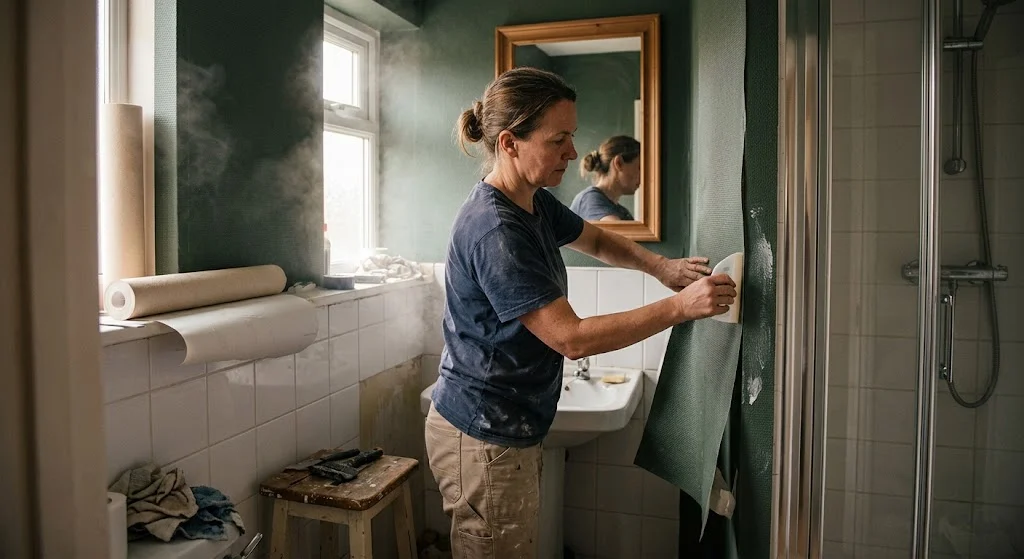
Non-woven small bathroom wallpaper gets a bad reputation it doesn’t always deserve, honestly. In a genuinely dry room — good fan, no shower, a window that opens — it can last for years without a single issue. The problem only shows up when someone installs it in a steamy full bath and then blames the material instead of the mismatch. Match the product to the room’s actual moisture level, not to whatever’s on sale at the store, and most of these “wallpaper doesn’t work in bathrooms” horror stories just don’t happen.
Peel-And-Stick Vs Traditional Paste
People ask me this constantly, and the honest answer for small bathroom wallpaper is: it depends on how wet your bathroom actually gets, not on how much of a hurry you’re in.
Peel-and-stick has come a long way. The good brands now use a real vinyl face with a proper adhesive backing, and for an accent wall away from the shower spray, it performs great. It’s also just less intimidating — no paste bucket, no smoothing brush, no waiting for glue to set up. That’s a big reason it’s become the default choice for small bathroom wallpaper projects among first-time DIYers.
That said, I won’t pretend it’s bulletproof. In a bathroom with a shower running hot water daily and weak ventilation, I’ve seen peel-and-stick edges start lifting within a year. The adhesive just isn’t rated for constant humidity cycling the way traditional paste plus vinyl is. This isn’t the product’s fault, exactly — it’s a mismatch between the material and the room.
I learned this one the hard way early on. A client wanted a soft pink peel-and-stick print in her main bath, the one her kids showered in twice a day, and I didn’t push back hard enough. Within eight months, the top corner nearest the shower door had lifted clean off the wall. We ended up redoing that whole wall in commercial vinyl with paste, and it’s been fine for years since. Lesson learned: peel-and-stick small bathroom wallpaper is fantastic in the right room and a slow-motion failure in the wrong one.
My rule of thumb, after doing this enough times to trust it:
- Powder room, no shower: peel-and-stick is fine, go wild with pattern.
- Full bath with a shower and decent fan: peel-and-stick works if it’s away from the wet zone, vinyl-plus-paste if it’s anywhere near splash range.
- Full bath with poor ventilation: skip peel-and-stick entirely, go with commercial-grade vinyl.
- Renting: peel-and-stick, no question — you need it removable anyway.
If you’re leaning toward the removable route, it’s worth reading a proper installation walkthrough before you start. This Old House has a solid peel-and-stick wallpaper guide that covers surface prep, which honestly matters more than people expect — half the “bad” peel-and-stick jobs I’ve seen were really just a poorly prepped wall underneath.
Does Pattern Shrink The Room?
No, not if you pick the right scale of print — that’s the short answer, and it surprises almost everyone. Forget the old rule about small rooms needing pale, quiet wallpaper. I’ve broken that rule dozens of times with small bathroom wallpaper choices, and the results speak for themselves.
What actually matters is scale and contrast, not brightness. A tiny, busy print with high contrast can genuinely make a small bathroom feel more chaotic — too many little shapes for the eye to settle on. But a larger-scale pattern, even in a dark or saturated color, reads as calm because there’s less visual noise per square foot.
A few patterns I keep coming back to for small bathroom wallpaper jobs:
- Large botanical prints in deep green or navy — feels like a jewel box, not a cave
- Wide stripes, vertical, to pull the eye up toward a taller ceiling
- Marbled or veined patterns that mimic stone without the stone price tag
- Geometric prints with generous negative space between shapes
If big leafy botanicals are the direction you’re leaning, it’s worth seeing how far that category actually goes — our floral wallpaper collection covers everything from tiny ditsy prints to the oversized jewel-toned botanicals that work so well in a small room.
One thing I’ll push back on: mirrors matter as much as the wallpaper choice. A dark, dramatic small bathroom wallpaper paired with a big mirror bounces enough light around that the room never feels cave-like, even at midnight with the overhead off. Skip the mirror and go too dark, and yeah, it can feel closed in. It’s a package deal, not just a wall decision.
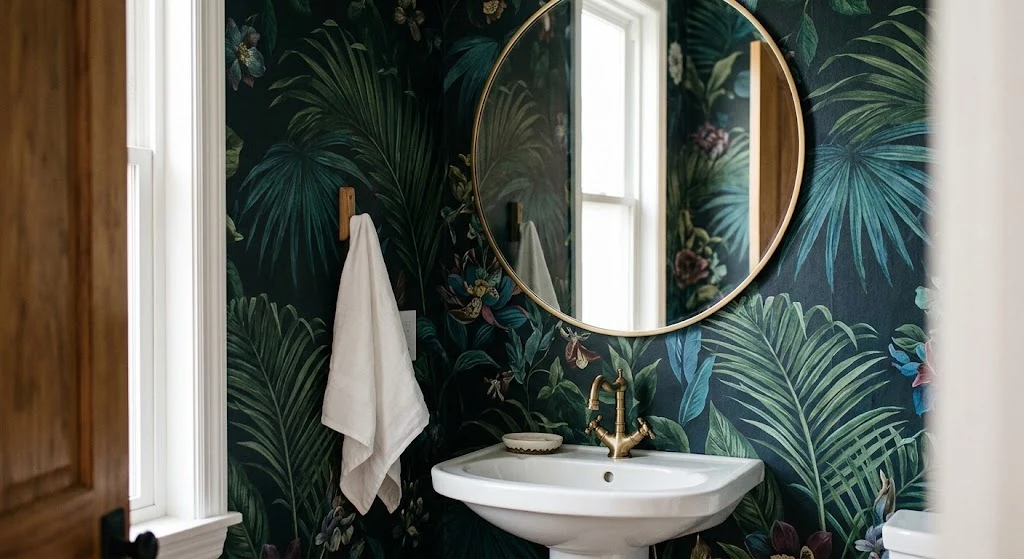
I’ll also say this: don’t let a showroom sample talk you out of boldness. Small swatches almost always look busier and darker than the finished wall does at full scale, because you’re staring at a six-inch square instead of stepping back and seeing it across a room. I’ve had clients nearly back out over a swatch, then thank me the day the full wall goes up and reads completely differently in context.
Common Wallpaper Mistakes
Some of these are obvious once you hear them. Others took me actual failed installs to learn. If you’re weighing a small bathroom wallpaper project right now, these are the exact slip-ups worth avoiding before you order a single roll.
- Skipping the primer on painted walls. Old paint, especially anything with a sheen, doesn’t grip adhesive well. Wallpaper will bubble at the seams within weeks.
- Measuring once. Bathrooms have weird angles around vanities, toilets, and windows that regular rooms don’t. Measure twice, cut once, and add a couple extra inches per strip for trimming.
- Wallpapering directly behind the shower head. Even the best vinyl isn’t meant for direct, sustained water spray. Tile that zone and wallpaper around it instead.
- Ignoring pattern repeat when buying rolls. Cheaper wallpapers sometimes have awkward repeat distances that waste a surprising amount of material in a small room.
- Choosing based on a screen swatch alone. Colors shift under bathroom lighting, especially warm LED vanity bulbs. Order a sample and tape it up before committing.
- Forgetting the exhaust fan location. A fan mounted right where you planned your focal pattern can throw off the whole layout. Map fixtures before you order rolls, not after.
If you want a broader sense of what’s out there before locking in a decision, it’s worth browsing a wider set of bathroom wallpaper ideas rather than settling on the first pattern that catches your eye — I’ve had clients change their mind three times before landing on the right one, and that’s completely normal.
Hanging It In Tight Corners
Installation in a small bathroom is genuinely easier than in a big room, if only because there’s less wall to mess up. But the tight corners around fixtures do make it fussier in a different way. Once your material’s picked, actually hanging small bathroom wallpaper comes down to prep, patience, and not rushing the corners.
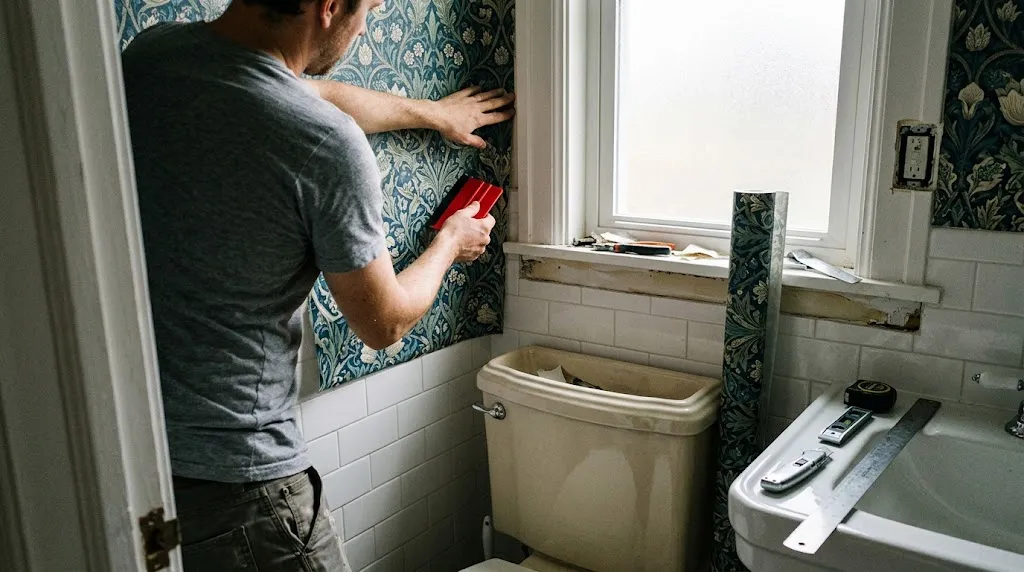
Here’s roughly how I approach it every time:
- Turn off the bathroom fan and let the room fully dry out — humidity during installation causes bubbling later.
- Remove switch plates, towel bars, and anything mounted to the wall.
- Prime the wall if it’s painted with anything glossy or semi-gloss.
- Start on the least visible wall to practice your technique before tackling the focal wall.
- Work in short sections, especially around the toilet and vanity, where you’ll need small cut pieces anyway.
- Trim last, once the paper’s fully set, using a sharp blade and a straight edge.
Tool-wise, you don’t need much: a smoothing brush or squeegee, a sharp utility blade, a level, and a tape measure cover most small bathroom wallpaper jobs. I keep a straight metal edge on hand too, since it makes trimming around toilets and vanities far cleaner than eyeballing it with just a blade.
Small bathroom wallpaper projects go faster than people expect — most powder rooms take an afternoon, not a weekend. That said, don’t rush the corners. A rushed corner is the first place a seam lifts six months later.
Steam, Fans, And Mold
This is the part people skip thinking about until it’s a problem. Wallpaper doesn’t fail in bathrooms because it’s a bad material choice most of the time — it fails because the room traps moisture with nowhere to go.
The EPA’s guidance on home moisture control comes down to one core idea: mold needs damp conditions to grow, so drying the room out matters far more than which wall covering you picked. Their mold moisture guide points to running the fan during and after a shower as one of the simplest habits for keeping a bathroom dry — something that costs nothing and does more for your wallpaper’s lifespan than any sealant ever will.
If your bathroom doesn’t have a working exhaust fan, honestly, fix that before you even think about wallpaper. No material, not even fully sealed commercial vinyl, holds up indefinitely against trapped steam with nowhere to escape. I’ve seen gorgeous waterproof installs fail at the ceiling line simply because the fan was undersized for the room.
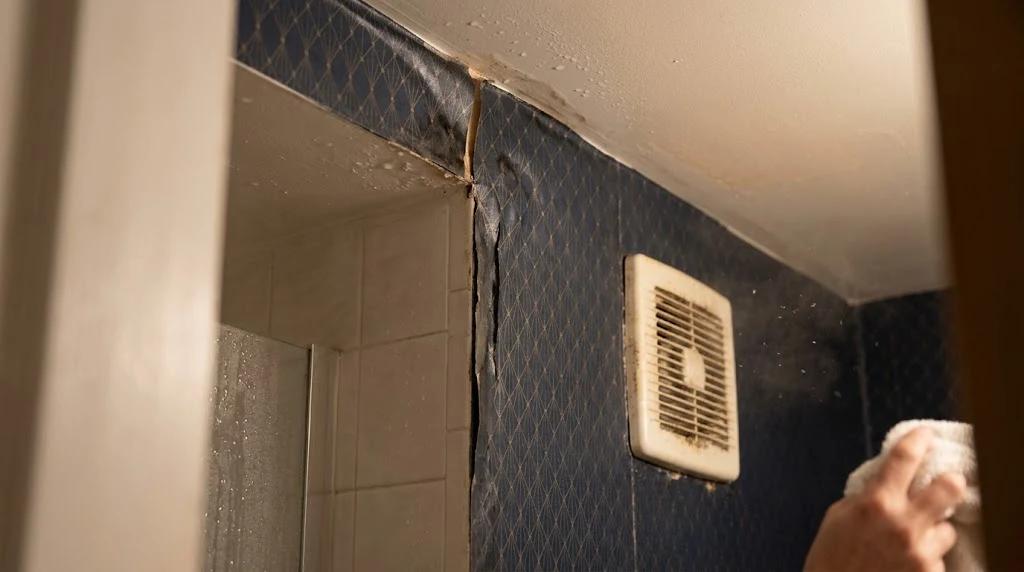
One bathroom I worked on had a beautiful navy small bathroom wallpaper job that looked flawless for the first year, then started bubbling right along the ceiling seam. Turned out the fan was original to a decades-old house and moving barely half the air it should have been. Swapping it for a properly sized unit fixed the problem permanently — no re-wallpapering required. Moral of the story: check the fan before you blame the wallpaper.
Speaking of which — if moisture is your main worry, there’s a specific category built for exactly this situation. Our waterproof bathroom wallpaper guide breaks down the coated options rated for constant humidity, which is worth a look if you’re dealing with a windowless bathroom or a shower that runs long and hot most mornings.
A few habits that genuinely extend the life of small bathroom wallpaper, steam or no steam:
- Run the fan for at least 20 minutes after every shower
- Wipe down visible condensation on the wallpaper itself, not just the mirror
- Crack the door if there’s no fan and the room feels muggy afterward
- Reseal any lifting edges early, before moisture gets behind the paper
Wallpaper Vs Tile Cost
People assume small bathroom wallpaper is the “cheap” option and tile is the “real” upgrade. In a small bathroom, that math doesn’t hold up the way it does in bigger spaces.
Because you’re covering so little wall, small bathroom wallpaper often ends up costing about the same as a decent paint job once you factor in primer, tools, and a couple of rolls — but you get pattern and texture paint simply can’t deliver. Tile, on the other hand, usually runs several times more once you add labor, grout, and waterproofing membrane, even for a small footprint.
That’s not an argument against tile — small bathroom wallpaper and tile do different jobs, and the smart move is usually using both. Full showers still need it — no wallpaper belongs inside a shower stall, full stop. But for the dry two-thirds of a bathroom, wallpaper gets you a far more dramatic result per dollar spent than either paint or tile manages on its own. I’ve had clients redirect the money they saved by wallpapering instead of tiling a feature wall toward a nicer light fixture or a better mirror, and the room ends up feeling more finished overall.
Rough numbers, since people always ask about small bathroom wallpaper budgets: a mid-range small bathroom wallpaper job, materials plus DIY labor, tends to land somewhere between what you’d spend on two cans of quality paint and a basic tile accent strip — closer to the paint end if you go peel-and-stick, closer to the tile end if you hire a professional hanger for a tricky, angled room. Either way, it’s rarely the most expensive line item in a bathroom refresh, which is part of why I push for it so often.
Frequently Asked Questions
Is wallpaper actually okay in a bathroom with a shower?
Yes, as long as it’s not inside the shower stall itself or getting direct spray. Vinyl or vinyl-coated wallpaper handles the general humidity of a full bath just fine when there’s decent ventilation.
Does peel-and-stick wallpaper work in a humid bathroom?
It can, but it’s less reliable in constantly steamy rooms than traditional vinyl with paste. It’s best suited to powder rooms or accent walls away from the shower.
How many rolls do I need for a small bathroom?
Most powder rooms need one to two standard rolls, though it depends on ceiling height and pattern repeat. Measure your walls and check the roll’s coverage specs before ordering.
Will a bold pattern make my small bathroom feel smaller?
Not usually — large-scale, high-contrast patterns tend to feel intentional rather than cramped, especially paired with a good mirror to bounce light around.
How long does small bathroom wallpaper installation take?
Most powder rooms take a few hours to a full afternoon. Add extra time if you’re working around a lot of fixtures or cutting in tight corners.
Can I mix wallpaper with tile in a small bathroom?
Absolutely, and it’s one of my favorite combinations. Tile the lower half where splashes actually happen, then let small bathroom wallpaper take over above the tile line for pattern without the moisture risk.