

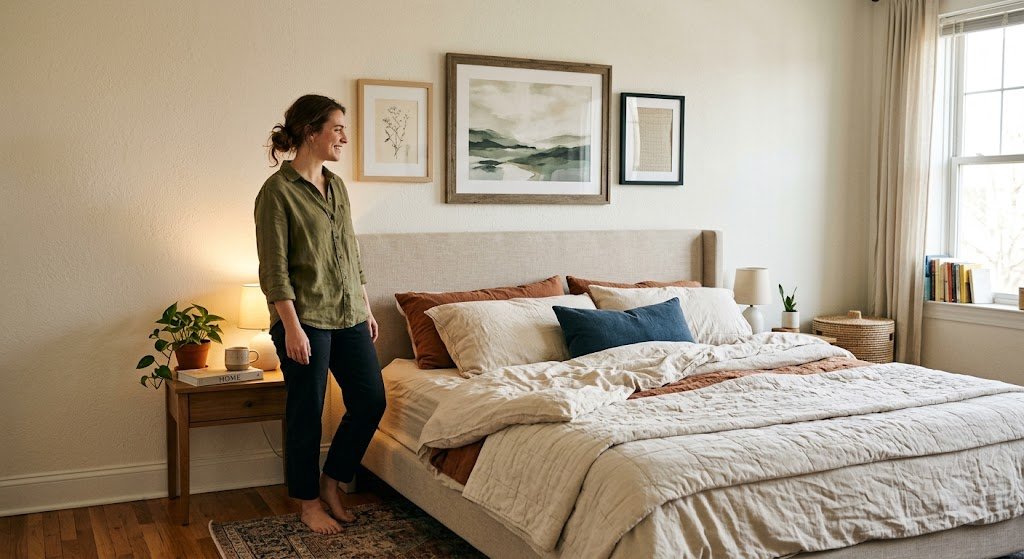
I didn’t plan on becoming the person everyone texts photos of their bare bedroom walls to. It just happened after a decade of styling client homes and, more times than I can count, redoing my own bedroom because I got bored on a Sunday. So when someone asks me about bedroom wall art, I don’t reach for a Pinterest board — I reach for what’s actually worked, and what’s flopped, in real rooms with real budgets.
Here’s the thing most people miss: bedroom wall art isn’t the last step of decorating. It’s the thing that decides whether a room feels finished or just… furnished. You can have the best linens, the softest rug, a headboard you saved up for — and the room will still feel unfinished if the walls are empty. I’ve watched it happen over and over.
This isn’t a list of forty generic ideas ripped from a catalog. It’s what I’d tell a friend over chai if they messaged me asking, “okay but what do I actually put above my bed?” So consider this your honest, slightly opinionated guide to bedroom wall art — no fluff, no filler.
Why Walls Matter More Than You Think
People underestimate how much wall space actually shapes a bedroom’s mood. Paint color gets all the credit, sure, but bedroom wall art is doing quieter, heavier lifting — it sets the emotional temperature of the room before you even register why.
A cold, sparse wall makes a bedroom feel like a hotel you’re just passing through. Fill that same wall with something personal, textured, a little imperfect, and the whole room softens. I’ve seen it flip a space from “guest room nobody wants to sleep in” to “the room everyone fights over” — same furniture, same paint, different wall.
There’s also a practical side nobody talks about. Good bedroom wall art hides flaws. Uneven plaster, an old patch job, a weird outlet placement — a well-placed piece (or a small gallery cluster) just quietly solves it.
Picking Bedroom Wall Art That Fits

Start With Scale, Not Style
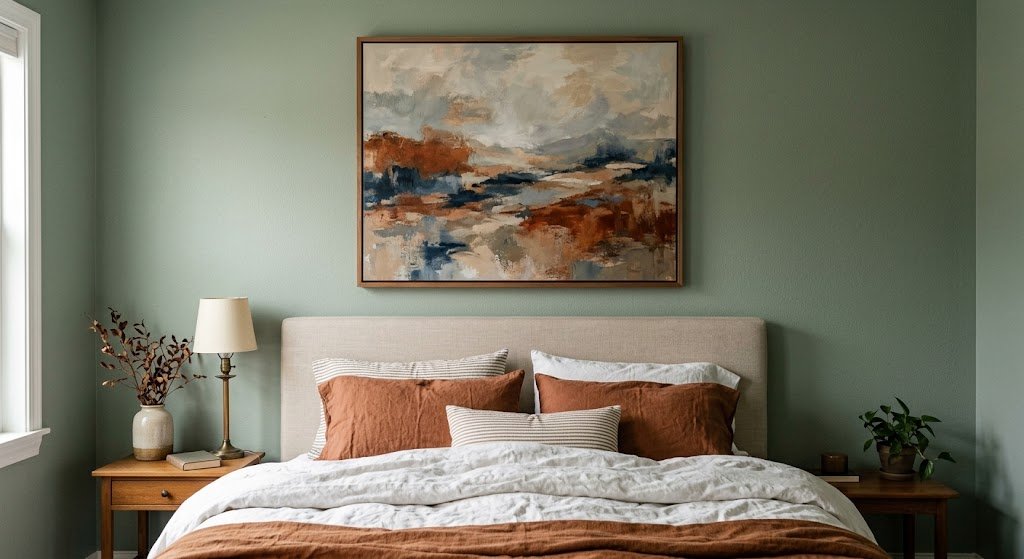
This is where I see people go wrong constantly. They fall in love with a print online, buy it small because it’s cheaper, then hang it above a queen bed where it looks like a stamp. Scale first, taste second — that’s the order that actually works.
A rough rule I use: lay your main piece (or the full spread of a gallery grouping) against the headboard and check that it covers most of it — leaving maybe a third of the frame’s width bare on either side. Go smaller and it reads as an afterthought. Go bigger and it can genuinely swallow the room, so don’t overcorrect either. Getting the scale right is what actually separates good bedroom wall art from art that just happens to be on a wall.
Color Doesn’t Have To Match, It Has To Talk
I’ve stopped telling clients to “match the art to the bedding.” Matching is boring, and a little dated if we’re being real. What you want is a piece that references one or two colors already in the room without repeating the whole palette. A rust-toned abstract next to sage walls does more for a space than a print in the exact same sage.
Mood Before Motif
Ask what you want to feel when you wake up, not what looks trendy in a showroom. Botanical prints calm things down. Bold geometric bedroom wall art energizes a space, maybe too much for some sleepers. Black-and-white photography reads timeless and a bit moody in the best way. Pick the feeling, then hunt for the piece — that’s the order that actually produces bedroom wall art you won’t tire of in six months.
Where To Actually Hang It
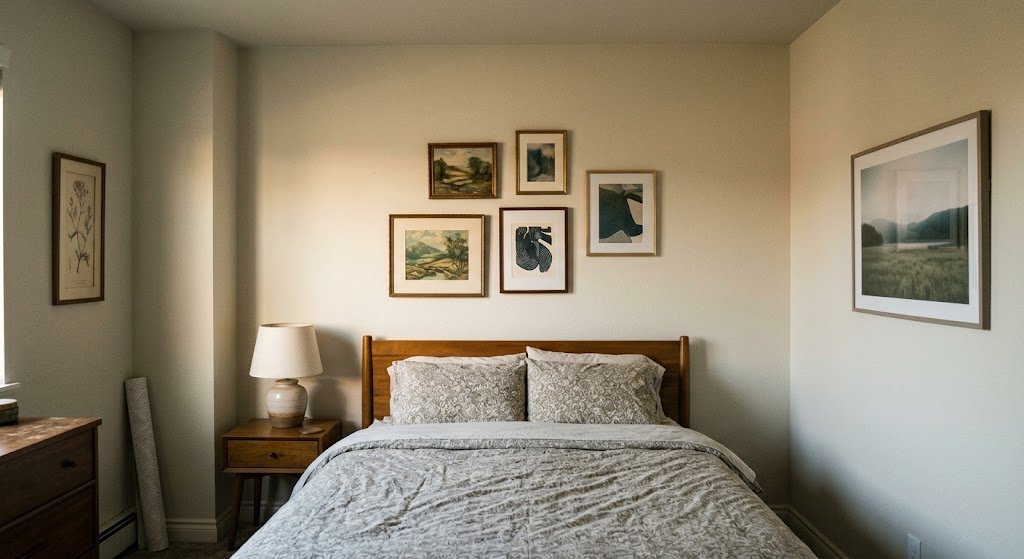
Above-the-bed is the obvious spot, and for good reason — it’s the largest uninterrupted wall in most bedrooms and the first thing your eye lands on walking in. But it’s far from the only option, and treating it like the only option is how you end up with a room that peaked at the headboard and gave up everywhere else.
Side walls next to nightstands are criminally underused. A single narrow vertical piece on each side, echoing each other without matching exactly, adds rhythm to the room. I did this in my own place with two mismatched botanical sketches and it’s still my favorite thing I own.
Don’t ignore the wall facing the bed either — it’s the last thing you see before sleep and the first thing you see waking up. That deserves something you actually love, not whatever was left over.
If you’re nervous about commitment, this is genuinely a good spot to lean into removable or peel-and-play options before drilling a single hole — a small taste of how wallpaper ideas for a bedroom might change the whole room without any permanent decision.
For general placement, forget “eye level” as a phrase — it means something different depending on how tall you are. What actually works: measure from the floor to somewhere between four-foot-nine and five feet, and center the art there. It’s roughly fridge-handle height on most kitchens, if you need a mental anchor. There’s more nuance to it than a single number, though, so it’s worth reading up on proper hanging height before you touch a hammer.
Gallery Walls Without The Chaos
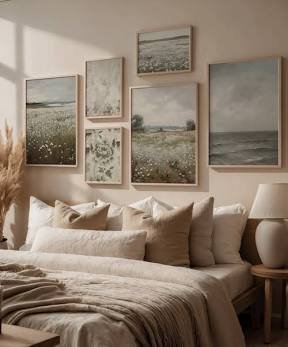
Gallery walls get a bad reputation because most people attempt them without a plan and end up with something that looks like a dorm room in 2011. But done right, a gallery arrangement is some of the most effective bedroom wall art you can put together, because it lets you mix scale, texture, and story in one spot.
Lay It Out On The Floor First
Non-negotiable, in my experience. Arrange everything on the floor exactly how you want it on the wall, take a photo from above, then hang from that photo. Skipping this step is how nail holes multiply.
Leave Breathing Room
Two to three inches between frames feels intentional. Push them together and it reads cluttered instead of curated — a mistake I made in my very first apartment and regretted for years.
Anchor With One Larger Piece
Every strong gallery wall I’ve built has one piece that’s noticeably bigger than the rest. It gives the eye somewhere to land first before wandering to the smaller pieces around it. This one trick alone has saved more gallery walls than any amount of careful spacing.
Done thoughtfully, a gallery cluster is genuinely some of the most rewarding bedroom wall art to put together, since it grows and changes as your taste does — you just keep adding pieces over the years.
If patterns are more your thing than framed prints, a single accent surface can do the same visual job as a whole gallery cluster — there’s a reason so many designers now treat a bedroom accent wall as the statement piece instead of stacking multiple frames. Plenty of rooms end up using both, just on different walls.
Budget Doesn’t Mean Boring
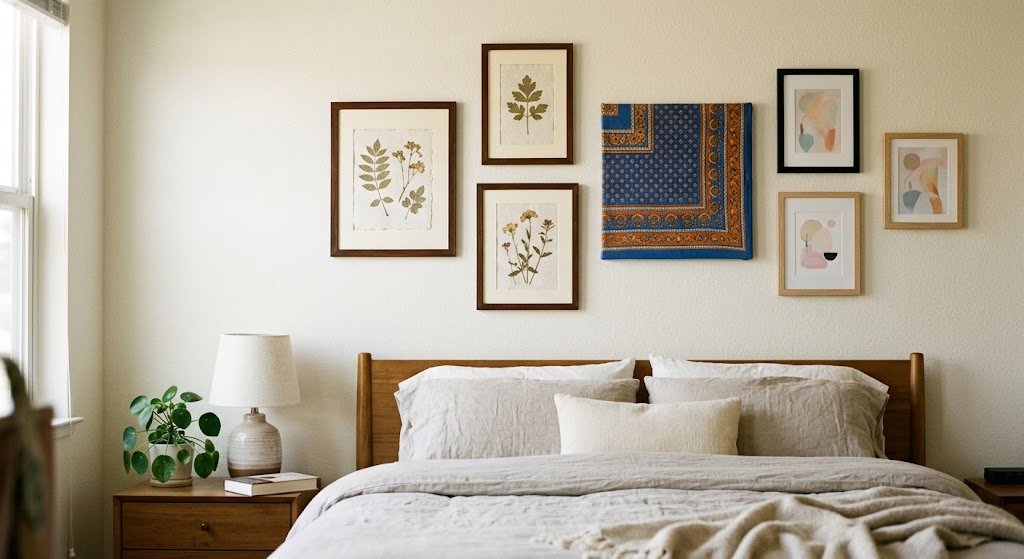
I’ll say something slightly unpopular: expensive art is not automatically better bedroom wall art. Some of the best walls I’ve styled cost under a hundred dollars total.
Thrifted frames with fresh mats look custom for almost nothing. Pressed botanicals from your own garden, framed simply, beat a lot of store-bought prints. Even fabric — a scarf, a remnant of patterned textile, stretched over a canvas frame — makes surprisingly good bedroom wall art and costs a fraction of a gallery piece.
Print-on-demand sites have also gotten genuinely good. You can commission something that feels one-of-one without paying gallery prices, and truth is, most guests can’t tell the difference between a $40 print and a $400 original once it’s framed and hung well. Budget-friendly bedroom wall art, done with a little patience, often outshines whatever’s sitting in a pricier showroom.
Matching Wall Art To Your Bedroom’s Personality
For Calm, Restful Spaces
Think soft-edged abstracts, muted landscapes, anything with a horizon line. Horizontal compositions tend to read as more restful than busy vertical ones — there’s actual research behind that, not just designer intuition.
For Romantic Bedrooms
Florals, soft portraiture, warm-toned abstracts — anything with a bit of movement in the brushwork. If you’re leaning into this direction fully, it’s worth browsing romantic bedroom wallpaper options too, since art and wall covering often end up doing the same emotional work in a room like this.
For Kids And Teens
This is where I let personality run wild, no joke. Bold color, playful shapes, art that can grow with the kid rather than get replaced every two years. Framed prints of their own artwork, oddly enough, tend to outlast anything store-bought in terms of sentimental value.
For A Grown-Up Primary Suite
Fewer, larger pieces. Restraint reads as luxury here more than volume does. A single striking piece of bedroom wall art above a well-made bed does more for a primary bedroom than five smaller ones scattered around.
Common Mistakes I See Constantly
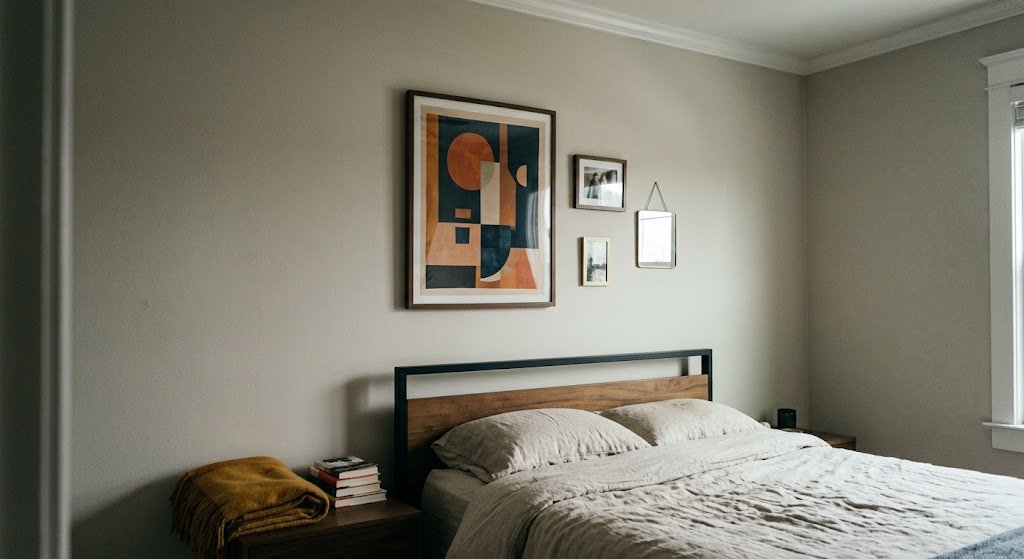
Hanging everything too high is probably the number one issue — people compensate for a tall ceiling by pushing art up near the crown molding, and it ends up floating awkwardly instead of anchoring anything.
Buying art before buying furniture is another one. You end up with a piece that technically works but never quite feels intentional against whatever bed frame you eventually pick.
And honestly? Playing it too safe. Neutral, inoffensive prints that “go with everything” often end up going with nothing — no personality, no pull. I’d rather see one weird, slightly-too-bold piece of bedroom wall art than a wall full of safe choices nobody actually looks at twice.
If you want a broader sense of how professionals approach this room specifically, Homes & Gardens has a solid roundup of bedroom art ideas worth flipping through before you commit to anything, and their general wall decor guide is a decent second opinion if you’re still torn on direction.
Lighting Changes Everything
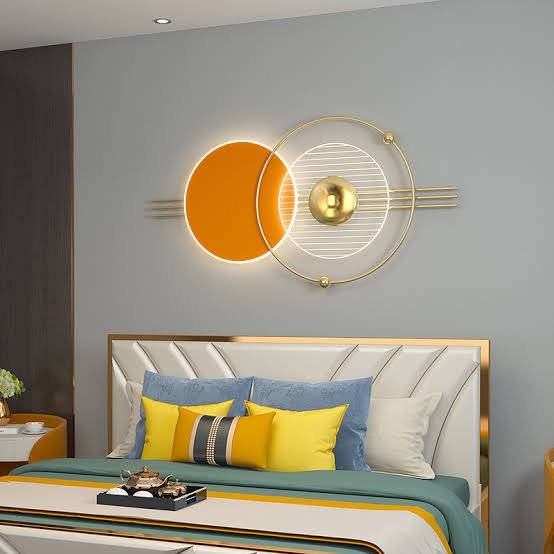
Nobody talks about this enough, but the exact same piece can look flat in one bedroom and stunning in another purely because of how it’s lit. Overhead lighting, the kind most bedrooms rely on by default, tends to flatten texture and wash out color. It’s fine for finding your socks in the morning, not great for actually appreciating a piece on the wall.
A small picture light mounted above a frame, or even a warm-toned floor lamp angled toward the wall in the evening, does more for a piece than swapping the art itself ever would. I learned this the hard way — spent months convinced a print I’d bought just “wasn’t working” in my bedroom, moved a lamp six inches, and suddenly it was the best thing in the room.
Natural light matters too, obviously. A wall that gets harsh afternoon sun will fade certain pigments faster than you’d expect, so if you’ve splurged on an original or a limited print, keep it out of direct sunlight or invest in UV-protective glass. Cheap insurance for something you’ll be looking at every day for years.
Warm Bulbs Over Cool Ones
Stick to warm white bulbs, somewhere around 2700K to 3000K, for anything near the bed. Cool, bluish light makes even the coziest bedroom wall art look clinical, almost like it belongs in an office rather than a place you sleep.
Seasonal Swaps Without The Hassle
You don’t need to overhaul your whole wall every few months, but a small rotation keeps a bedroom feeling alive instead of static. I keep two or three smaller pieces in a closet and swap them into a gallery arrangement depending on the season — nothing dramatic, just enough to notice.
Command strips or a simple picture rail make this painless. No new holes, no commitment, and it gives you an excuse to actually look at your bedroom wall art again instead of walking past it on autopilot, which — let’s be honest — is what happens to most decor after the first few weeks.
Mixing Art With Wallpaper
This one trips people up. They assume art and pattern can’t coexist, so they pick one and abandon the other. Not true — you just have to be deliberate about where each one lives.
If your walls already carry a pattern, keep the art simpler: solid mats, minimal frames, fewer pieces overall. The wall is already doing visual work, so the bedroom wall art shouldn’t compete with it.
On the flip side, a plain wall is where you can go bigger and bolder with art, since there’s no competing pattern eating attention. I tend to steer clients toward picking one hero — either the wallpaper for the bedroom walls or the art — and letting the other one support it quietly.
For anyone weighing whether to commit to a full pattern or keep things art-led, it’s worth looking through master bedroom wallpaper ideas side by side with a few art arrangements before deciding, because seeing both mocked up genuinely changes people’s minds more often than you’d expect.
Final Thoughts
At the end of the day, bedroom wall art is one of the cheapest, fastest ways to make a room feel like yours instead of a showroom nobody actually lives in. You don’t need a huge budget or a design degree — you need a piece (or a few) that actually means something to you, hung at a height that makes sense, on a wall that’s been thought through instead of just filled.
Start small if you have to. One piece, hung well, beats five pieces hung badly. And if you’re still staring at a blank wall wondering where to start, just pick the wall you look at most — the one across from your bed — and begin there.
Go put something up this weekend. Your walls have waited long enough.
FAQs
Do I need to match my bedroom wall art to my bedding?
No — reference a color or two instead of matching exactly. Matching everything tends to flatten the room rather than pull it together.
How high should I hang art above my bed?
Aim for the center of the piece landing between four-foot-nine and five feet off the floor — adjust up a touch for a tall headboard, down a touch for low ceilings.
Can I mix wallpaper and framed art in the same bedroom?
Yes, as long as one stays simple while the other carries the visual weight — don’t let both compete for attention.
What size should my main piece be?
Aim for roughly two-thirds the width of your headboard as a starting point, then adjust based on how the wall actually feels.
Is expensive art necessary for a bedroom to look finished?
Not at all. Thrifted frames, framed textiles, and print-on-demand pieces can look just as intentional as gallery originals when hung thoughtfully.