

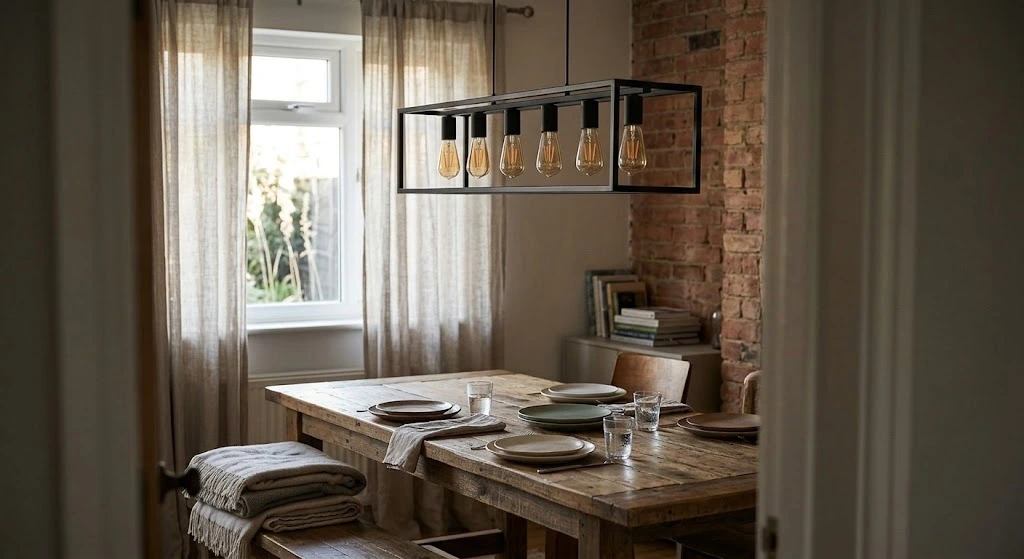
I’ve walked into more dining rooms than I can count where the chandelier was the first thing to go wrong and the last thing anyone thought to blame. Usually it’s not the fixture itself. It’s how it got picked, sized, or hung. A linear dining room chandelier can genuinely transform a long table into the centerpiece of the room — I’ve seen it happen — but it can just as easily sit there looking like an afterthought if a few basic things get skipped.
Here’s the thing about linear fixtures specifically: they’re less forgiving than round chandeliers. A round chandelier hung slightly off-center over a rectangular table just looks a little odd. Hang a linear dining room chandelier off-center or too high, though, and it stops looking like a design choice and starts looking accidental — like nobody double-checked the tape measure. That’s exactly why I want to walk through the mistakes that come up again and again, before you commit to ordering one or finally get around to installing the one gathering dust in a closet somewhere (mine sat unopened for weeks, no shame).
Sizing It Too Small
Nobody sets out to buy an undersized fixture. It happens because a chandelier that looks big enough in a product photo shrinks the second it’s hanging over a real table in a real room — photos lie about scale constantly, and I’ve fallen for it myself.
Think of it this way: your table is the anchor, and the fixture needs to visually “cover” a meaningful chunk of it, not just decorate the middle. A rough way I explain it to clients — take your table’s length, cut it roughly in half, and that’s your absolute minimum fixture length. If you want the fixture to read as an actual design statement rather than a small accent, lean toward the upper end — closer to two-thirds of the table’s length instead of half.
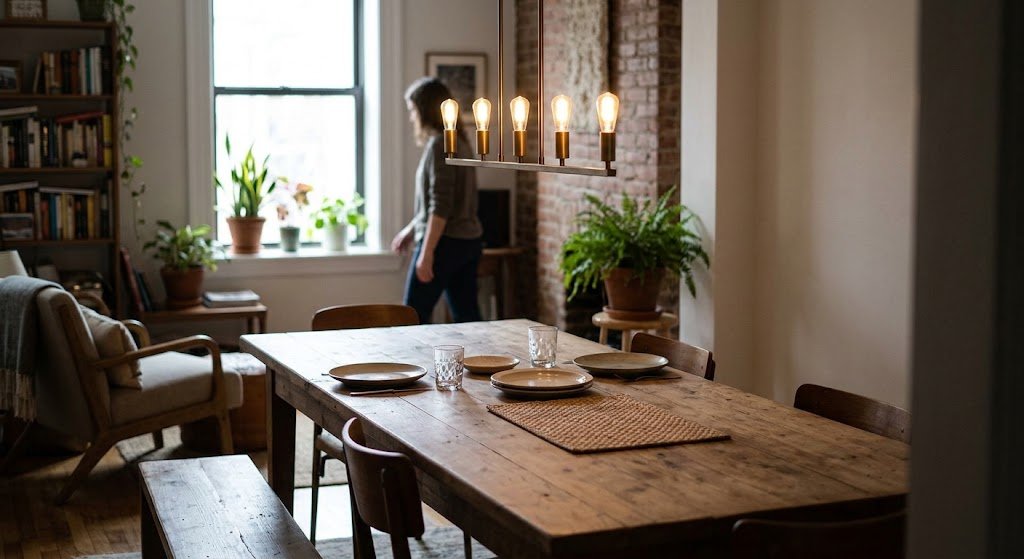
For a table stretching 72 inches, that generally puts you in a range from the high 30s up toward 50 inches. Go below that range and the chandelier ends up looking isolated in the center, leaving the far ends of the table dim and underlit.
Width throws people off too. Linear dining room chandelier designs run narrow by nature — that’s not a flaw, it’s the whole point of the shape. Don’t compare it to how wide a traditional round chandelier looks; it’s solving a different problem.
Matching It To The Wrong Table Shape
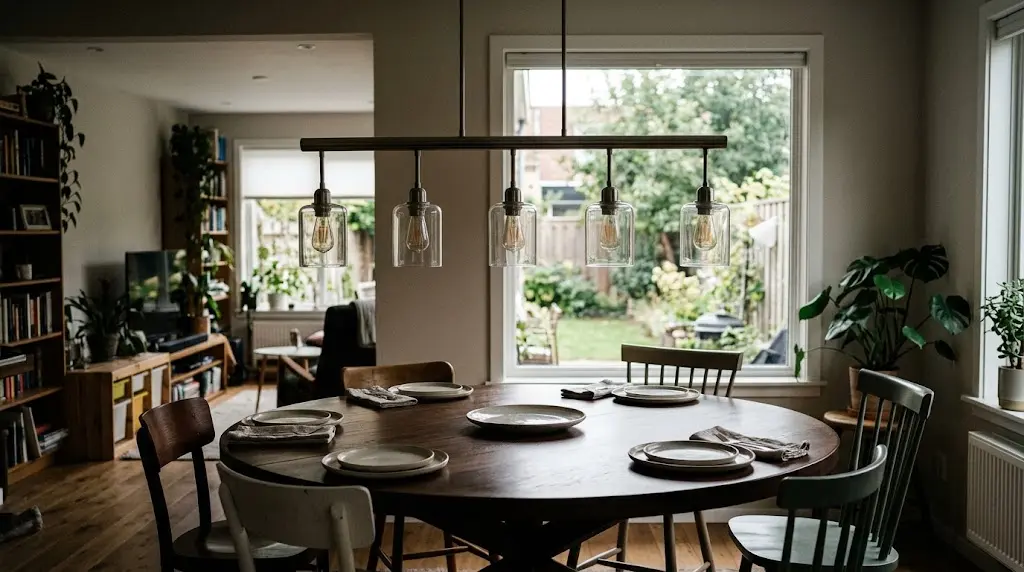
Here’s where I see people waste money. A linear dining room chandelier is built for a rectangular or oval table. Full stop. Hang one over a round table and it looks like a mismatch no matter how expensive the fixture was — the light falls in an oblong pattern that doesn’t match the circular shape below it, and it just feels off, even to people who couldn’t tell you why.
If your table is round, you’re better off with a round chandelier or a cluster pendant. We’ve got a full breakdown of pairing fixtures with round tables and chairs if that’s the direction you’re actually headed. And if you’re still deciding on the table itself, our guide to the 60-inch round dining table walks through sizing that shape specifically, since round tables have their own scaling rules that don’t overlap with linear fixtures at all.
For anyone with a long farmhouse table or an oval extendable one, though, a linear dining room chandelier is honestly the better call. It follows the table’s line instead of fighting it.
Hanging It At The Wrong Height
This is the mistake nobody notices until they’re the sixth person that week ducking their head walking past the table. Get the clearance wrong in either direction and the fixture stops working. Too tight to the table, and it becomes something people physically navigate around during dinner. Too far up, and the room loses the close, gathered feeling a dining fixture is meant to create in the first place.
In my own work, I keep landing on the same comfortable zone — roughly three tennis balls’ worth of clearance, stacked, between the tabletop and the bottom of the fixture. That translates to about 30 to 36 inches on a standard-height ceiling. Once ceilings climb past 8 feet, I add a small buffer for every extra foot — nothing dramatic, just enough that the fixture doesn’t look like it’s floating disconnected from the table below it. Skip this adjustment and a linear dining room chandelier either clips tall guests or looks orphaned from the furniture it’s meant to light.
Here’s a quick reference for how that plays out:
| Table Length | Suggested Fixture Length | Hanging Clearance Above Table |
| 48–60 inches | 24–36 inches | Roughly 2.5–3 tennis balls high |
| 60–72 inches | 36–48 inches | Roughly 2.5–3 tennis balls high |
| 72–96 inches | 48–66 inches | Slightly under 3 tennis balls high |
| 96+ inches (two fixtures) | Two fixtures, 30–40 inches each | Same range, evenly spaced |
That bottom row trips people up. Past about 8 feet of table, a single long fixture starts looking stretched and thin — two shorter ones, spaced evenly, almost always look more deliberate.
Forgetting To Adjust For Ceiling Height
How high your ceiling sits changes more than just chain length — it changes how the fixture reads against the room. Under a standard 8-foot ceiling, a substantial linear fixture feels anchored and deliberate. Move that same piece under an 11- or 12-foot ceiling, though, and it can start looking small and lost, swallowed up by all the open air surrounding it. Simply adding chain to reach a taller ceiling doesn’t solve that problem on its own.
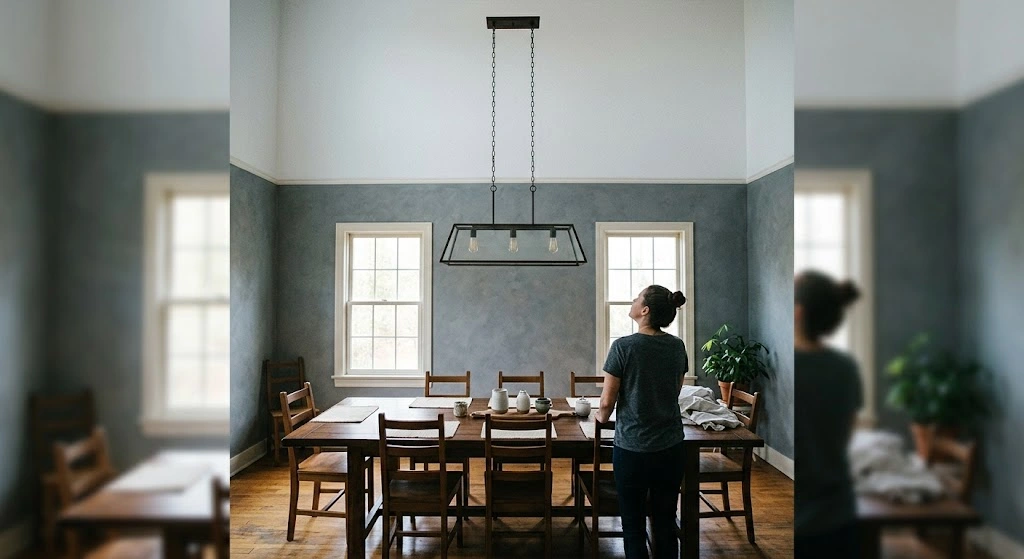
Either size up the fixture itself so it holds its own visually, or bring in supplementary lighting so the chandelier isn’t the lone thing anchoring a very tall room. This is one spot where a lighting sizing guide from Lightopia is worth a look, since it covers how proportions shift once you’re outside a standard 8-foot ceiling — a detail a lot of buying guides skip entirely.
I had a client with an 11-foot dining room ceiling and a fixture that looked commanding in the showroom. Once it went up, it read almost toy-like against all that vertical space. We swapped it for something with nearly double the visual scale, and the room finally felt finished. Ceiling height just isn’t something you can judge from a catalog photo — you have to stand in the actual room.
Picking The Wrong Bulb Temperature
Nobody thinks about this until dinner looks weird. Kelvin rating is what actually decides whether a linear dining room chandelier makes a meal look inviting or makes it look like it’s sitting under office lighting.
Dining rooms generally do best somewhere between 2700K and 3000K — warm enough to bring out wood grain and table settings, and far more forgiving on food and faces than anything in the cooler range. Go much cooler than that — anything pushing 4000K or higher — and you get a bluish cast that honestly makes even good cooking look a little unappealing on the plate.
A few practical notes worth keeping in mind:
- Keep bulbs in the 2700–3000K warm range for most dining rooms, particularly with wood furniture or warm wall colors
- Choose dimmable LEDs so brightness can change without shifting the color tone
- Check that all bulbs in a multi-socket linear fixture match — mismatched temperatures within one chandelier look sloppy fast
- Avoid “daylight” bulbs (5000K+) in dining spaces unless you’re going for a very specific, cold-modern look
Skipping The Dimmer Switch
I genuinely don’t understand why this gets left out so often, given how cheap it is to fix at the install stage. A linear dining room chandelier without a dimmer is stuck at one brightness, which means it’s either too harsh for a quiet weeknight dinner or too dim for actually reading the menu, so to speak, during a dinner party.
Dimmers cost next to nothing compared to the chandelier itself, and they instantly make the fixture more useful. Bright and even for homework or meal prep, low and warm for a dinner with wine on the table — it’s the same fixture doing two completely different jobs. For anyone wanting a second layer of light instead of putting everything on the chandelier, wall sconces in the living room use a comparable approach to layering — and it carries over nicely into open dining areas that flow straight into a living space with no wall separating them.
Ignoring The Room’s Existing Style
This one’s less technical, more taste-driven, but I still see it go sideways constantly. By default, a linear dining room chandelier tends to lean modern — simple lines, not much extra ornamentation. Put that same fixture in a room dominated by heavy traditional furniture, thick drapery, and carved detailing, and it can feel like it was borrowed from a completely different house.

That said, linear fixtures aren’t locked into modern-only spaces. They hold up well in transitional rooms and even farmhouse-style dining rooms, particularly when the finish — wood, wrought iron — matches what’s already in the room. The mismatch happens when nobody thinks about finish and silhouette together with the rest of the room. If you want a deeper look at shapes and styles specifically built around this fixture type, our full linear chandeliers for dining rooms guide covers the style variations in more detail than I can fit into one section here.
My honest opinion, and I’ll own that it’s an opinion: matte black and aged brass linear fixtures age better across style changes than shiny chrome does. Chrome looks great for about five years, then it starts looking dated the second a design trend shifts. Matte finishes just hold up longer.
Overcrowding The Fixture With Décor
One last habit worth breaking: hanging a linear dining room chandelier and then stacking tall centerpieces, vases, or holiday décor directly beneath it. Now the chandelier is competing with a flower arrangement for the same visual attention instead of simply anchoring the table.
Keep whatever sits on the table low-profile so the chandelier keeps ownership of the space above it. A flat runner with low candles or a shallow bowl arrangement works with a linear fixture instead of against it. Tall centerpieces belong on tables lit by something other than a low-hanging chandelier — or need to sit off to the side rather than dead center.
FAQs
How long should a linear dining room chandelier be for a 6-foot table?
Somewhere between 36 and 48 inches works well — roughly half to three-quarters of the table’s full length keeps the light even across the surface instead of concentrated in the middle.
Can I use a linear chandelier over a round table?
Technically yes, but it’s not the best match — the fixture’s shape fights the table’s shape. A round chandelier or cluster pendant almost always looks more intentional over a round table.
What height should a linear dining room chandelier hang at?
Around 30 to 36 inches above the table for a typical 8-foot ceiling, with a bit more clearance added for each additional foot of height.
Do linear chandeliers work with traditional decor?
They can work, particularly in warmer finishes like matte black or aged brass, though very ornate traditional rooms sometimes suit a classic chandelier shape better.
Is a dimmer necessary for a dining room chandelier?
It’s not required, but it’s one of the lowest-cost upgrades that makes the biggest practical difference across different types of meals.
Final Thoughts
A linear dining room chandelier is one of those fixtures that either makes a dining room feel pulled together or makes it feel like something’s slightly off, and there’s rarely much middle ground. Most of the mistakes above come down to skipping basic math — table length, ceiling height, bulb temperature — rather than picking an ugly fixture.
Nail the sizing, the hanging height, and the bulb temperature, add a dimmer, and make sure the style actually fits the room — do that and you’ve sidestepped every mistake on this list. Measure everything twice before ordering, and don’t let the box sit around as long as mine did.