

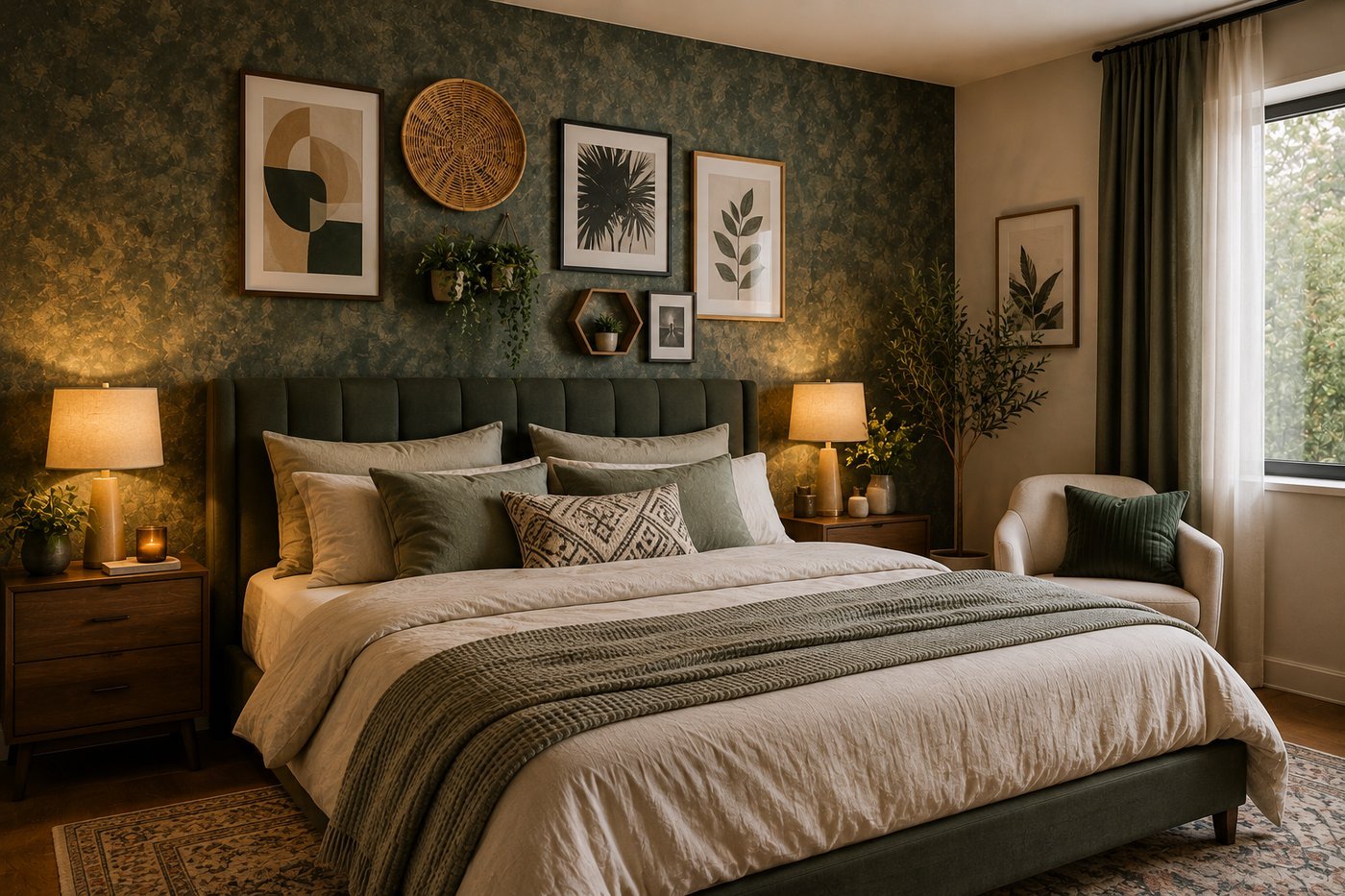
Most people finish a bedroom backwards. The bed gets picked first, then the lamp, then a rug that took three weekends to choose — and somewhere in that process, the walls just get skipped. I’ve walked into client bedrooms where the furniture clearly ate the whole budget and the walls were left to fend for themselves, bare and kind of sulking about it.
None of this needs a contractor or a weekend of chaos to fix. It needs a plan, a little willingness to commit to something, and a sense of which bedroom wall decor choices earn their keep versus which ones just look good in a phone screenshot.
That Blank Wall Isn’t Innocent
An unfinished wall does something sneaky: it drags the whole room down with it, even when everything else is done right.
I once styled a bedroom with beautiful linen bedding and a genuinely great rug, and the whole thing still felt off — because one entire wall was completely bare and kept pulling focus by doing nothing.
There’s a mood angle here too, one that gets skipped in a lot of decorating advice. A bedroom with untouched walls can feel like you’re passing through it rather than living in it — closer to a layover than a home. One deliberate object changes that instantly: a mirror, a small shelf, even a single framed photo you actually chose on purpose.
So it’s not fussy to care about this stuff. You spend more unconscious hours staring at these particular walls than almost any other surface in your home.
Budget Bedroom Wall Decor Tricks
Good bedroom wall decor and an actual design budget don’t have to be the same conversation. Some of my favorite results cost less than a takeout order for two.
Mismatched thrifted frames are a sneaky-good move. Buy five different ones, hit them all with the same spray paint color, and they instantly read as an intentional set instead of five random garage-sale finds thrown together.
Fabric gets slept on constantly. Stretch an interesting textile over a cheap canvas frame, or pin it straight to the wall behind your headboard, and you get texture that a printed poster just can’t fake. Before locking in a full pattern commitment, it’s worth scrolling through affordable pattern inspiration so you don’t end up mid-project regretting the choice.
And don’t sleep on paint doing the job alone. One wall, two or three shades darker than the rest of the room, outperforms three separate purchased art pieces almost every time I’ve tested it.
Wall Decor Mistakes Everyone Makes
Hanging art too high tops the list, by a wide margin. People measure for “standing eye level,” which puts the piece near the ceiling from the one position that matters most — lying down, looking sideways at it.
Going too small is the second-biggest offender. A postage-stamp frame on an oversized wall reads as an afterthought rather than a choice. Proportion beats quantity here; a piece needs real weight relative to the furniture it’s sitting near, not a shrunken presence above it.
Overdoing symmetry is another trap. Matched pairs flanking a bed can look sharp, sure, but a room where every single element mirrors its opposite starts to feel more like a hotel corridor than someone’s actual bedroom. A slightly off-center arrangement reads as more lived-in.
For the actual math behind placement rather than guesswork, there’s a breakdown covering correct picture height worth checking before you drill anything.
Last one: buying decor on day one, before you’ve actually used the room. Give it a week or two of real living first. What the space is missing tends to become obvious fast once you’re sleeping in it instead of just imagining it.
DIY Projects Using Scrap Materials

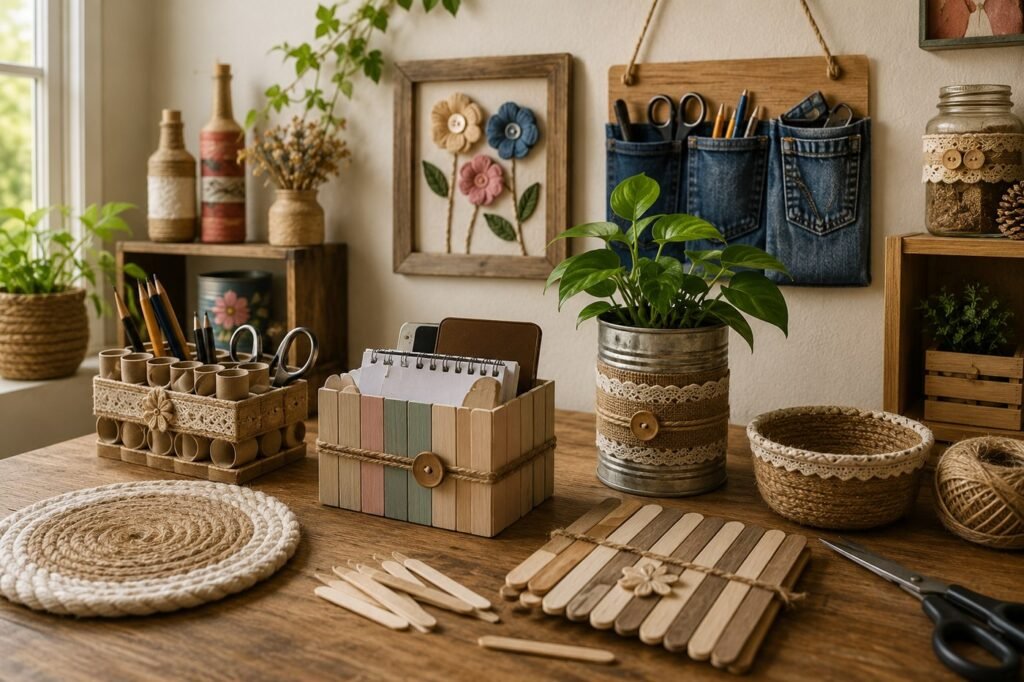
There’s usually more usable material sitting in a garage than most people realize. Leftover wood, cut into uneven lengths and arranged loosely, turns into a geometric wall feature that looks far more deliberate than its cost suggests.
Old fabric stretched over embroidery hoops costs next to nothing and clusters beautifully. Three or five, mixed sizes, slightly staggered — it reads like curated gallery art, not a weekend craft project.
Pressed flowers or leaves in cheap dollar-store frames are another one worth trying. Flatten a few under heavy books for about a week, frame them plainly, and the result feels more personal than anything you’d find on a store shelf.
Even shipping materials have made an appearance in projects I’ve styled — cardboard cut into interesting shapes, painted over, mounted in a loose arrangement. Nobody guesses the source material once it’s on the wall.
Renter-Friendly Wall Decor Tricks
Renting a place doesn’t have to mean living with bare walls for years. Most landlords care about one thing: no permanent damage to drywall or paint when you move out.
Command-style hooks have improved a lot. The heavier-duty versions now hold real weight — small shelves, mirrors, lightweight framed pieces — though it’s smart to check the rated limit before trusting one with anything you’d hate to lose.
Leaning oversized art against a wall instead of hanging it is a trick more renters should use. A large framed piece propped against the baseboard, resting on a low dresser, looks almost more curated than something perfectly centered and hung.
Removable wallpaper technology has also come a long way in a short time. For anyone wondering how well a damage-free wall covering actually performs at move-out, the short version is: quite well, when it’s applied correctly the first time.
Hooks rated for string lights or hanging textiles are another underused option. In my experience they’ve held more weight than the packaging admits, though I’d still stay under the printed limit for anything breakable.
Wallpaper Versus Wall Art
People ask me to pick a side on this constantly, and honestly it has less to do with taste and more to do with how often your mind changes.
Wallpaper is a commitment. That’s not automatically a downside — it can transform a bedroom faster than nearly anything else on this list — but it’s not something you swap out casually every few months. A single statement panel behind the headboard tends to be where most people land eventually, since it makes an impact without covering the whole room.
Wall art moves in the opposite direction. Pieces can rotate between rooms, get resold, get replaced on a whim. It’s a slower way to build a finished look, but it never locks you in.
| Factor | Wallpaper | Wall Art |
| Upfront cost | Moderate to high | Low to moderate |
| Commitment level | High, especially traditional paste types | Low, easy to swap |
| Visual impact | Immediate and bold | Builds up gradually |
| Best for renters | Only peel-and-stick versions | Yes, very adaptable |
| Install effort | Moderate to high | Minimal |
| Lifespan of the look | Years, until redone | However long you want |
For something more immersive than a single accent wall, going with full room coverage creates a completely different atmosphere — closer to a cocoon than an accent. It’s not for every bedroom, but in the right one it’s genuinely striking.
Is Bedroom Wall Decor Worth It
Yes — though not for resale value or anything that belongs on a spreadsheet. It’s worth it because these are the surfaces you spend the most quiet time looking at, full stop.
Compare the hours spent in a bedroom against a living room sometime. It’s not close. And most of that bedroom time, your eyes land on the ceiling or the walls, not the furniture everyone spends so much money agonizing over.
There’s a cost-perception angle too. Thoughtful, cheap bedroom wall decor tends to make an entire room read as pricier than it actually was. I’ve watched budget furniture suddenly look expensive once the walls finally caught up to it.
For a primary bedroom aiming at something more polished, browsing elevated suite styling is a decent starting point before locking in a direction — it gives a clearer sense of what “done” looks like at that tier.
One caveat worth repeating: worth it doesn’t mean expensive. Some of the highest-impact walls I’ve put together cost under fifty dollars, total.
Before And After Wall Makeovers
Those dramatic before-and-after photos aren’t exaggerated for clicks — walls genuinely are one of the highest-impact, lowest-effort changes available in a bedroom.
One project involved swapping three mismatched frames for a single oversized print. That was the entire change. No paint, no new furniture, nothing else touched. The client swore it looked like a different apartment.
A mirror placed across from a window is another classic flip. The room reads twice as large almost instantly, and the light in the space effectively doubles. It’s inexpensive, quick to do, and it photographs well — but more than that, it just feels noticeably better to be in.
Across nearly every dramatic transformation I’ve watched happen, the shift wasn’t about adding more. It was better placement paired with fewer, more decisive choices. People assume the “after” photo means someone spent a lot. Usually the opposite is true — someone cleared out the clutter and let one or two good pieces actually breathe.
Frequently Asked Questions
What’s the cheapest way to decorate bedroom walls?
Thrifted frames, DIY fabric art, and a single painted accent wall are the lowest-cost options that still look genuinely finished.
How high should art hang above a bed?
Roughly six to ten inches above the headboard works best, with the piece sized proportionally to the bed’s width.
Is wallpaper better than paint for a bedroom?
Neither wins outright — wallpaper delivers pattern and texture fast, while paint stays cheaper and easier to change later.
Can renters use wallpaper safely?
Yes, provided it’s a genuine peel-and-stick removable type built not to damage the paint or drywall underneath.
How many pieces of art should go above a bed?
Depends on scale, but one large statement piece or a tight cluster of three usually beats scattered single pieces.
Does bedroom wall decor actually affect mood or sleep?
Many people report feeling calmer in a finished-feeling room, though the effect is personal and varies by taste.
What size art works best for a small bedroom wall?
One medium-to-large piece typically outperforms several smaller ones, which tend to read as clutter in tight rooms.
Should wall decor match the bedding exactly?
Coordinating tones works better than an exact match — matching everything too closely can flatten the whole room.
Conclusion
None of this is really about chasing a trend or spending money you’d rather not spend. Bedroom wall decor is the gap-closer between a room that’s furnished and a room that actually feels like it belongs to you. Walls carry more visual weight than most people give them credit for, and once that clicks, an empty one becomes hard to ignore.
If you’re starting from nothing, don’t rush the process. Spend some real time in the room first, notice what it’s actually missing, and start with one meaningful choice instead of a dozen small ones grabbed in a last-minute panic before guests arrive. Budget isn’t really the obstacle people assume it is — some of the strongest transformations I’ve seen cost almost nothing beyond patience and a clear idea.
Whether that means a bold wallpaper moment, a wall of thrifted frames pulled together with a coat of paint, or something as simple as one well-placed mirror, the underlying goal stays the same: make the walls feel like an actual decision, not something left over after the rest of the budget ran out. Get that part right, and everything else in the room tends to settle into place with far less effort than expected.