

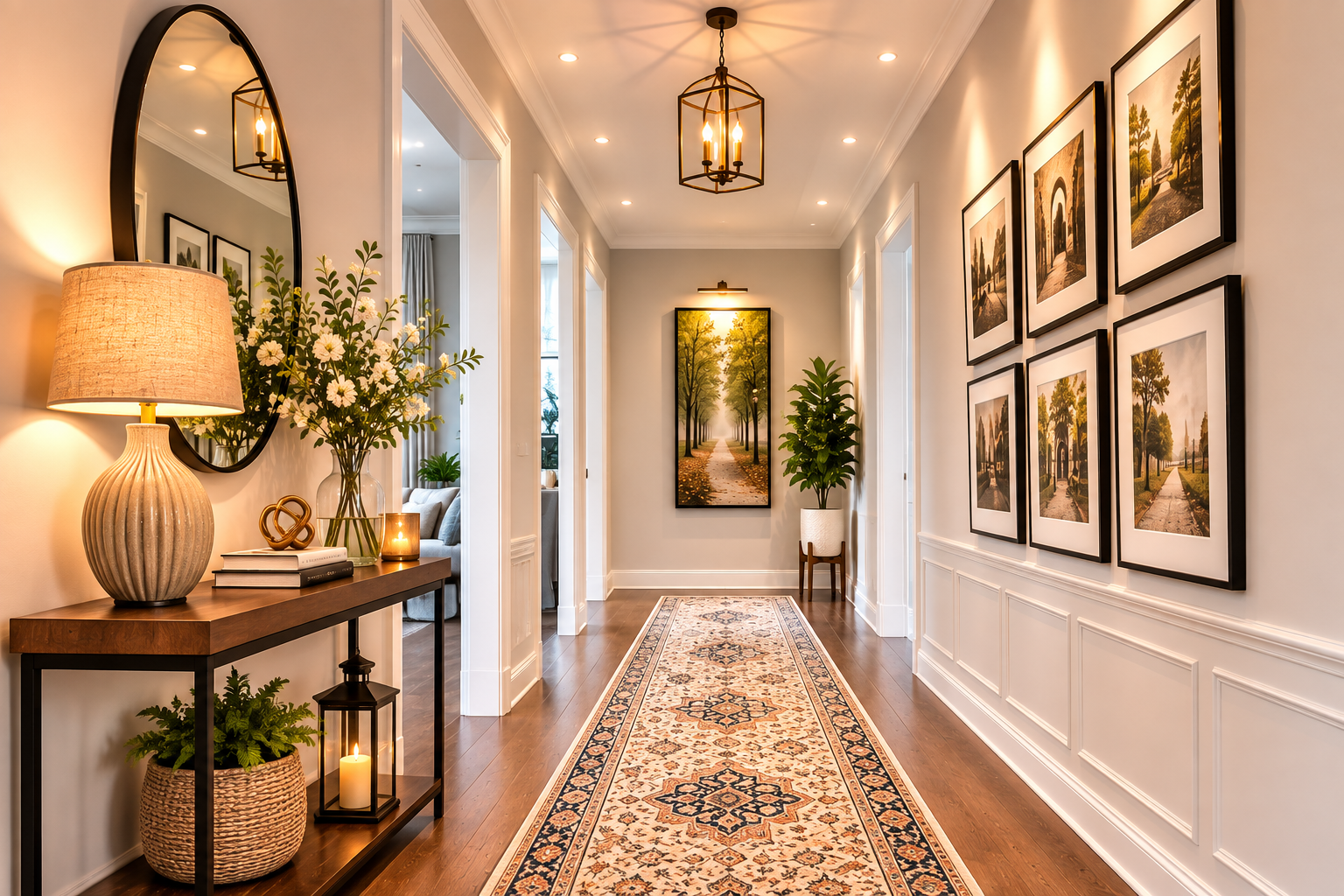
Chai in hand, staring down a fifteen-foot stretch of nothing — that’s basically how most long hallway decor projects start for me. Nobody plans a hallway. It just gets left blank while every other room in the house gets fussed over for months. Long hallway decor, when it finally happens, usually happens by accident, after enough friends walk past that bare wall and say nothing, which somehow says everything.
What follows here isn’t a checklist copied from a catalog. It’s what actually holds up once shoes are being kicked off and kids are sprinting through with backpacks flying — real long hallway decor built around wall art, honest lighting, and a runner that earns its keep, not one staged for a photo.
The Reason Hallways Never Make It Onto Anyone’s To-Do List
Budgets get spent where people linger — sofas, kitchen islands, that one accent chair nobody sits in. A hallway isn’t a lingering space, so it quietly gets skipped, year after year, until it just becomes wallpaper nobody notices.
Funny thing though: it’s the one stretch of the house every visitor is guaranteed to cross. Forgetting it is a bit like polishing your shoes and leaving the laces undone.
Agents who sell houses for a living figured this out long before decorators did. Walk two identical listings and the one with a styled connecting hallway sticks in memory days after the open house ends, while the other blurs into every other showing that week.
Most advice floating around treats hallways like shrunken living rooms. Wrong move. Square footage barely matters in a corridor — steps matter, and how far your eye travels before it lands on something. That one shift changes almost every call you make after it.
Why a Narrow Passage Plays by Its Own Rules
Nobody lingers in a hallway. People move through it, glance sideways, and keep walking — so anything hung there has to register at a glance, not reward slow inspection the way a living room wall might.
Scale gets weird here too. A framed print that looks perfectly proportioned above a sofa can shrink to almost nothing once it’s stranded on fifteen feet of bare wall with nothing around it for context.
Durability matters more than most people admit. Backpacks clip corners, dogs cut turns too sharp, kids treat the space like a runway — anything delicate or jutting too far into the path is living on borrowed time. Good long hallway decor survives that daily traffic without looking fragile.
Rethinking Long Hallway Decor Light Before Anything Else Gets Hung
A single bulb overhead turns any hallway into something closer to a tunnel than a room. Break that one source into several — a run of wall sconces, a dimmer worth actually using — and the whole stretch stops feeling like something to rush through.
People who design these spaces for a living tend to avoid evenly spreading light across the whole hall. Instead they aim brightness toward one specific spot near the far end, which pulls your eye forward the entire length instead of letting it settle halfway. This layered hallway lighting guide walks through exactly how that trick plays out with real fixtures.
Battery picture lights solve a problem nobody wants to pay an electrician for. Stick one above a frame, done — instant warmth, zero wiring headache.
Motion sensors get dismissed as a gadget until the night you’re hauling groceries down a pitch-black hallway and the light just clicks on before you ask. Small thing. Ridiculously useful thing.
Turning Blank Wall Into Something Worth Looking At
A hallway is a gallery that hasn’t been told it’s allowed to act like one yet. Mismatched frames, that one photo from a trip nobody remembers planning, a print you bought on impulse — none of it needs to coordinate.
Spread every frame across the floor first, long before a hammer comes anywhere near the wall. Nudge pieces around until the gaps between them feel right — undoing a nail hole takes a lot more effort than dragging a frame six inches to the left. This hang a gallery wall breakdown handles spacing far better than I can in a couple of sentences.
Anyone wanting a broader plan before committing to one look should skim this explore hallway styling looks page first — worth five minutes before frames start going up.
One loose thread should connect every piece on the wall — a shared color, a repeated subject, similar frame tone. Skip that thread entirely and the wall reads as leftovers instead of a collection, which defeats the whole point of long hallway decor in the first place.
Rugs and Runners That Actually Belong There
A runner rug carries more of this project than almost any single decision after it. Leave a few inches of bare floor visible on either side rather than covering wall to wall, and the whole hallway suddenly reads as designed rather than stumbled into.
Pattern earns its keep here. Plain runners draw attention straight to how far the hallway stretches, while a busy pattern breaks that length up without you consciously noticing why. I lean pattern almost every time, for what it’s worth.
Length trips people up constantly. A runner stopping three feet before the end wall looks like the budget simply ran dry mid-project — finish it or skip it, no middle ground.
Weave matters as much as color choice. Flat weaves shrug off daily foot traffic; plush pile flattens unevenly and sheds within a season once real walking traffic hits it.
A rug pad underneath solves two problems nobody thinks about until they’ve already happened — someone slipping, and the backing wearing thin against hardwood a year in.
A Cheat Sheet for Deciding What to Tackle First
| What You’d Change | Work Involved | Payoff on the Wall | Rough Cost |
| Wall sconces | Medium | High | $$ |
| Gallery wall | Low | High | $ |
| Runner rug | Low | Medium | $$ |
| Wall mirror | Low | High | $$ |
| Floating shelves | Medium | Medium | $$ |
| Fresh paint color | High | High | $ |
Paint and Glass Tricks That Bend How Long It Looks
Dark paint sounds like the riskier move in a tight space, but it usually wins over white by a wide margin. Cover all four walls in one saturated shade and the hallway starts reading as an actual room instead of a gap between doors — scuffs practically vanish into a dark wall in a way they never do against something pale.
A mirror does something paint simply can’t. Hung at the far end and tilted to catch the length of the hall dead-on, it throws light back down the whole corridor and stretches the space beyond anything a measuring tape would ever agree to.
Mid-wall mirrors are a mistake worth naming. They chop the sightline in the wrong spot and confuse the eye instead of extending anything.
For anyone nervous about committing to a full color, painting only the end wall gives nearly the same payoff on a fraction of the risk — a small move that still counts as genuine long hallway decor, minus the four-wall commitment.
Keeping Storage Useful Without Blocking the Path
Consoles under twelve inches deep hug the wall close enough that elbows stay safe walking past. Hooks mounted above handle keys, bags, and a jacket, finally giving that dead stretch near the door an actual job.
Floating shelves pull the same trick higher up the wall. Nothing legs into the walkway — just clean lines and room for books, a plant, whatever needs a home that isn’t the floor.
Baskets tucked under a console hide shoes completely while still looking intentional. That’s really the whole move behind smart long hallway decor storage — function that never announces itself.
Even a narrow bench earns its keep near a door. Somewhere to sit while tying laces, plus hidden storage underneath if the seat happens to lift.
A small tray by the door for keys barely sounds worth mentioning, yet it kills that daily habit of patting down every pocket before leaving the house. Go flush-mounted so it doesn’t steal a single inch from an already narrow path.
Long Hallway Decor Mistakes Worth Naming
Cramming too much in tops the list of long hallway decor mistakes. A console, a bench, and three plants down one narrow hall stops reading as decorated and starts reading as an obstacle course.
Matching frames age faster than people expect. A wall of identical black frames felt sharp a decade back; now it just reads like a hotel corridor rather than a lived-in home.
Bolting lighting on at the very end ruins plans that otherwise worked. Furniture gets picked, art goes up, and lighting gets remembered whenever someone finally notices it exists — the mismatch shows the second the sun goes down.
Rushing every change into one weekend causes the last common slip. A hallway decorated over a few calendar months tends to feel like someone actually lives there; the same hallway finished in one manic weekend tends to feel like a showroom nobody’s moved into yet.
FAQ
What’s the cheapest way to update a long hallway?
Paint wins, no contest. A single coat costs a fraction of any furniture piece, and by Sunday evening the entire mood of the corridor has shifted more than most standalone purchases ever manage.
Should hallway runners match the rest of the house?
Loosely, not exactly. Let the runner nod toward your existing colors without becoming a twin of your living room rug — a touch of contrast reads as more deliberate than a perfect match ever does.
How wide should a hallway runner be?
Aim to leave four to six inches of floor showing on each side. That gap keeps the whole thing looking proportioned instead of like it barely squeezed into the hallway.
Is a gallery wall too busy for a narrow corridor?
Only when the spacing gets sloppy. Cramming frames edge to edge is what causes clutter — leave roughly two inches between pieces and the same wall reads as curated instead.
What lighting works best for a hallway with no windows?
One overhead bulb loses to layered sources every time. Combine a ceiling fixture with sconces or picture lights so nothing single-handedly flattens the whole corridor at once.
Can a mirror really make a hallway look bigger?
It genuinely can. Positioned at the far end instead of halfway down, a mirror sends light back down the hall and adds depth the eye reads as extra length.
Do I need matching frames for hallway wall art?
Not remotely — mismatched frames tend to look more personal and collected anyway. Just keep one loose connector running through the wall, like a repeated tone or subject, so nothing feels random.
What’s a low-effort long hallway decor idea that still looks intentional?
Trade a dull fixture for one with some personality. One afternoon, zero furniture moved, and the hallway reads differently the moment the ladder’s put away.
Conclusion
Count how many times I’ve walked this exact fix through a client’s hallway and you’ll understand why the pattern’s obvious to me now: this stretch of any home ranks among the most underrated, and flipping it from forgettable to worth walking through takes far less than most people assume. No renovation loan needed, no design degree required — a plan, one weekend of real follow-through, and the discipline to actually reach the far wall instead of stalling halfway there.
If the hallway feels flat, start with light — nothing chosen afterward lands properly if nobody can see it clearly. A runner comes next on the list, since almost nothing else turns a bare floor into something deliberate this quickly. Once those two pieces exist, wall art and a mirror slot in naturally, and holding back from cramming all seven ideas into a single weekend genuinely pays off. Spaces built up slowly tend to read better than ones rushed to completion in an exhausting sprint.
None of this really comes down to any single item covered above. It comes down to treating a hallway as a room worth attention on its own terms, not merely a connector between rooms that already get plenty. The moment that stretch of floor starts counting as real square footage instead of leftover space, everything mentioned here stops sounding like extra effort and starts sounding like common sense.
Choose two or three changes from what’s been covered, see them through properly, and let the space sit for a few weeks before deciding what’s next. Most people find out they never needed the entire list at once — the goal was never doing everything simultaneously, just picking the right couple of moves and actually finishing them before anything new gets started.
Get it right and that stretch of hallway becomes the part of the house guests mention on their way out the door, which feels like an odd thing to take pride in until it happens to you and suddenly makes total sense. Deliberate, small choices beat a big budget here every single time, and that’s really the entire point behind everything written above.