

My sister’s backsplash job stalled for a full week two summers back because the plumber walked in, looked at her plaster-over-lath walls, and quietly killed her plan for a wall mounted kitchen faucet before she’d even finished describing what she wanted. Nothing wrong with the fixture.
The wall just wasn’t going to cooperate without an extra day of demo and a cost she hadn’t budgeted for. She went deck mounted instead, and I still think about it, because a wall mounted kitchen faucet would’ve suited that farmhouse sink she chose better than anything else on her shortlist. Nobody warns you about this part going in: the faucet is never the obstacle. What’s hiding inside the wall is.
Say you’re circling a wall mounted kitchen faucet for your own place. You’re picturing the payoff already — a counter that stays clear, a basin that’s easier to wipe down, a look that reads custom instead of catalog. Reasonable. What doesn’t get said enough is how different the showroom version of a wall mounted kitchen faucet is from the version bolted into a house that’s already finished and lived in. I’d rather walk you through both sides than sell you the highlight reel.
What Is a Wall Mounted Kitchen Faucet, Exactly?
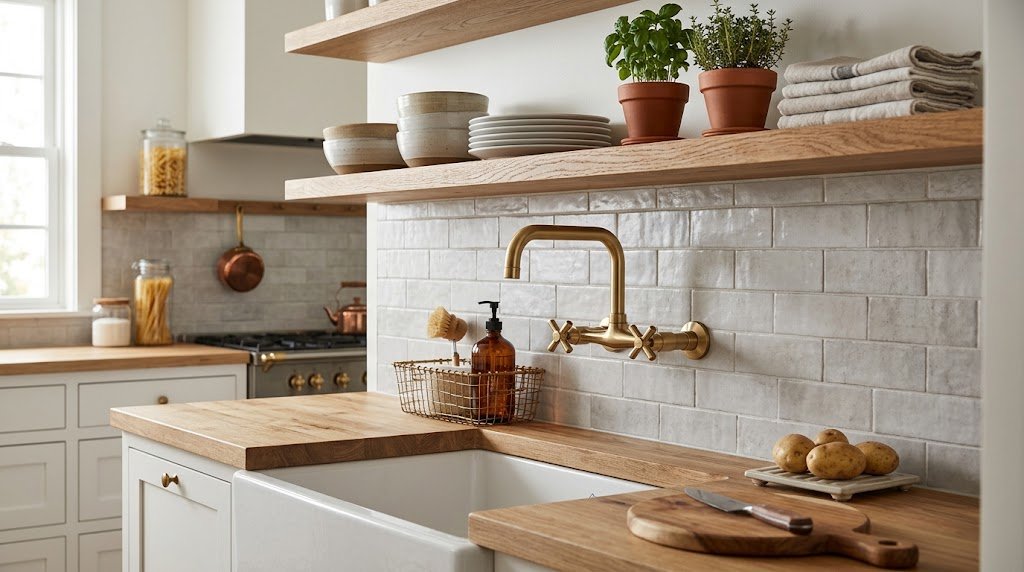
Picture the spout and handles growing straight out of the tile above your sink instead of rising up from the counter — that’s the whole idea behind a wall mounted kitchen faucet. Water supply travels through the wall cavity rather than climbing up through the countertop, and that one swap is what turns a simple faucet job into a small construction project.
Because everything runs behind the wall, the rough-in has to land at an exact height and spacing before tile or drywall ever goes up. Miss that measurement and you’re either tearing into a finished wall again or squinting at a faucet that sits crooked over your sink for years. This isn’t a Saturday-afternoon fixture, and I’d guess a good chunk of people who buy one don’t grasp that until the plumber shows up.
Still, the draw is legitimate. Nothing sits on the counter, nothing pools at a base, nothing collects the grime that builds up where a deck faucet meets the sink deck. If you’ve ever taken a toothbrush to that ring of gunk around a standard faucet base, you already get why people chase a wall mounted kitchen faucet.
Wall Mounted vs. Deck Mounted: Which One Actually Wins?
Calling one option objectively superior would be dishonest — it hinges on your sink, your wall’s construction, and your appetite for spending money you didn’t plan to spend. Laid out next to each other, though, the trade-offs get pretty clear fast.
| Factor | Wall Mounted Kitchen Faucet | Deck Mounted Faucet |
| Counter/sink space | Fully open, easier to clean | Base takes up sink deck room |
| Installation | Requires in-wall rough-in plumbing | Connects through existing counter holes |
| Best for | New builds, full remodels, farmhouse sinks | Faucet swaps, rentals, quick upgrades |
| Typical install cost | $500–$1,500 including plumbing work | $150–$400 for a straightforward swap |
| Repair access | Harder — may involve opening the wall | Easier — accessible from under the sink |
| Visual style | Custom, architectural | Standard, widely available |
Gut-renovating anyway? Then a wall mounted kitchen faucet costs you almost nothing extra in hassle, since the wall’s already torn open regardless. Swapping a tired faucet on a kitchen you’re otherwise leaving alone is a different math problem entirely — you’d be inviting demo work that had no business being on your to-do list this month. That single fact ends the debate for a lot of homeowners long before finishes or handle styles come into it.
Full disclosure: I’ve got a soft spot for pairing a wall mounted kitchen faucet with a farmhouse or apron sink, particularly if a kitchen wall color refresh is happening at the same time — the exposed spout and wall plate stop looking like plumbing and start reading as part of the design. Not many fixtures let their own hardware double as decor.
What Installation Actually Involves
I want to skip the sugarcoating most guides give this step. A wall mounted kitchen faucet behaves more like a shower valve during installation than like a normal faucet — same rough-in mindset, same need to know your wall’s exact thickness and surface material before a single pipe gets set.
Here’s the rhythm of the job, stripped of jargon: water gets shut off and whatever faucet was there before comes out along with its supply lines. Then the wall opens up — sometimes from the kitchen side, sometimes from a closet or room on the other side if the finish material (tile, stone) makes front-access demo a nightmare. New shutoff valves go in at a height and center spacing the manufacturer specifies down to the millimeter, and that number is locked the moment the wall closes back up — no second chances once drywall or tile covers it. If the fixture needs extra bracing, that gets built in now too, since a wall mounted setup absorbs more daily physical stress than something sitting flush on a counter ever does. Only after the wall is patched, finished, and dry does the actual faucet trim go on and connect to those buried valves. Then you test. And you test again a few days later, once normal use has had a chance to shake anything loose.
A plumber worth hiring will insist on measuring off your actual sink rather than a spec sheet, since sink depth swings more than most people assume. Contractor guidance published on JLC makes the case that a wall mounted setup takes rougher daily treatment than a deck faucet does, which is why paying extra for a solid-brass connection beats grabbing the cheapest trim kit on the shelf — a call that matters more here than it would on a standard sink faucet. Get that one detail right and you buy yourself years before you’re back inside that wall chasing a leak.
Homeowners I’ve swapped notes with tend to split two ways on this: hire a licensed plumber outright, or — if genuine rough-in experience is already in the toolbox — handle it themselves. If you’re in that second group, this isn’t a project for a crescent wrench and an evening of video tutorials. You’ll want a level, a stud finder, whatever pipe-cutting or soldering setup your supply line material calls for, and more patience than the job seems to demand at first glance, because rushing the center-distance-and-height step is the one mistake you can’t undo once tile or drywall goes back up.
Access matters more than people expect, too. A basin wrench does fine reaching up under a counter, but working inside a wall cavity for a wall mounted kitchen faucet is a different kind of cramped, especially if the only entry point is straight through the finished kitchen wall. More than one plumber has told me they’d rather cut a hole in a hall closet on the other side than wrestle a wrench through a tight front-facing cavity.
How Much a Wall Mounted Kitchen Faucet Really Costs
Money is usually what settles this decision one way or the other, so here are actual numbers. Swapping a faucet where the plumbing already exists typically lands between $300 and $800, labor included. Add a wall mounted kitchen faucet into the mix — meaning new supply lines threaded inside the wall — and that range climbs to roughly $500 to $1,500 once you factor in opening the wall, doing the rough-in, and putting everything back together, based on cost breakdowns from Bob Vila. If a permit’s required for the plumbing change in your city, budget another $50 to $500 on top of that.
Here’s the part people get wrong: the faucet itself barely moves the needle on total cost. Entry-level wall mounted models start close to $100, and you can land something genuinely functional in the $150 to $300 range without much searching. The real spend is in labor and wall work, not the hardware hanging on your wall. If a contractor’s quote for wall mounted kitchen faucet work comes in suspiciously low, ask flat out whether it covers opening and re-finishing the wall — that’s where a bargain quote usually falls apart once the job’s underway.
One honest caveat: these numbers move with region and with time, so treat them as a starting point for the conversation with your own plumber rather than a locked figure, and double-check current pricing whenever you’re actually budgeting for this.
The Height and Reach Problem Nobody Warns You About
More DIY installs get tripped up here than anywhere else in this whole process. There’s no single correct height for a wall mounted kitchen faucet across every kitchen — it shifts with sink depth, counter thickness, and how the spout itself is shaped. A few hard limits do exist, though, and you can’t design around them.
Code sets a floor of roughly one inch of air gap between the bottom of the spout and the sink’s flood rim, though most installers leave more room than that in practice — kitchen basins run deeper than bathroom ones, so a height built for a bathroom faucet will sit uncomfortably low over a kitchen sink. Mount it too high and every use sends water splashing off at an angle you didn’t account for. Mount it too low and you’ve lost the clearance to slide a stockpot underneath, which undercuts the entire reason you have a kitchen faucet in the first place.
Installation guidance summarized by Hunker backs this up: measure off the sink you’re actually installing, not a generic spec sheet, because depth and counter thickness vary enough between models that “standard” heights rarely fit as advertised. One thing I’d tack onto that from firsthand experience — factor in the spout’s curve, not just its mounting point, since a gooseneck adds several inches of drop that a straight spout simply doesn’t have.
Reach counts just as much as height does. A short spout paired with a wide sink turns every rinse into an awkward lean toward the far corner. Most wall mounted kitchen faucet models land somewhere between 8 and 12 inches of reach, and anyone with a large single-basin or farmhouse sink should lean toward the longer end of that range without hesitation.
Finishes, Styles, and Handle Types Worth Considering
Once the plumbing decisions are locked, this is where the project turns fun again. A wall mounted kitchen faucet comes in enough finish and configuration combinations that it genuinely reshapes the personality of the wall around your sink, not just the faucet itself.
Matte black and unlacquered brass keep coming up in requests I see right now, mostly because they read as a choice rather than a default — chrome and brushed nickel still move plenty of units, they just tend to disappear into the background instead of standing out. Kitchens already leaning warm, with wood tones or wall cabinets in a natural finish, tend to suit unlacquered brass especially well, since it patinas into the space over years instead of staying frozen at showroom-new.
Handle setup deserves its own thought, too. A single-handle wall mounted kitchen faucet keeps the wall plate uncluttered and stays operable with one hand full of a dirty pot — a bigger deal in daily use than it sounds on paper. Cross-handle or lever-handle designs with separate hot and cold controls lean more traditional and fit farmhouse kitchens especially well, though they do require two separate valve connections behind the wall instead of one, which nudges the rough-in slightly more complex.
Spout shape splits into two camps: straight and gooseneck. Straight reads clean and architectural, at home in a modern kitchen. Gooseneck arches higher, genuinely useful if tall stockpots are a regular part of your cooking, but it also shifts your height math from the section above — settle on the spout shape before anyone finalizes your rough-in height, not after.
Where a Wall Mounted Faucet Makes the Most Sense
Not every kitchen calls for a wall mounted kitchen faucet, and I say that despite genuinely liking them. This fixture earns its complexity and cost in a handful of specific setups.
Farmhouse and apron-front sinks are the clearest case by far. They sit further forward on the counter than a standard sink, which leaves a deck-mounted faucet stuck at an awkward reach or crammed onto a narrow ledge that barely fits its base. Moving the faucet to the wall erases that geometry headache entirely, and the result usually looks like it was designed that way from day one rather than bolted on as a fix.
Vessel-style prep sinks and butler’s pantries fit the bill too, especially where counter real estate is already scarce and every inch is spoken for. Reworking nearby storage at the same time — say, hanging open shelving above the sink — pairs naturally with a wall mounted faucet, since there’s no bulky base cluttering a zone that’s already doing a lot of visual work.
Where I’d talk someone out of it: a plain undermount sink in a kitchen that isn’t getting touched otherwise. The math doesn’t work if opening a finished wall is the only reason you’re doing it. Shelve the wall mounted kitchen faucet idea until a renovation you’re already planning has the wall open anyway.
There’s a middle case worth naming, too — kitchens with a window sitting right above the sink. A tall gooseneck deck faucet can crowd that sill or block part of the view, and pull-down sprayers need swing room a window ledge doesn’t always give. Shifting the faucet to the wall, usually positioned just under the window’s bottom frame, frees that whole sill for plants or whatever else deserves the spot. I’ve watched that single detail push people who were on the fence into finally choosing a wall mounted kitchen faucet.
Which Brands Actually Hold Up
I’d rather not turn this into a sponsored list, but a few names surface often enough in plumber conversations that skipping them would be leaving out useful information. Kohler and Moen both build solid wall mounted kitchen faucet lines with parts that are easy to track down years later — worth caring about, since a faucet with hard-to-source cartridges turns a quick fix into a weeks-long wait.
Rohl and Waterworks sit higher on the price ladder and show up disproportionately in farmhouse kitchens, largely because their spout geometry looks purpose-built for apron sinks rather than borrowed from a standard faucet line. The premium shows in the fit. On the more budget-friendly side, Kraus and Peerless both put out wall mounted options that get the job done without draining the renovation fund — though I’d still insist on a solid-brass connection behind the wall no matter whose trim ends up on the front.
Whatever name you land on, ask two things before handing over your card: how easy will replacement cartridges be to find in five or ten years, and does the spout’s reach and height actually suit the sink you own or plan to install. A stunning faucet that fights your sink’s dimensions was never really a good deal, price tag aside.
Is a Wall Mounted Kitchen Faucet Worth It for Resale?
This question comes up constantly from people eyeing a sale in the next few years, and the honest answer is: it depends on the market, but it rarely tanks a deal either direction. In higher-end listings — especially ones already built around a farmhouse sink — a wall mounted kitchen faucet reads as intentional rather than odd, and buyers shopping that bracket tend to expect this level of finish detail already.
In a more modest or entry-level market, don’t count on a wall mounted kitchen faucet shifting offer prices much at all. Buyers browsing that tier are weighing roof age, HVAC condition, and total square footage long before faucet placement even registers. None of that means it hurts you — it just means the math works out best when you’re installing it because you actually want it, not as a last-minute value play before listing.
Where it does pull weight, no matter the price bracket, is in photos. An open, uncluttered sink area photographs better than one with a bulky base in the frame, and in a market where buyers scroll through dozens of kitchen shots before ever scheduling a walkthrough, that small visual edge quietly matters more than people give it credit for.
Mistakes People Make With Wall Mounted Faucets
The same handful of mistakes keeps resurfacing on wall mounted kitchen faucet jobs, and nearly all of them trace back to skipping steps during planning.
Trusting a spec sheet over the actual sink tops the list. Sink depth can swing by a couple of inches between models, and that gap alone is enough to throw the spout height off in a way you’ll notice every day. Measure the real sink — or its exact dimensions at minimum — before anyone sets the rough-in valves.
Cutting corners on the solid-brass connection to save a little money is a close second, and it’s the one that costs people the most down the line. A wall mounted fixture absorbs more mechanical stress than a deck faucet, since the full weight of daily use pulls on a joint buried inside the wall rather than resting flush on a counter. A cheap connector there eventually means cutting into a finished wall to fix a leak, and that repair costs far more than whatever was saved buying it.
Forgetting to lock in the spout shape before the rough-in height gets set rounds out the top three. Worth repeating because it’s so easy to overlook — a gooseneck spout drops several inches lower than a straight one, and setting the rough-in ahead of picking the actual faucet risks a spout that hangs too low over your sink once everything’s installed.
One smaller but genuinely annoying mistake: picking a finish that clashes with the rest of your kitchen hardware. Sounds purely cosmetic until you’re staring at brushed nickel cabinet pulls beside a matte black faucet for the next decade. Choose the faucet finish in the same breath as your other hardware, not as an afterthought once everything else is already locked.
Keeping It Working: Maintenance and Care
Day to day, a wall mounted kitchen faucet doesn’t demand more upkeep than a standard one — what’s different is the stakes when something small goes wrong, since a leak hiding behind the wall won’t announce itself the way a leak under an open sink cabinet would.
Wipe the wall plate and spout down regularly with something soft, especially on matte or unlacquered finishes, which show water spots more readily than chrome ever does. Skip abrasive cleaners entirely on brass or black finishes — they’ll dull the surface faster than soap and water ever would.
Give the connection point where faucet meets wall a look every few months, checking for any hint of moisture or discoloration on the nearby wall or backsplash. Because those supply lines are hidden, a small drip can go undetected for a stretch and cause real damage before it ever becomes visible at the faucet itself. Treat even a faint water stain near a wall mounted kitchen faucet as urgent, not as something to note and forget.
Cartridges and valves inside eventually wear out like they would on any faucet, but on most current designs, reaching them means pulling the trim rather than tearing into the wall — worth confirming for your specific model before purchase, since older or custom units sometimes demand more invasive access than that.
Water pressure quirks are worth mentioning too. Because supply lines for a wall mounted kitchen faucet take a different path than a typical under-sink hookup, sudden pressure shifts — a washing machine kicking on elsewhere in the house, say — can register more noticeably at the tap. Not a flaw, just a side effect of the layout, and it rarely matters unless your home’s water pressure was inconsistent to begin with.
How to Choose the Right One for Your Kitchen
Choosing a wall mounted kitchen faucet starts with the sink, not the catalog. Depth, basin width, and whether you’re working with a farmhouse or standard undermount style will narrow your spout length and height options before finish even enters the conversation.
Next, take an honest look at your wall. Already open for a remodel? Cost stops driving the decision and style takes the wheel. Finished and would only open for this one fixture? Weigh that against a deck-mounted option that delivers most of the visual payoff for a fraction of the disruption.
Budget for the whole picture — labor and possible wall repair, not just the sticker price of the faucet itself. A $150 fixture sitting on top of $1,000 in wall work is still an $1,150 project, and going in aware of that full number beats getting blindsided by it halfway through. Still gathering styling inspiration for the rest of the room? Do that now, before the plumber locks in the rough-in — the faucet’s finish and spout shape genuinely shape decisions you’ll make about hardware and lighting elsewhere in the kitchen.
And if you’re already deep into planning everything else — flooring, wall decor, cabinet hardware — settle on the faucet finish in that same pass instead of treating it as an afterthought. It’s a small fixture, sure, but it sits at eye level over your sink more than almost anything else in the room, and a mismatched finish is the kind of thing you notice every single day once you’ve spotted it once.
FAQs
Is a wall mounted kitchen faucet harder to install than a regular one?
Yes, by a meaningful margin. It needs in-wall rough-in plumbing set at an exact height and spacing before the wall closes, which is a fundamentally different job than connecting a faucet through counter holes that already exist.
How much does a wall mounted kitchen faucet cost compared to a standard one?
The faucet itself lands in roughly the same $100 to $800 range depending on finish and brand. The gap in total cost comes from installation — opening a wall for new plumbing can push the full project to $500–$1,500, versus a few hundred dollars for a simple swap.
Can I put a wall mounted kitchen faucet over any sink?
Technically, yes, but it fits best over farmhouse, apron-front, or vessel-style sinks where the geometry naturally works with a wall-fed spout. Over a plain undermount sink, it’s usually more disruption than the payoff justifies unless the wall’s already open for other reasons.
Do wall mounted kitchen faucets leak more than deck faucets?
Not by nature, but because the connections live inside the wall, a leak is harder to catch early and costlier to fix once it’s found. Going with solid-brass connections and checking the surrounding wall periodically cuts that risk down considerably.
What height should a wall mounted kitchen faucet be set at?
No single number works for every kitchen — it depends on sink depth and spout shape. Code sets a minimum one-inch air gap above the sink’s flood rim, but most kitchens end up needing more clearance than that to comfortably fit pots underneath.
Final Thoughts
Coming back around to where this started: I still land in the same spot I did while standing in my sister’s half-torn-apart kitchen. A wall mounted kitchen faucet is a genuinely strong choice, but only under the right conditions. Walls already open for a remodel, or a new build from scratch — there’s barely a reason to skip one, especially alongside a farmhouse or apron sink where form and function line up almost too neatly. Open counter space, a cleaner visual line, an easier wipe-down around the whole sink zone — those aren’t showroom talking points, they’re benefits you’ll actually feel every week.
Where I’d hit the brakes is the retrofit scenario. Tearing open a finished wall purely to chase this look costs real money, and it’s exactly the kind of project that uncovers extra problems the second the wall comes down — old plumbing, sketchy wiring, insulation nobody’s touched in decades. None of that rules out a wall mounted kitchen faucet forever. It just argues for timing it alongside a renovation you’re already committed to, rather than treating it as a standalone weekend project.
If you do move forward, two decisions carry more weight than everything else combined: getting height and spout reach right before the wall closes for good, and refusing to cheap out on the connection hardware hidden behind it. Everything past that — finish, handle style, brand — really is down to personal taste, and there’s no wrong pick among the solid options out there. Just don’t let finish decisions get made before the measuring happens; that order, reversed, causes more regret than nearly anything else in this whole process.
My honest take, for what it’s worth: measure against your actual sink more than once, spend the extra money on solid brass where the wall will hide the connection anyway, and choose your finish alongside the rest of your kitchen hardware so it never feels like it wandered in from a different room. Get that right, and a wall mounted kitchen faucet becomes one of those upgrades you stop consciously noticing — which, for a kitchen fixture, might be the best compliment it can earn. Mid-renovation and juggling a dozen other decisions? Sit down with your contractor and map out the entire wall — plumbing, finish, everything — before a single pipe gets cut.