

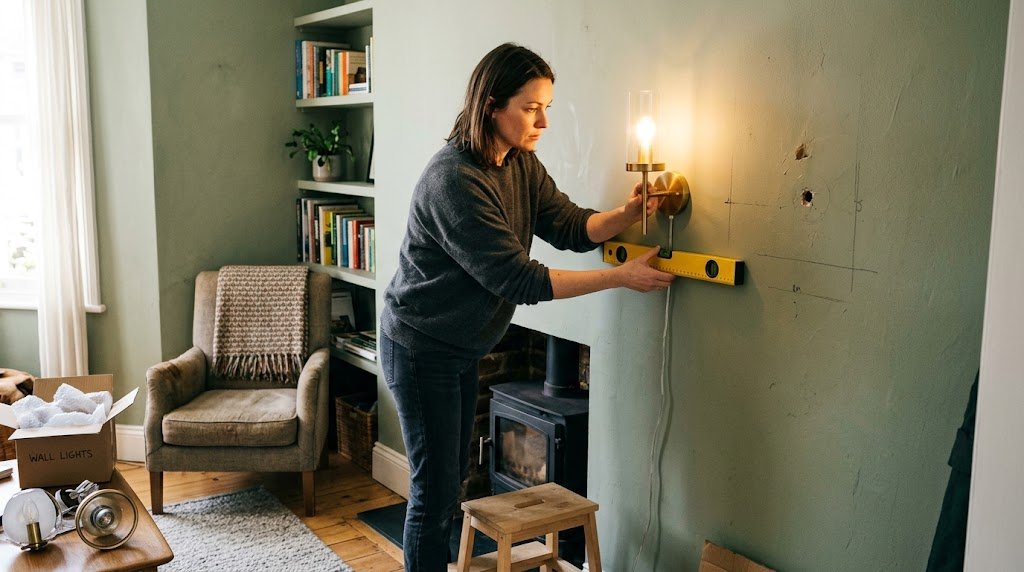
Three sconces went back to the store before I kept the fourth one. Not because they were badly made — I just kept holding each one against my wall and something felt off every time. That’s the trap with living room wall lights specifically: they photograph beautifully online, and then the moment one’s actually screwed into your drywall, a dozen small details start mattering that nobody warned you about.
Height, spacing, bulb color, whether you even need an electrician — none of it feels obvious until you’re standing there holding living room wall lights up to the wall with a level in your other hand. I want to go through the parts that actually trip people up when it comes to living room wall lights: which fixture type fits which room, where they belong, what they cost once labor gets involved, and whether they can stand in for your main light source. Some of this is from researching installer pricing. Some of it’s from my own trial and error.
The Different Types of Living Room Wall Lights, and Why It Matters
“Wall light” covers a lot of ground, which is probably why shopping for living room wall lights feels confusing at first. For a living room specifically, you’re really choosing among a handful of distinct categories, and each does a different job.
Hardwired sconces connect straight into your home’s electrical system and switch on from the wall. This is the traditional style of living room wall lights — arm and shade, or a fully enclosed fixture, wired directly into the circuit.
Plug-in fixtures look nearly identical from the front, but a cord runs to a nearby outlet instead of tying into house wiring. A lot of people route the cord through a paintable channel so these living room wall lights blend into the wall color.
Picture lights are narrow and angled, mounted above a frame to wash light downward across the art. As a category of living room wall lights, they’re more mood piece than functional source — don’t expect one to brighten a whole corner.
Wall-wash LEDs sit flatter and spread light across a broader stretch of wall rather than standing out as an object. Used as living room wall lights behind a media console or along a TV wall, this low-profile option avoids competing visually with the screen.
Rechargeable sconces are the newest entrant, and probably the easiest living room wall lights for renters — no cord, no wiring, mounted with adhesive, recharged every so often.
Before buying living room wall lights, be honest about the job you need done. Decorative accent, or something you’ll actually read by? Picture lights and wall washers lean decorative. A hardwired sconce with a diffusing shade can genuinely function as reading light. Asking one fixture to cover both jobs is usually where people end up a little disappointed.
| Fixture Type | Install Method | Typical Fixture Cost | Best For |
| Hardwired sconce | Wired into electrical system | $30–$300+ | Flanking a fireplace or sofa |
| Plug-in sconce | Outlet + cord channel | $30–$150 | Renters, quick swaps |
| Picture light | Hardwired or plug-in | $50–$200 | Framed art, gallery walls |
| LED wall wash | Low-voltage hardwired | $40–$250 | TV walls, media consoles |
| Rechargeable sconce | Adhesive, battery-run | $30–$120 | Temporary setups, dorms |
Height Isn’t One Number — Here’s the Actual Range for Living Room Wall Lights
This is the part that ate my whole weekend. There’s no single “correct” measurement for living room wall lights, just a workable range that shifts depending on the job.
For general ambient glow, most placement guidance puts the center of living room wall lights somewhere between 60 and 72 inches off the floor — close enough to standing eye level that it reads as balanced instead of stranded too high or too low. One detailed room-by-room breakdown pushes toward the top of that window for shared living spaces, so a taller guest doesn’t clip the fixture walking past — a detail I only picked up after reading this sconce height guide.
Mounting living room wall lights near a mirror or artwork changes the math slightly. Aim closer to eye level for whoever’s likely standing near it, and if you’re hanging a pair, keep the spacing identical — 28 to 36 inches center-to-center usually keeps the light pools from crossing awkwardly.
The Fireplace-Flanking Setup
This layout shows up constantly, and there’s a reason — living room wall lights on either side of a mantel are symmetrical, flattering, and fill wall space that would otherwise sit empty. Measure from the floor with an actual tape measure. My first pair came out nearly two inches uneven, and it bothered me every evening until I fixed it.
Watch ceiling clearance too. Mount living room wall lights too close to crown molding and the light just bounces off it without reaching anyone sitting below. A fixture placed slightly “wrong” by the rulebook but actually doing its job beats one that’s perfectly measured and useless.
Planning something bigger first — new paint, a rearranged layout, maybe an accent wall behind the couch? Handle the wall treatment before committing to where your living room wall lights go. I’ve watched people mount fixtures first, only to find the spacing looked wrong once wallpaper went up around them.
What Living Room Wall Lights Actually Cost, Once Labor’s Factored In
This is usually where the enthusiasm quietly fades. With living room wall lights, the fixture price is rarely the expensive part.
Hardwired installation mostly pays for an electrician’s hours, not the fixture itself. Rates generally run $50 to $150 an hour, and swapping an existing fixture — where wiring’s already there — takes one to three hours. That lands most single living room wall lights jobs in the $100 to $450 range, a figure that matches what this breakdown of sconce types and installation costs found across several installers.
Add a brand-new location with no existing wiring, though, and costs for living room wall lights climb quickly. Cutting drywall, running fresh wire, patching, repainting, sometimes pulling a permit — a single new install can pass $300, and a pair often lands around $600 to $900 once everything’s added up. Get an actual quote before locking in a layout that needs new circuits run.
Plug-in living room wall lights skip almost all of that. You’re buying the fixture — typically $30 to $150 — maybe a cord channel, and you’re done. No electrician, no scheduling, no drywall repair. The downside is you’re limited to wherever your outlets already sit, and even a well-hidden cord rarely looks as clean as flush-mounted living room wall lights. Still, for renters or anyone testing the idea before committing to wiring, it’s the lower-risk starting point.
Can Living Room Wall Lights Replace Your Ceiling Fixture?
Mostly not on their own, and I’d push back on anyone who tells you otherwise.
Designers generally treat living room wall lights as secondary lighting — good for softening shadows, adding warmth in the evening, dressing up a bare stretch of wall. What they typically can’t do well is provide enough consistent brightness for actual tasks: reading across the room, or a gathering where everyone needs to see each other’s faces clearly.
Smaller rooms with lower ceilings are the exception. A few well-placed living room wall lights paired with a lamp or two can genuinely cover a compact space without a ceiling light doing much work at all. I ran a small apartment living room that way for close to a year — two sconces near the window, one floor lamp in the corner, ceiling fixture basically ornamental. It worked fine, but that room was under 200 square feet. I wouldn’t try the same setup in a bigger space without another light source somewhere.
Think of it in layers instead: overhead light for general brightness, lamps for task zones, and living room wall lights for the ambient layer that ties the room together. Drop any one layer and the room tends to swing too flat and bright, or too dim, with not much comfortable middle ground.
The Bulb Color Detail Almost Everyone Skips
This gets overlooked more than the shape of the fixture ever does, and it changes the room’s feel more too — even for living room wall lights that are otherwise perfectly placed.
Bulb color is measured in Kelvin, and for living rooms the range that keeps showing up in lighting guides is 2700K to 3000K — warm and slightly golden, closer to old incandescent light than anything office-like. A Kelvin breakdown by room from Feit lays this out clearly. Push past roughly 3500K and living room wall lights start reading cooler and more clinical — fine above a kitchen sink, wrong for a room built for unwinding.
I got this wrong myself. Installed a pair of living room wall lights, grabbed whatever bulbs were sitting in a kitchen drawer, and they turned out to be 4000K leftovers from a bathroom fixture. For close to two weeks my living room looked like a dentist’s waiting room in the evening before I finally noticed and swapped them. Small fix, noticeable difference. On a dimmer, warm bulbs get cozier as you lower them; cool bulbs in living room wall lights tend to just look murky instead.
Small Rooms Need Their Own Rules
Most advice assumes a generous wall with plenty of clearance. Smaller living rooms don’t always follow that same logic when it comes to living room wall lights.
A large sconce can visually crowd a tight wall, making the room feel more boxed-in rather than more finished. Go smaller here — slim, low-profile living room wall lights instead of anything projecting six or eight inches off the wall. That clearance matters when people are walking past it daily.
Placement gets less forgiving too. Living room wall lights near a doorway, mounted below the usual 60-inch mark, become something people actually bump into in a tight room. Lean toward the higher end of the range even if it looks slightly off-proportion on paper. Function wins over textbook measurement once space is tight.
Matching Living Room Wall Lights to Your Layout
A handful of setups come up over and over, and each calls for a slightly different choice of living room wall lights:
- Behind or beside a television — low-profile LED washes or slim linear strips work better than a bulky sconce, since nothing should visually compete with the screen. Worth checking TV wall ideas before finalizing where your living room wall lights go, since the two choices affect each other.
- Flanking a bookshelf or built-in — narrow living room wall lights mounted at shelf height rather than standard eye level can highlight the shelving itself, almost like a small gallery setup.
- Above a console or credenza — either one centered piece or a symmetrical pair, mounted slightly higher than flanking height since there’s no seated sightline to account for.
- Along a bare accent wall — this is where living room wall lights can become the actual focal point, especially with wallpaper or a textured finish behind them, carrying a wall that would otherwise need artwork.
Still figuring out the room as a whole rather than just the lighting piece? Browsing living room wall decor or general wall ideas can help decide whether your living room wall lights should lead the wall or just support everything else on it. Leaning traditional, or wanting something close to a reading-lamp substitute near the sofa? Worth checking dedicated wall sconces for the living room styles before deciding.
One opinion I’ll stand behind: don’t force every wall in the room to match exactly. Living room wall lights over the fireplace, a different picture light by the bookshelf, a third style near the TV — that combination still works if one detail ties them together, like matching brass or matching black hardware. Forcing total uniformity across every fixture tends to read like a showroom display rather than somewhere people actually live.
Frequently Asked Questions
Do living room wall lights need an electrician?
Only if you go hardwired. Plug-in and rechargeable living room wall lights skip wiring entirely and work well for renters.
What’s the right mounting height?
Generally 60 to 72 inches from floor to fixture center, leaning higher in busy shared rooms.
Can living room wall lights be the only light source in the room?
Sometimes, in compact rooms under roughly 200 square feet. Larger rooms usually still need a lamp or ceiling light too.
What bulb color should I use?
Stay within 2700K to 3000K for a warm, relaxed glow — higher than that starts feeling clinical.
What’s a realistic cost for installing a hardwired pair?
Roughly $300 to $900 total depending on whether wiring already exists, on top of the fixtures themselves.
Final Thoughts
None of this needs to be complicated once it’s broken apart — match your living room wall lights to the actual job you need them to do, get the height measured rather than guessed, and don’t skip the bulb-color decision because it seems trivial. It isn’t. Hardwired versus plug-in mostly comes down to budget and how permanent you want the setup, and there’s no wrong side to land on.
Take the extra hour to hold the fixture up and step back before you commit to drilling. It saves you from doing it twice.