


If you’ve ever stood in your hallway wondering why it feels like leftover space instead of an actual room, you’re not alone. Good hallway decor ideas aren’t about cramming in furniture — they’re about small, deliberate choices that make a narrow stretch feel intentional.
This piece walks through eight ideas that hold up in real homes, not just in photos where the light is perfect and nobody’s shoes are lying around. Some need a weekend. Some need an hour and a nail. Either way, these hallway decor ideas will get your hallway noticed, maybe for the first time in years, with a bit of entryway styling, smarter wall art placement, and better lighting fixtures doing the heavy lifting.
1. Hallway Decor Ideas Begin With Better Lighting, Not More Stuff
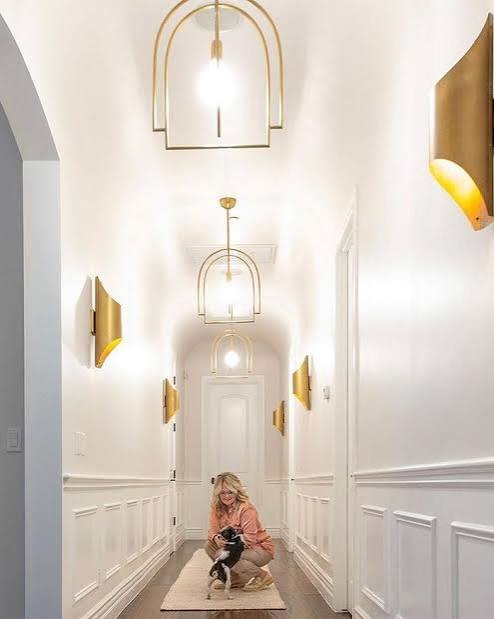
Here’s the thing nobody tells you: most hallways are dark because builders treat them as an afterthought. One overhead bulb, usually the wrong temperature, doing all the work. Fix that first, before you buy a single frame.
Warm white bulbs, somewhere around 2700K, make a corridor feel welcoming instead of clinical. Layer in a wall sconce or two if the ceiling height allows it. Sconces throw light sideways, which softens shadows and makes the walls themselves feel like part of the design instead of just boundaries.
I’ve seen people spend hundreds on art for a hallway that was still gloomy afterward, because the lighting never changed. Swap the bulb before you swap anything else. It’s the cheapest fix on this entire list, and it’s the one people notice without knowing why.
Dimmers are worth the extra twenty minutes of install time too. A hallway doesn’t need to blast full brightness at 11pm when someone’s shuffling to the kitchen for water, and a dimmer switch lets you dial that down without fumbling for a lamp that isn’t there. Motion-sensor fixtures solve a similar problem for anyone tired of flipping switches with an armful of groceries — they’re not glamorous, but they’re the kind of upgrade you stop noticing because it just works.
If your hallway has a stretch longer than about eight feet, one fixture in the middle usually isn’t enough anyway. Spacing two smaller fixtures along the length does more for evenness than one bright bulb trying to cover the whole run. Uneven lighting, with bright pools and dark gaps between them, often looks worse than dim-but-consistent light across the board.
2. Paint Color Does More Work Than People Realize
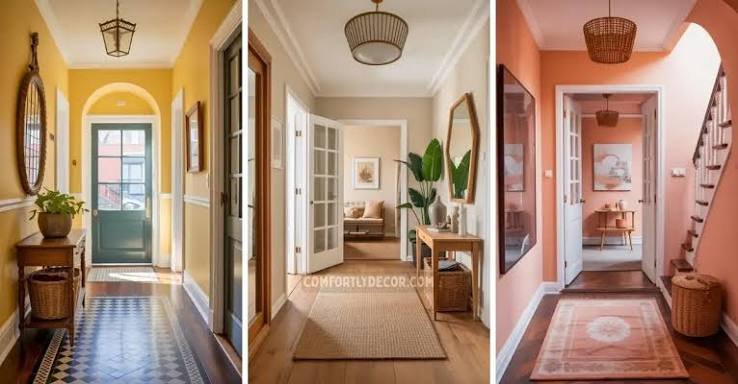
A hallway’s walls are basically one giant canvas, and most of us waste it on builder-grade white. That’s not a crime, but it’s a missed opportunity.
Lighter shades genuinely do make narrow spaces feel roomier — that part isn’t just decorating folklore, it’s about how light bounces around a tight corridor. Warm neutrals or soft grays tend to outperform stark white because they don’t show scuffs the same way, and busy hallways collect scuffs fast.
If you want a shortcut instead of standing in a paint aisle for an hour, Sherwin-Williams put together an official hallway color guide that breaks colors down by how much natural light your space gets. Worth a look before you commit to a gallon.
| Color Family | Best For | Mood It Creates |
| Warm white / cream | Windowless hallways | Bright, open, calm |
| Soft gray | High-traffic entries | Sophisticated, low-maintenance |
| Muted blue | North-facing corridors | Tranquil, cool |
| Deep charcoal (one wall) | Wide hallways | Dramatic, cozy |
| Blush or dusty pink | Small entryways | Warm, unexpectedly neutral |
One trick worth stealing: paint just one wall a darker shade while keeping the rest light. It adds depth without swallowing the whole space in shadow, and it costs about the same as painting the entire hallway one flat color.
Finish matters as much as color, maybe more, in a corridor this size. Flat paint looks nice in photos but shows every scuff within a month of foot traffic and stray backpacks brushing against it. Satin or eggshell wipes clean without the shine of full gloss, which tends to highlight every dent and imperfection in the drywall underneath. It’s a small technical detail that almost nobody mentions, and it’s the reason some freshly painted hallways still look tired within a season.
Testing color in the actual hallway, not just on a swatch card under store lighting, saves a lot of regret too. Paint a section roughly two feet wide near the darkest part of the corridor and live with it for a couple of days before committing to gallons. Colors shift more under hallway lighting conditions than almost anywhere else in a house, since there’s rarely a window offering a second opinion.
3. A Runner Rug Can Rescue an Awkward Floor
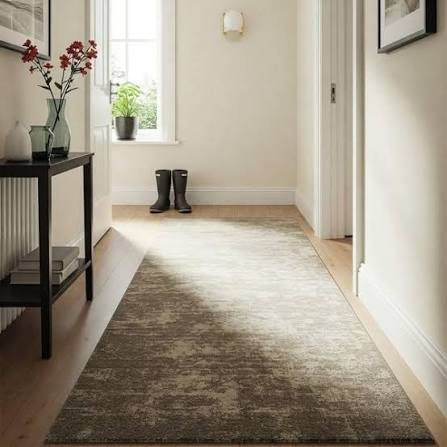
Hallway floors take a beating. Shoes, pets, dropped grocery bags — it’s the most abused flooring in most houses, and it usually looks it.
A runner rug solves two problems at once. It protects the floor, and it adds texture in a space that’s otherwise just walls and a ceiling. Go with something low-pile if the hallway gets heavy foot traffic; anything shaggy turns into a tripping hazard within a month.
Pattern helps more than people expect. A busy runner hides dirt between cleanings far better than a solid color does, which matters a lot if this is the path from the front door to the kitchen. Measure twice, though — a runner that’s too narrow for the hallway looks like an accident, not a design choice.
Leave a border of visible floor on either side, roughly four to six inches if the hallway width allows it. A runner that stretches wall to wall looks like carpet installed slightly wrong, while one with breathing room on both sides reads as an intentional layer added on top of the floor. Non-slip backing isn’t optional either, especially on hardwood, since a runner that slides underfoot in a narrow walkway is more of a hazard than most people account for until someone actually trips on it.
Material choice depends heavily on the household. Wool blends handle heavy traffic and hide wear for years, though they cost more upfront. Flat-weave cotton runners are cheaper and machine-washable in some cases, which matters a lot if there are kids, muddy dogs, or both tracking through daily.
4. Gallery Walls Turn Blank Space Into a Story
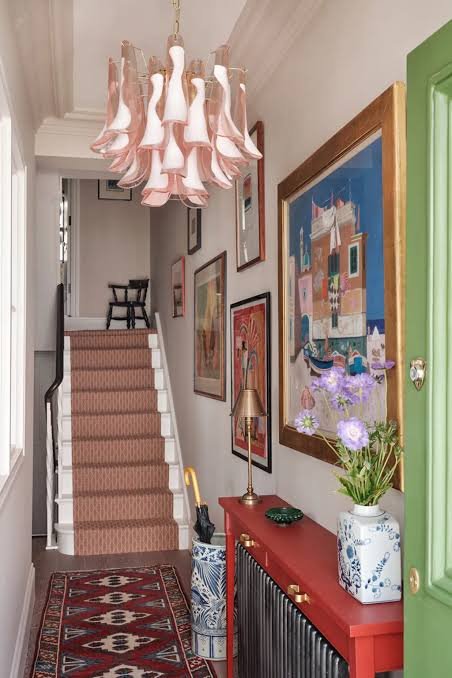
This is the one everyone wants to try and almost nobody gets quite right on the first attempt. The instinct is to grab whatever frames are in the closet and start hammering. Resist that.
Lay everything out on the floor first. Mix sizes — one larger anchor piece, a few medium frames, a couple of small ones — and leave the closet junk out of it entirely. Hallways are narrow, so people view gallery walls from an angle more often than head-on, which changes how spacing should feel; leave a little more breathing room than you think you need.
For actual hanging height, there’s a widely used standard art hanging height that most professional stagers still follow — roughly the center of the whole grouping at eye level, not the top or bottom edge. It sounds fussy, but it’s the difference between a wall that looks curated and one that looks scattered.
Paper templates save a lot of nail holes. Trace each frame onto kraft paper, cut it out, and tape the shapes directly to the wall before you commit to a single hammer swing. Move them around for a day or two if needed. It feels slow compared to just eyeballing it, but patching drywall afterward takes longer than any amount of careful planning up front.
Mixing frame finishes — a few black, a few natural wood, maybe one brass — usually looks more collected than matching everything perfectly. A hallway gallery wall that looks like it was bought as a boxed set often reads as staged rather than lived-in, and lived-in is generally the better look for a space this personal.
5. Mirrors Aren’t Just for Bathrooms Anymore
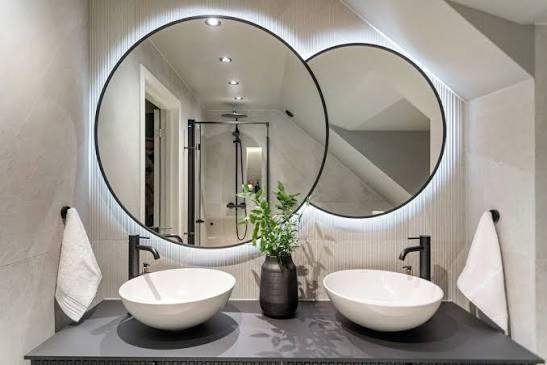
A well-placed mirror does something paint and lighting can’t: it doubles the perceived depth of a space instantly. In a narrow hallway, that’s not a minor upgrade.
Hang one opposite a window if you have one, even a small hallway window, and watch how much brighter the whole corridor feels by midday. No window? A mirror facing a light fixture works almost as well.
Skip the tiny decorative mirror here. Go bigger than feels comfortable — an oversized mirror leaning against the wall or mounted at eye level reads as intentional, while a small one just looks like an afterthought nobody planned around.
Shape changes the feel more than most people expect walking into a showroom. A tall, arched mirror elongates a low ceiling. A wide horizontal one visually stretches a narrow width, which is usually the exact problem a cramped hallway is dealing with in the first place. Round mirrors soften a hallway full of hard edges and straight lines, which sounds like a small detail until you’re standing in the space and everything suddenly feels less boxy.
Weight matters too, practically speaking. A large mirror needs proper anchors into a stud, not just a picture hook rated for a five-pound frame. It’s an unglamorous detail that gets skipped constantly, right up until a heavy mirror ends up on the floor.
6. Small Hallway Decor Ideas for Genuinely Tiny Spaces
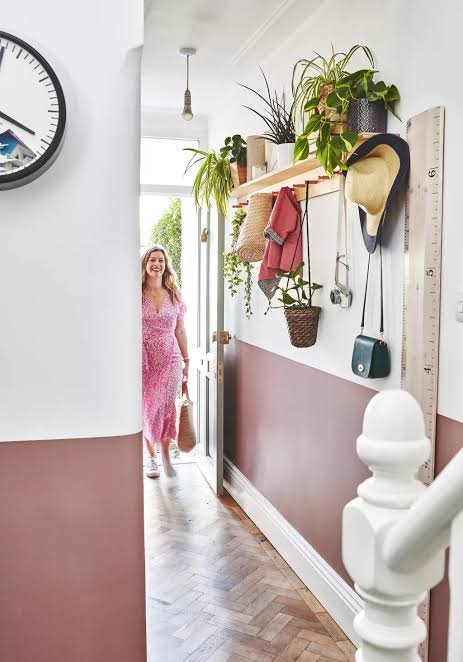
Not every hallway has room for furniture, and that’s fine. Some of the best small hallway decor ideas involve nothing more than the walls themselves.
Wallpaper on just the ceiling, sometimes called a “fifth wall,” adds personality without eating into the width of a tight corridor. Peel-and-stick versions make this a weekend project instead of a professional job.
Floating shelves, mounted narrow and shallow, hold a few objects without jutting into the walking path. Three items per shelf, max — anything more starts to look cluttered fast in a space this size. Keep it editorial, not crowded.
Vertical stripes, whether painted or wallpapered, trick the eye into reading a low ceiling as taller than it actually is. It’s an old trick, but it still works, and it costs nothing beyond a steady hand with painter’s tape if you’re not ready to commit to actual wallpaper.
Even door hardware counts as decor in a hallway this small, since there’s rarely room for much else. Swapping dull builder-grade knobs and hinges for something with a bit of finish — brushed brass, matte black, whatever fits the rest of the house — changes the feel of the whole corridor for the cost of a hardware store trip, not a renovation.
7. Functional Touches: Hooks, Shelves, and Baskets
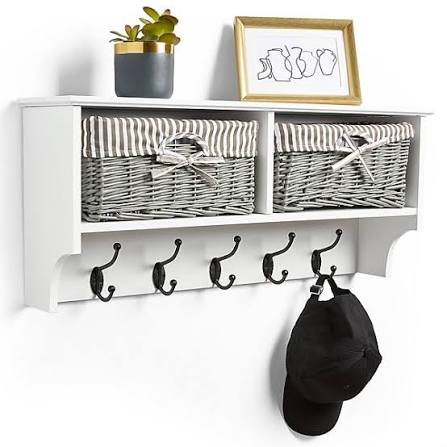
Decor that does nothing but look pretty eventually gets resented, especially in a hallway that everyone walks through multiple times a day.
Hooks near the entry catch bags, jackets, and leashes before they end up on the floor. A slim console table, if there’s room for one, gives keys and mail somewhere to land instead of the kitchen counter. Woven baskets underneath handle shoes without looking like storage bins from a hardware store.
None of this has to look utilitarian. Brass hooks, a wood-topped console, baskets in a natural fiber — functional pieces can still carry the same visual language as the rest of your hallway decor ideas, so the space feels finished rather than half-decorated-half-drop-zone.
Height matters for hooks in households with kids. A lower row at kid height, separate from the adult hooks above, actually gets used instead of becoming another thing parents nag about. It’s a small adjustment that solves a genuinely common frustration in family homes.
A console table doesn’t need much depth to earn its space. Even eight to ten inches is enough for keys, a small tray, and maybe a lamp, and a table that thin barely narrows the actual walking path, which matters a lot in a hallway that’s already tight to begin with.
8. Scent and Sound Are the Decor Nobody Talks About
This one gets skipped constantly, and it shouldn’t. A hallway is a transition space — it’s the first impression when someone walks in, and first impressions aren’t purely visual.
A subtle reed diffuser or a small plug-in near the entry sets a tone before anyone even reaches the living room. Nothing overpowering; hallways are usually enclosed, so strong scents get trapped and turn cloying fast.
Sound matters too, in a smaller way. Hard floors and bare walls in a corridor can make footsteps echo more than they need to. A runner rug, which you’ve probably already added by this point, quiets that down as a side effect, which is a nice bit of overlap between two ideas on this list.
Even artwork with texture, like a woven wall hanging instead of a flat framed print, absorbs a bit of sound in a hard-surfaced hallway. It’s not going to turn a corridor into a recording studio, but it softens the echo just enough that the space feels calmer to walk through, not just better to look at.
A Few Mistakes Worth Avoiding
Most hallway mistakes come from treating the space like an afterthought instead of an actual room, and a handful of them show up over and over in homes that otherwise look pulled together.
Overcrowding is the biggest one. A narrow corridor can’t absorb a console table, a bench, a gallery wall, and a plant stand all at once — pick two or three focal points and let the rest of the space breathe. Cramming everything in at once usually backfires, making the hallway feel smaller instead of more finished.
Ignoring scale is another common trap. Tiny framed art scattered across a long, tall wall gets visually lost, while one oversized piece or a properly spaced gallery wall actually fills the space the way it’s meant to. Furniture sized for a living room, dragged into a hallway because it was available, usually ends up blocking the exact path people need to walk through daily.
Skipping maintenance planning trips people up too. Light, pale rugs and walls look stunning on install day and rough within a month if the household includes muddy shoes or shedding pets. Choosing durable materials from the start saves a repaint or a rug replacement down the line, and it’s a far cheaper decision to make early than to fix later.
Frequently Asked Questions
What’s the cheapest way to improve hallway decor?
Swap the light bulbs for warmer ones and add a runner rug. Both cost under a hundred dollars combined, and together they change a hallway’s mood more than most people expect.
How do I decorate a hallway with no natural light?
Lean on warm white paint, layered lighting instead of one overhead bulb, and a large mirror to bounce whatever light exists. Avoid cool grays — they read as dim without daylight to soften them.
Is a gallery wall too much for a small hallway?
Not if you keep frame sizes modest and leave breathing room between pieces. A cramped gallery wall feels chaotic, but a well-spaced one makes the corridor feel curated instead of tight.
What rug works best for a busy hallway?
Low-pile, patterned runners hold up best. They hide dirt between vacuuming sessions and don’t create a tripping hazard the way shaggier textures can in a narrow, high-traffic walkway.
Should hallway walls match the rest of the house?
Not necessarily. A hallway can handle a bolder color or wallpaper precisely because you’re only in it briefly. Treat it like a transition moment rather than forcing it to match every adjoining room exactly.
How high should I hang art in a hallway?
Center artwork around standard eye level, roughly the same height used in galleries. For mixed groupings, treat the whole cluster as one piece and center that as a unit rather than each frame individually.
Do plants work in a hallway with low light?
Yes, if you pick the right ones. Snake plants and ZZ plants tolerate low light well and add life to an otherwise flat corridor without demanding a maintenance routine most people don’t have time for.
What’s a quick weekend hallway decor project?
Painting one accent wall and adding a runner rug covers most of the visual impact in a single weekend. Both are reversible, affordable, and don’t require any tools beyond what most households already own.
Final Thoughts
A hallway doesn’t get much credit in most homes. It’s the space between the spaces, the part nobody plans a whole room around, and the part that ends up with mismatched shoes, a lonely coat rack, and whatever paint color was left over from the last project. That neglect is exactly why a little intention here goes further than it would almost anywhere else in the house — because expectations start so low.
None of the eight ideas above require a renovation budget or a weekend crew. A bulb swap costs less than a takeout order. A runner rug is a weekend Amazon delivery. Even the gallery wall, which sounds like the most involved project on this list, is really just an afternoon with a tape measure and some patience. What changes the outcome isn’t money, it’s whether you actually plan the layout before you start hammering nails into drywall.
The hallways that end up looking intentional share a pattern: layered lighting instead of one harsh bulb, a color that was chosen instead of defaulted to, and at least one feature — a mirror, a gallery wall, a bold runner — that gives the eye somewhere to land. Function matters just as much as looks here, maybe more, since this is a space people move through rather than sit in. Hooks that catch coats before they hit the floor and a console table that intercepts mail clutter do as much for the feel of a hallway as any framed print ever will.
Start with whichever idea feels least intimidating. Swap a bulb this week. Order a runner next week. Save the gallery wall for a slower weekend when you’re not rushing. Hallway decor doesn’t need to happen all at once, and honestly, it rarely does in real homes — it accumulates, one small decision at a time, until one day you notice the space actually feels like it belongs to the rest of the house instead of apologizing for existing.