

Here’s the assumption almost everybody makes: the Ohio Department of Education does everything. Hires the teachers, picks the textbooks, fires the principals, grades the schools. Nope. It does a slice of that, leaves a slice to the State Board of Education, hands a big slice to local districts, and answers to Washington on the rest.
That split matters more than any single fact about the agency. The federal side has its own logic too, and a look at what the U.S. education secretary actually controls helps you see where Ohio’s say ends. What follows is the Ohio Department of Education as it stands in late September 2026: leadership, jobs, report cards, graduation rules, and which office to contact for licenses and scholarships.
What Is the Ohio Department of Education Now?
The Ohio Department of Education is the state agency that oversees public primary and secondary schools, and its official name today is the Ohio Department of Education and Workforce, or DEW. Cabinet-level. The governor appoints the director. Headquarters: 25 South Front Street, Columbus.
Now the messy part. News stories, school newsletters, and half the internet still say “Ohio Department of Education” or “ODE,” because that’s what people called it for decades. I’ll mostly stick with the old name here since it’s what folks type into Google. Same building, same director, bigger job.
Two differences from a typical state education office. It carries workforce and career-technical education under the same roof as K-12 policy. And it doesn’t answer to a state school board the way the old version did.
Its website is education.ohio.gov, and that’s where the official versions of everything below live. The Ohio Department of Education pulls data from more than 600 public school districts, per 2023 reporting.
A small warning about dates. An article from 2019 that says “Ohio Department of Education” means the pre-merger agency. One from 2026 almost certainly means the Ohio Department of Education and Workforce. Check the date before trusting the details, because the rules moved.
The 2023 Merger
It started with House Bill 33, the state budget bill Governor Mike DeWine signed in July 2023. Most duties the State Board of Education used to handle moved to a new cabinet-level agency, the Ohio Department of Education and Workforce, and workforce training landed in the same building as classrooms. The agency took shape that fall The new agency took shape that fall, and Wikipedia’s overview lays out the same timeline if you want a second read.
The argument for it was easy to state. Match what schools teach to what Ohio employers need, and give voters one chain of command to hold accountable. A director answers to the governor, which supporters liked. Critics worried about shrinking an elected board’s role.
For parents, the practical effect is subtle. Nothing about your child’s day changed on the morning the new agency opened. The bus still came, the same teacher was at the door. What shifted was who sets statewide priorities, and who you’d hold responsible if a statewide program flopped. That’s a boring answer, I know. Most governance changes are boring right up until they aren’t.
Both camps have a point. Responsibility is easier to trace now, which helps parents who never knew whom to blame. But policy can also lurch harder from one administration to the next. I don’t think either fact cancels the other.
You can see the workforce angle in ordinary school life. Every Ohio district and educational service center has a Business Advisory Council: school leaders, business people, community members, all working to line up student opportunities with local job needs. In February 2026 the governor’s office announced awards for the strongest ones, and the Ohio Department of Education and Workforce director was part of the announcement.
Who Runs It
Stephen D. Dackin is the director. His department bio lists more than 40 years in education, covering state policy, instructional leadership, postsecondary work, and workforce readiness. He reports to the governor, not to an elected board.
The department directory (updated August 2026) names Jeremy Varner as deputy director for Career-Technical Education and Workforce Readiness, and Diane Allen as deputy director for Primary and Secondary Education. Chris Woolard is chief integration officer. That title tells you a lot about how the merged Ohio Department of Education sees itself. Melissa Weber-Mayrer shows up on recent agendas as chief academic officer.
Cabinet agencies tend to echo the governor. Recent agendas and announcements lean toward literacy, career pathways, and school choice, and a different governor could reshuffle that list without much friction. So when someone tells you what the state “always” does, be a little suspicious.
One more habit worth building: read the meeting agendas. They’re posted ahead of time, they name the staff presenting each topic, and they’re the closest thing to a preview of what the Ohio Department of Education is about to prioritize. Reporters use them. Parents rarely do, which is a shame, because the agenda for the May 2026 meeting alone covered a federal waiver request, literacy, and career pathways in a single morning.
Ohio also has a governor’s election this November. Names here are accurate at time of writing, so glance at the current directory before you email anyone. Thirty seconds, saves you a bounce.
Department vs. State Board of Education
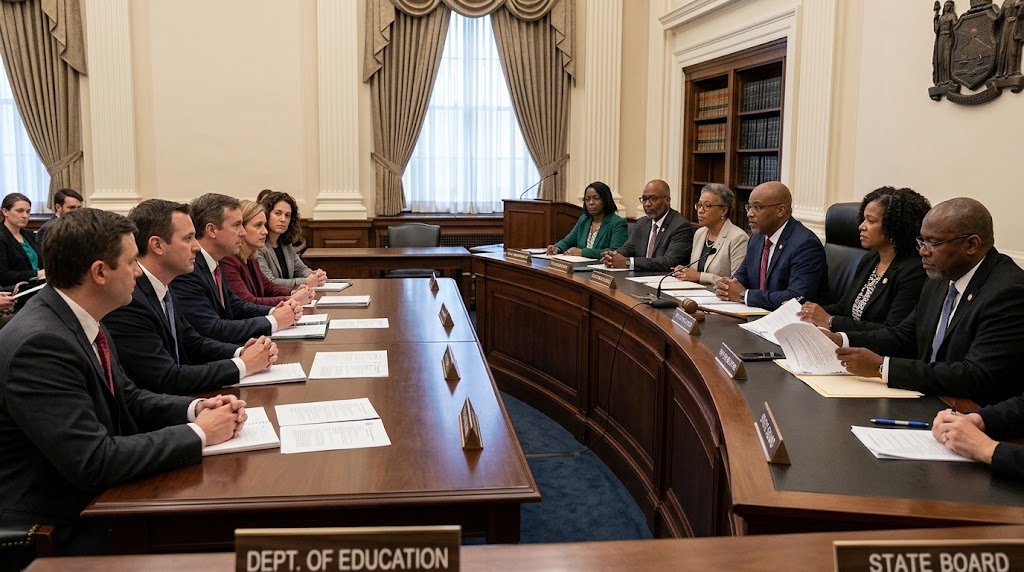
The State Board of Education didn’t vanish. Mixing it up with the Ohio Department of Education is probably the most common mistake people make, and they really are separate agencies.
The board lost most of its powers in 2023 but held onto a few big ones, like educator licensing and professional conduct cases. Its membership is shrinking too, with elected seats fading out and a smaller group of appointed seats meant to represent rural, suburban, urban, charter, and community schools. If boards in general confuse you, a primer on school board basics fills in the background.
Quick sorting method. Teacher license or educator conduct complaint? State Board. District star rating, state test, or scholarship? The Ohio Department of Education and Workforce. Bus route, school calendar, which textbook got adopted? Your local district.
That last bucket is bigger than people expect. Districts control hiring, budgets, calendars, and daily discipline, the stuff families feel every morning. The state builds the guardrails. The district drives.
There’s a related trap with phone calls. Front-desk staff at any agency will route you politely, and it’s tempting to assume the first person you reach is the right one. Ask, early in the call, whether the office actually owns your question. If not, get the name of the office that does. Saves everyone time.
Wrong office, wasted week. Emails get forwarded, forwarded emails sit.
Five Jobs You’ll Run Into Most
The Ohio Department of Education does a lot, but five jobs come up first for families and educators.
- State testing and data. The Ohio Department of Education runs the assessments state and federal law require, including end-of-course exams like Algebra I and English II and the Ohio English Language Proficiency Assessment. It also gathers the data behind every report card.
- Report cards and improvement support. Each fall the Ohio Department of Education publishes ratings for every district and school, then supports the ones that fall short. More on that below.
- Literacy and standards. ReadOhio pushes the science of reading in classrooms and in educator prep programs, and literacy updates keep turning up at public meetings. Standards say what students should know by grade. Districts decide how to teach it.
- Career-technical education and workforce readiness. The 2023 change added this most visibly. It gets its own section next.
- School choice programs. EdChoice scholarships run through the Ohio Department of Education, which handles the applications private schools submit for families.
A quick example of how that plays out. Say your district adopts a new reading curriculum and you hate it. Emailing the Ohio Department of Education won’t get it reversed, since the choice belongs to the district’s leadership. The state’s role there is the standards and the test results that follow. Your school board meeting is where that fight happens.
Now the flip side. The Ohio Department of Education doesn’t hire your kid’s teacher, choose the reading program, or set the bell schedule. Knowing that saves you a lot of frustration, since most “why did the state do this?” complaints end up at the local level anyway.
And money. There’s a sixth job in the background: the agency distributes state and federal funds using formulas the legislature writes. I’ll get to that further down.
Career-Tech, Workforce, and the Merger’s Big Bet

If you want to know why Ohio merged these agencies, this is the reason. The Ohio Department of Education and Workforce has an entire division for career-technical education and workforce readiness, led by a deputy director. It supports Career Pathway Support Networks and an Office of Graduate Success too, both listed on the May 2026 public meeting agenda.
The logic: kids should see real career options well before senior year, and local employers should help shape what schools prepare them for. Business Advisory Councils are the local connection, tying classrooms to employers and opening doors to work-based learning.
The February 2026 awards showed what “good” looks like. Officials praised councils that work as a team to expose students to the full range of opportunities in Ohio’s top career paths, not just one program or one employer.
Report cards carry this too. The college, career, workforce and military readiness component turns the emphasis into a number districts get judged on, which is why credentials, diploma seals, and work-based learning suddenly matter to superintendents.
I like the direction. My worry is geography. Pathways only help kids who can reach them, and rural districts often have fewer employers nearby. No report card component fully captures that gap. Worth watching how the Ohio Department of Education handles it over the next few budget cycles.
Practical step for parents: ask your child’s school which pathways and work-based learning options exist, and whether the district’s Business Advisory Council is active. Every district has one. The real question is whether anyone at the school can tell you what it does.
How Ohio Report Cards Score Your District
The Ohio Department of Education’s most visible product is the report card, and the 2025-26 edition came out Tuesday, September 15, 2026. Districts and schools get an overall rating from one to five stars in half-star steps. Three stars means meeting state standards. Five means significantly exceeding them.
Six components sit behind that number. Achievement covers performance on state tests. Progress measures growth against past results. Gap closing checks whether groups of students are catching up. Graduation counts four- and five-year rates. Early literacy tracks reading in kindergarten through third grade. And the newest, college, career, workforce and military readiness, asks how prepared graduates are for what’s next.
The history is bumpy. Lawmakers overhauled the system in 2021 after the pandemic paused grades for two years. Overall ratings disappeared in 2022 and came back in 2023. The readiness component was reported for a year before it started counting toward a district’s overall rating in the 2024-25 cycle.
Reading the 2026 Results
Statewide math proficiency rose to 56.4 percent and English language arts reached 62.2 percent, according to Spectrum News reporting on the release. Governor DeWine’s office called the English number a five-year high. Good news. But roughly four in ten students still fall short in math, so I wouldn’t call it a victory lap. Chronic absenteeism improved for a fourth straight year, from 25.1 to 23.9 percent, though about a quarter of students are still chronically absent.
Local results were mixed. Columbus City Schools got 2.5 stars, up from two, although the state noted the rating may not fully reflect performance because spring 2026 test results for two high schools were invalidated. Toledo Public Schools stayed at two.
Here’s what most people get wrong, and Toledo shows it perfectly. Toledo Early College High School and Toledo Technology Academy of Engineering High School each earned five stars, inside a district that earned two. A district rating is an average of very different buildings. Your child’s school might look nothing like the label on the whole district.
Cincinnati Public Schools is another useful case. It landed at 2.5 stars in 2024-25, the second year running below the three-star mark, according to Cincinnati Enquirer coverage. A flat number like that invites the lazy conclusion that nothing is changing. The components are where you’d check whether progress, literacy, or graduation is moving even when the overall rating sits still.
So skip the headline star and open the component ratings. Strong progress with weak achievement says something different than the reverse. Progress in particular tells you whether kids are gaining ground even when they start behind.
One more thing: stars are a snapshot, and old numbers go stale fast. In 2023 about 90 percent of districts earned three stars or more, which says very little about this year. Pull the current report card from the Ohio Department of Education and Workforce site before any decision that hinges on a rating.
Finding yours is easy. Head to education.ohio.gov, open the report card section, search by district or school name. Each page lists the overall rating, the six component ratings, and the data underneath. Charter and community schools get report cards too, so you can compare them with nearby district buildings.
Graduation Requirements, Minus the Jargon
State law sets Ohio’s graduation rules, and the Ohio Department of Education and Workforce publishes the details. For the class of 2026 and beyond there are three buckets: course credits, competency on state exams, and readiness shown through diploma seals.
Credits first. District planning guides put the state minimum at 20, and plenty of districts ask for more, so check your school’s handbook. Starting with the class of 2026, students also need a half credit in financial literacy. Small addition, easy to miss until senior year.
Competency means passing the Algebra I and English II end-of-course exams. Students who don’t hit the required score have alternative paths, and that’s where I’d push families to talk to a counselor early, not in May of senior year.
Readiness is the newer piece. Students earn at least two diploma seals, and at least one has to be state-defined. Options include science, citizenship, honors coursework, and military enlistment, plus seals districts define themselves. The department’s graduation requirements page lists every seal and pathway in one place.
I think seals are one of the smarter parts of the current system. A student heading toward a trade gets recognition for that path, not only for test scores. The catch is access. A small rural district may offer fewer seals than a big suburban one.
Ohio’s own materials for students also stress that testing isn’t everyone’s strength and that alternative routes exist. I like that the state says so out loud. A kid who freezes on one exam shouldn’t have a diploma hanging on a single Tuesday morning in April, and the Ohio Department of Education and Workforce clearly knows families worry about that.
Requirements shift by graduating class, and the legislature changes things, so a 2022 handout could be wrong for a freshman today. When in doubt, email gradrequirements@education.ohio.gov.
Teacher Licenses: Wrong Door, Right Door
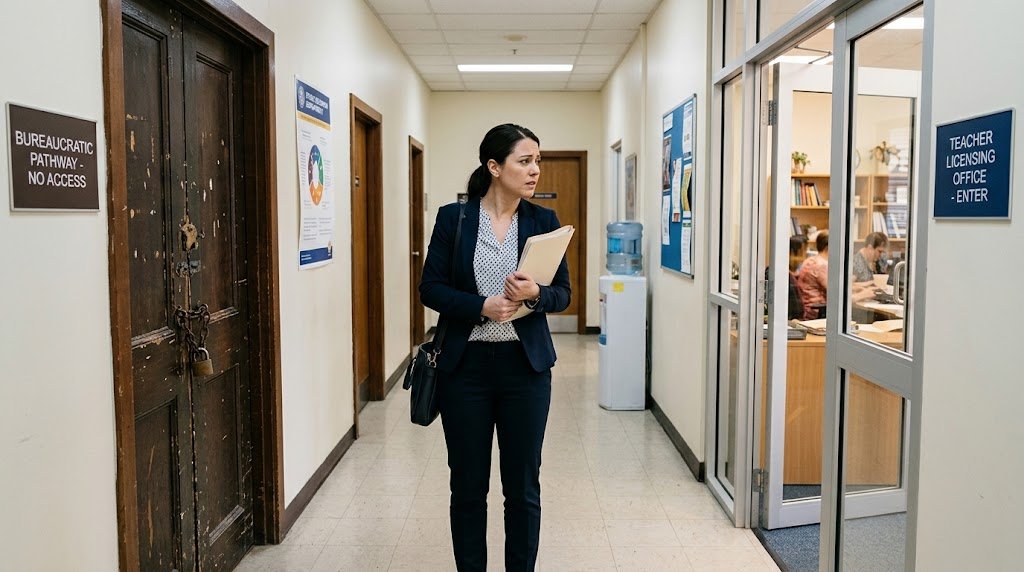
Classic wrong-door situation. Someone wants a teaching license, finds the Ohio Department of Education, assumes that’s the office, and starts hunting for the application. It isn’t. Educator licensing sits with the State Board of Education, through its Office of Educator Licensure and Effectiveness.
Applications go through CORE (Connected Ohio Records for Educators), and you sign in with an OHID account. First-time applicants need criminal history checks from both the Bureau of Criminal Investigation and the FBI, with fingerprints taken at a WebCheck location. Active license holders submit FBI checks every five years.
Most candidates pair a bachelor’s degree from a state-approved preparation program with the Ohio Assessments for Educators exams, though some specialized licenses use other tests. Out-of-state teachers face extra steps, BCI checks included, so start early. Earlier than you think.
Timing trips people up. An Ohio license’s effective year begins July 1 no matter when it’s issued, and renewal applications open in November for licenses expiring the following June 30, as they did for 2025. Applying early dodges the summer pile-up.
Questions go to the Office of Educator Licensure and Effectiveness at 855-983-4868 or 614-466-3593. The State Board’s website also explains alternative, supplemental, and traditional pathways, which matters if you’re changing careers.
Fees change, so I’m not quoting one. Confirm the current amount inside CORE before paying, and read the fine print about nonrefundable processing charges if an application times out. And if you’re a career changer, call before you enroll anywhere. Ten minutes on the phone can save a semester.
Employed applicants should know that a school district or university often has to approve the application before it reaches the State Board. If the district declines, it goes no further. Make sure your employer or program is ready before you hit submit.
EdChoice in Plain English

EdChoice is the state scholarship program for K-12 students at participating private and chartered nonpublic schools, and the Ohio Department of Education and Workforce administers it. Two tracks.
Traditional EdChoice covers students assigned to public schools the state has designated underperforming, plus some other groups like certified foster families. EdChoice Expansion is income-based and open to students in any district.
For 2026-27, participating schools report amounts of $6,166 for grades K-8 and $8,408 for grades 9-12 (at time of writing; amounts can change with each budget). Under Expansion, families at or below 450 percent of the federal poverty level get the maximum, and awards prorate for households at 451 percent or higher. Families at or below 200 percent qualify for low-income status, meaning they owe no tuition beyond the scholarship.
The private school, not the family, files the application through the state’s online system, and the Ohio Department of Education and Workforce reviews it within 14 days. Families seeking low-income status must submit household income to the department every year.
One participating school listed the 2026-27 window as February 1 through June 20, 2026. That’s over, so if you’re planning ahead, watch for next year’s dates. Deadlines tend to land in late spring.
A practical warning: scholarship amounts and tuition rarely match. If a school’s tuition runs higher than the scholarship and your family isn’t in low-income status, you may owe the difference. Ask the school for the exact number in writing before you commit, not after the award letter shows up.
On whether school choice is good policy, people disagree hard, and I’ll stay out of it. The paperwork itself is manageable if you begin with the school’s admissions office and the state’s income calculator.
Where the Money and Federal Rules Come From
Money reaches schools in two streams through the Ohio Department of Education. State dollars follow formulas the legislature writes. Federal dollars come with strings. The Ohio Department of Education and Workforce sits in the middle, distributing funds to districts and schools and reporting on how they’re spent.
Lottery revenue is one thread in school funding in Ohio and several other states, and North Carolina’s approach makes a useful comparison if you want to see how another state handles it. I’m skipping a lottery dollar figure since the exact share shifts every budget cycle.
Federal rules arrive through laws like the Every Student Succeeds Act (ESSA). At its May 27, 2026 public meeting, the department’s agenda included Ohio’s request for a waiver under the Elementary and Secondary Education Act and proposed amendments to Ohio’s ESSA plan. That’s the federal-state relationship in miniature: Ohio asks for flexibility, Washington decides.
Federal money also brings accountability rules, including the requirement to test students and publish results, which is partly why the Ohio Department of Education produces report cards at all. When Congress or the U.S. Department of Education changes program rules, the Ohio Department of Education is the state agency that translates the change for Ohio districts.
Who Handles What, at a Glance
| Question | Ohio Department of Education and Workforce | State Board of Education | Local district |
| District and school report cards | Publishes ratings and data | No lead role | Responds and plans improvements |
| Teaching license or renewal | Not the lead office | Issues and renews licenses | Verifies applications for employees |
| Educator conduct complaints | Not the lead office | Handles professional conduct | Reports concerns |
| Graduation requirements | Publishes rules and guidance | No lead role | Adds credit rules, awards diplomas |
| EdChoice scholarships | Administers the program | No lead role | Not involved in awards |
| Hiring and firing teachers | No | No | Yes |
| Textbooks and curriculum | Sets standards | No | Chooses materials |
Screenshot it. Three offices share the work, and each answers a different kind of question.
Exceptions exist, and the legislature reshuffles duties now and then, so use the table as a starting point and confirm anything high-stakes.
Three Moves for Parents This Fall
Report cards just landed and school’s in full swing, so this is a decent window to act.
Open your school’s component ratings. Skip the overall stars. Look at progress and early literacy first, since those show whether kids are gaining ground and whether the youngest readers are on track.
Ask about the graduation plan in ninth grade. Seals, exam competency, and the financial literacy credit are far easier to plan over four years than four months. Ask the counselor which seals your school offers.
Bookmark the right offices. Licensing goes to the State Board. Report cards and EdChoice go to the Ohio Department of Education and Workforce. Everyday school life goes to your district. That one habit prevents most of the runaround.
Reaching the Ohio Department of Education Itself

The Ohio Department of Education holds public meetings. The May 27, 2026 session opened at 9 a.m. with a welcome from Director Dackin, then covered the waiver request, literacy updates, and career-technical education. After each presentation staff open time for public discussion, and anyone who wants to speak fills out an information form so staff can follow up.
Rules open for public comment are posted on the agency’s rule comments page, and comments go to rulecomments@education.ohio.gov. Staff at the Ohio Department of Education say they consider each comment when drafting a rule.
For everyday questions, use the directory on education.ohio.gov. Mail goes to 25 S. Front Street, Mail Stop 309, Columbus, Ohio 43215.
When you write, name your district, grade level, and the specific rule. Vague emails get vague answers, and the Ohio Department of Education fields questions from families, districts, and lawmakers all day.
FAQs
What does the Ohio Department of Education do?
It oversees public K-12 education in Ohio, including state tests, school report cards, funding distribution, career-technical programs, and school choice scholarships like EdChoice.
Is the Ohio Department of Education the same as the Ohio Department of Education and Workforce?
Yes. The 2023 state budget renamed and expanded the agency, though the older name still shows up in everyday use.
Who is the director of the Ohio Department of Education?
Stephen D. Dackin holds the job as of September 2026, and the governor appoints the director.
Where do I apply for an Ohio teaching license?
Through the CORE system tied to the State Board of Education’s Office of Educator Licensure and Effectiveness, using an OHID account.
How does the Ohio Department of Education rate schools?
It assigns one to five stars in half-star steps across six components, with three stars meaning a district meets state standards.
Final Thoughts
If one idea sticks, make it the split. The Ohio Department of Education, now formally the Ohio Department of Education and Workforce, runs testing, report cards, school choice programs, and career-technical education. The State Board of Education keeps licensing and conduct. Your local district handles hiring, budgets, calendars, and the daily life of a school. Washington sits over all of it with federal rules and funding.
Most of the frustration people feel toward state education offices comes from knocking on the wrong door. A parent reads the district’s star rating and stops, missing the component scores. A student waits until senior year to think about diploma seals and loses options. A new teacher searches the wrong site and loses weeks. Nothing dramatic. All of it avoidable.
My own view is that the 2023 restructuring gave Ohio a clearer chain of command, and clarity counts when you’re a parent trying to work out who’s responsible. It also puts more weight on each governor’s priorities, so the agency’s focus can shift. Literacy, career pathways, and school choice lead the current agenda, and I’d expect the debate over all three to continue.
I keep coming back to the wrong-door theme because it’s the most fixable problem in the whole system. The Ohio Department of Education can publish clearer maps, and it should. Until then, families have to draw their own.
Report cards will keep arriving every fall. Graduation rules will keep getting tweaked. EdChoice deadlines will keep landing in late spring. Families who know which office owns which question move faster than everyone else, and that’s a quiet advantage.
Looking ahead, keep an eye on the governor’s election this November and on next year’s budget cycle, since both can change how the agency operates. Whatever happens, the basics in this guide tell you where to start.
Nobody should need a law degree to figure out who runs their child’s school. The Ohio Department of Education and Workforce publishes rules, agendas, and contacts openly, and that openness only helps if families use it. Show up to a meeting, send a comment on a proposed rule, or ask your district a sharper question. Agencies respond to the people who engage with them.
So here’s the assignment for this week. Pull up your school’s report card, read the component ratings, and write down one question for your child’s counselor about graduation seals. Bookmark the department directory while you’re at it. Then come back to this guide the next time a form, a deadline, or a rule change sends you searching.