

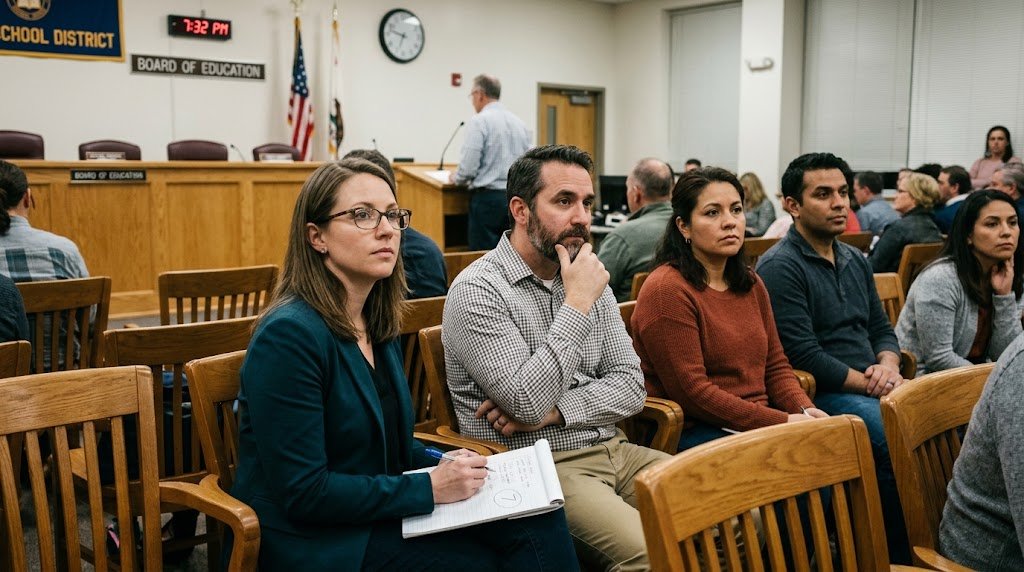
My first board of education meeting happened because of a rezoning map, not because I woke up one day curious about school governance. My daughter’s elementary was getting redrawn and half the parents in that gym had no idea what the board could actually decide versus what state law had already locked in months earlier. It got messy. Someone yelled about curriculum for a solid five minutes during a meeting that was, legally, only about attendance boundaries. Nobody in that room — me included — walked in knowing where a board of education’s authority started and where it stopped, or how different that is from what the Secretary of Education controls way up at the federal level.
That gap causes most of the confusion. And, yeah, most of the shouting too. So here’s an attempt to actually sort it out — who sits on a board of education, what members vote on, how the money moves, and the mistakes parents keep making before they even walk into the room.
A board of education is the body that sets policy for public schools within its jurisdiction, usually a district, sometimes a whole state. It doesn’t run the schools day to day — it hires the person who does. It builds the budget framework, approves the big policy calls, and answers, at least on paper, to voters or to whoever appointed it. That’s the elevator-pitch version. Reality has a lot more moving parts than that, and some of them genuinely surprised me once I started paying attention.
Who Actually Sits on a Board of Education?
Most local boards run five to nine members, though bigger urban districts stretch that number. Elected positions in most states. A few big cities hand appointment power to the mayor instead — New York does this, so does Chicago — and that one difference changes everything about how accountable a board feels to the people it serves. An elected board answers to voters. An appointed one answers to whoever put them there. Not the same relationship at all.
Terms usually run two to four years, staggered on purpose so one bad election cycle can’t wipe out the whole board’s institutional memory at once. A board of education that loses every returning member in a single election has to relearn how the district actually works from zero, and I’ve seen districts stumble through a rough year or two after exactly that happens.
Something most people don’t clock going in: seats are usually unpaid, or close to it. Maybe a few hundred bucks a month if there’s any stipend at all. So nobody’s joining a board of education for the paycheck. Some do it because they genuinely care about the schools. Some have a specific axe to grind. A few treat the seat as a launchpad toward bigger political office down the road. All three types end up on the same board together, and honestly that mix explains a lot about why meetings go the way they go.
Local Boards vs. State Boards of Education
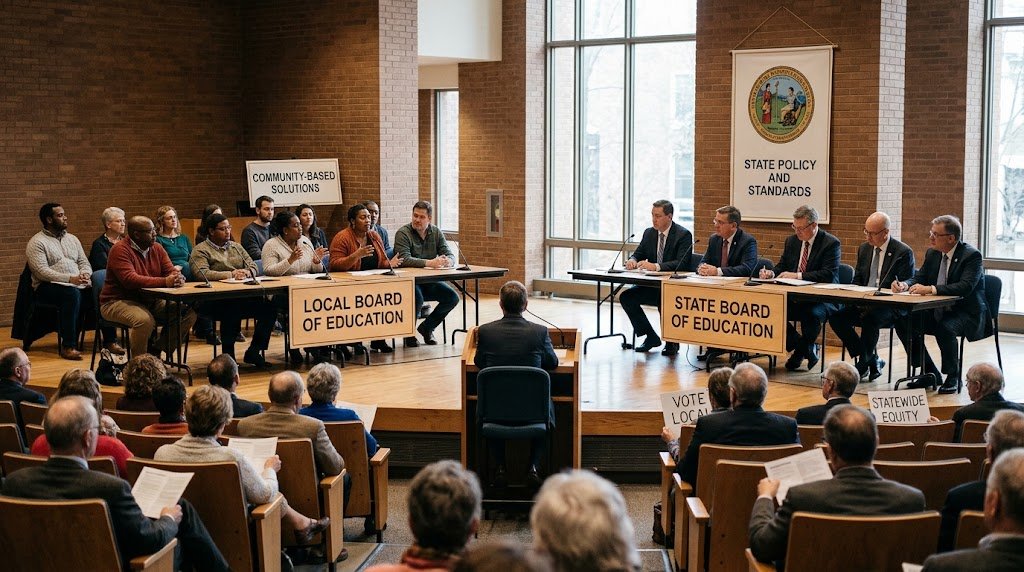
There’s a whole layer above your local board that most parents never think about until something breaks: the state board of education. Every state has one, and its job looks pretty different from your district’s board. State boards set statewide standards, sign off on curriculum frameworks, oversee teacher licensing, and often decide how funding formulas actually get applied on the ground.
Your local board works inside whatever fence the state board builds. Minimum instructional days, set at the state level? Your district’s board can’t just wave that off. State-mandated graduation requirements? A local board can pile more on top but usually can’t cut them down. Nobody lays this out clearly for parents, which is exactly why so many complaints aimed at a local board of education actually belong one rung up the ladder.
State board members get elected in some states, appointed by the governor in others, and in plenty of places it’s a mix of both — a handful of elected seats sitting next to governor picks. It varies enough that I’d genuinely tell you to look up your own state’s structure rather than assume it works like your cousin’s state three states over. The National Association of State Boards of Education breaks down how these governance models differ, and the range is bigger than you’d expect. One thing holds pretty much everywhere though: the higher up you go, the less any single parent’s voice matters directly, and the more everything runs through formal policy instead of a Tuesday-night public comment slot.
Following the Money: Where the Budget Comes From
Funding is where the real confusion around a board of education lives, honestly. It doesn’t just print a budget out of nowhere. Three main sources feed it: local property taxes, the state funding formula, and federal dollars — usually in that order by size, though the exact split shifts a lot depending on your state.
Property tax revenue tends to be the biggest single piece, which explains why wealthier districts almost always out-resource poorer ones even inside the same state. Bigger tax base, bigger budget. State funding formulas exist to smooth some of that gap out through equalization, though how well that actually works varies enormously depending on where you live.
Then there’s the stuff people don’t expect. Quite a few states run dedicated revenue streams that supplement school budgets outside the regular tax system. North Carolina’s a solid example of this — a chunk of lottery money gets carved out specifically for schools, and the way that cash actually reaches a district surprises people who assume it’s a much bigger slice of the pie than it really is. I dug into the full mechanics of how lottery proceeds fund schools if your state runs something comparable.
Federal money is usually the smallest slice, under 10% for most districts, but it comes wrapped in the most conditions — Title I dollars for low-income schools, IDEA funding tied to special education, that whole category. A board of education has to accept the strings if it wants the cash, and that’s exactly how federal priorities end up shaping local budgets even though Washington isn’t running the district.
A rough sense of where the money typically comes from, though your own district’s mix will differ:
| Funding Source | Typical Share of Budget | Who Controls the Rules |
| Local property taxes | 40-50% | Local voters, board of education |
| State funding formula | 35-45% | State legislature, state board |
| Federal funding | 5-10% | Congress, federal Dept. of Education |
| Other (lottery, grants, fees) | Varies | State-specific, program-specific |
Does the Board of Education Control Curriculum?
Sort of. Which is a frustrating answer, I know, but it’s the honest one. A local board typically signs off on specific textbooks and instructional materials, and it can layer extra requirements on top of whatever the state requires — an extra civics unit, a financial literacy add-on, things like that.
The big-picture stuff, though — what subjects get taught overall, statewide academic standards, testing requirements — that’s almost always a state call, not something a local board decides. When a parent storms into a meeting demanding a specific book get pulled, sometimes the board genuinely has that power. Other times it’s a state-mandated standard members legally can’t touch without breaking state law, no matter how loud the room gets.
I’ve watched this go sideways more than once. Somebody runs for a board of education seat on a promise to fix a specific curriculum issue, wins, then finds out the thing they campaigned on was never actually theirs to change. It’s not always some cynical bait-and-switch either — plenty of candidates just don’t fully understand the job’s limits before they run for it.
What Actually Happens at a Meeting
Meetings follow a pretty predictable shape across most districts: public comment first, then committee reports, old business, new business, votes at the end. Most run on some version of Robert’s Rules, though how strictly that gets enforced ranges from rigid to basically nonexistent depending on the chair.
Public comment runs on a timer, three minutes a speaker is typical, and this catches people off guard constantly. It’s not a conversation. It’s a monologue aimed at the board, not a back-and-forth, because open meetings laws in a lot of states restrict members from responding live — otherwise every meeting turns into an unstructured argument. Annoying, sure, but that’s how the format’s built pretty much everywhere.
Votes need a quorum, generally a simple majority of seated members, and routine stuff passes on a quick voice vote or show of hands. Anything contentious — budgets, policy shifts, personnel — usually gets a recorded roll-call vote, which means there’s a public trail of how each member voted. That trail matters more than people give it credit for come election season. It’s the clearest record of how a board of education member actually governed, not just what they said while campaigning.
The Superintendent Runs the Schools. The Board Runs the Superintendent.

This is the relationship that decides whether a district runs smoothly or falls apart, and it’s also the piece most outsiders never fully get. A board of education doesn’t run schools. It hires one person — the superintendent — and evaluates them. That person runs everything underneath.
It’s the corporate board-and-CEO model, basically. The board sets strategy, approves the budget, holds the superintendent accountable for outcomes. The superintendent hires principals, manages staff, handles operations, carries out whatever direction the board sets. When it works, members stay out of the day-to-day weeds and stick to policy and oversight. When it breaks — and it breaks more often than people assume — you get members trying to micromanage individual schools, or a superintendent who just ignores direction because they’ve got the votes locked up anyway.
A friend of mine spent six years running communications for a district. She once told me the single best predictor of whether a district was functional had nothing to do with budget size or demographics. It came down to whether the board and superintendent actually trusted each other on a basic level. Districts where that relationship soured churned through superintendents every couple years, and every single turnover cost momentum — on staff morale, on long-term planning, on grant applications, on all of it.
When a Board of Education Turns Political
I won’t pretend this part is simple, because it’s not. Local races have gotten noticeably more nationalized over the last several years. Stuff that used to stay purely local — curriculum choices, library book fights, mask policy during the pandemic — turned into proxy wars for much bigger political battles happening elsewhere.
That shift has real costs. Meetings that used to pull a dozen people now sometimes draw a few hundred, and not always because of anything actually on that night’s agenda. Outside political groups now organize and fund entire candidate slates in a way that barely existed a decade ago. Reasonable people disagree on whether that’s healthy or corrosive for local democracy. But it’s real, and pretending it isn’t happening would be a mistake if you’re trying to make sense of your own district’s dynamics.
I’ll say this plainly, though: a board of education works best when it sticks to whatever’s actually on the table that night — boundaries, budgets, personnel, facilities. That’s the real work. When every single meeting turns into a national culture-war venue, the actual governance suffers, and it’s usually the families with the least political connection or free time who feel that loss first. They’re the ones who can’t afford to keep showing up week after week just to be heard over the noise.
How to Actually Get Involved
Running for a seat isn’t the only path to influence, though it’s the most direct one. Here’s what moves things, roughly ordered by how much effort it takes.
Just show up to meetings, even ones that have nothing to do with your kid directly. Members notice regulars, and it genuinely changes how they treat your public comments over time.
Join an advisory committee if your district has one — budget committees, curriculum panels, facilities task forces. These groups feed real recommendations straight to the board, and most of them are desperate for volunteers.
Talk to your specific board member one-on-one. Most keep office hours or will meet you if you ask directly. Five minutes outside a formal meeting usually gets you further than three minutes at a podium ever could.
And if you’re serious, run for a seat. Local races often have embarrassingly low turnout and cheap campaigns compared to basically any other elected office out there. I’ve watched board of education seats get won with a few thousand dollars and a decent door-knocking push — try that at any other level of government and see how far it gets you.
7 Mistakes Parents Keep Making With School Boards
A handful of patterns keep showing up with parents and their local board of education, and I’ll cop to having made the first one myself before I understood how any of this actually worked.
- Assuming the board controls everything. Plenty of what frustrates parents is really a state-level call, not something the local board of education ever had power over. Aiming anger at the wrong level wastes everybody’s time and changes nothing.
- Treating public comment like a negotiation. It isn’t one. It’s a statement for the record, full stop. If you actually want dialogue, you need a separate meeting, not three minutes at a podium under a countdown clock.
- Only showing up when you’re furious. Members remember the difference between someone who’s consistently present and someone who only surfaces during a crisis. Fair or not, that history colors how much weight your comments get.
- Skipping the budget meetings entirely. These are usually the least attended and most consequential all year. Real priorities get locked in there, well before the flashier debates ever hit an agenda.
- Not knowing which level of government actually decides the issue. Curriculum standards, testing requirements, graduation minimums — a lot of that sits with the state, not the district’s board of education. Complaining to the wrong body just burns goodwill.
- Believing a campaign promise without checking a candidate’s actual authority. Candidates sometimes run on things they legally can’t deliver once elected. Ask directly what’s within the board’s power before you vote for someone on a single issue.
- Ignoring the superintendent relationship. Parents fixate on individual members and forget the board-superintendent dynamic is what actually determines whether anything gets implemented well. A board of education can vote for a great policy and still see it fail in execution if that relationship is broken.
Where the Federal Government Fits In
People often assume the U.S. Secretary of Education has direct say over what happens at a local board of education meeting. That’s not how it works. The federal Department of Education administers funding programs, enforces civil rights law across schools, and attaches conditions to federal dollars — but it doesn’t set curriculum, doesn’t hire local staff, and doesn’t run any individual district. The Department’s own overview of its role says as much: education is treated as primarily a state and local job, with the federal government mostly supplying funds and oversight rather than running things itself.
Whatever influence the Secretary has tends to be indirect — shaping national conversations, handing out competitive grants, enforcing statutes like Title IX or IDEA. A local board has to comply if it wants federal money, but the actual day-to-day authority stays firmly local and state-level.
That layering, federal on top of state on top of local, isn’t accidental. The whole system was built to keep control close to communities rather than centralized in Washington. Whatever you make of that politically, it explains why big national education headlines often barely register in your kid’s actual classroom the following Monday.
Decisions That Actually Touch Your Life
If you only care about the stuff your local board of education actually controls, here’s where to focus: attendance zone boundaries, the annual budget and any tax levy tied to it, the school calendar including snow days in some districts, big personnel calls like hiring or firing a superintendent, and sign-off on new construction or school closures.
Everything else — daily discipline policy, individual teacher assignments, most curriculum specifics — sits either with the superintendent’s office or gets decided at the state level, not with your local board. Knowing which bucket your issue actually falls into before you walk into a meeting saves your time, and it saves the board from fielding comments about stuff it genuinely can’t fix.
FAQs
What’s the difference between a school board and a board of education?
Mostly nothing — just different naming by state or district. Some call it a school board, others a board of education, but the job is identical.
Are board of education members paid?
Most get little to nothing, maybe a small monthly stipend. It’s not really a paid gig the way other elected offices are.
How often does a board of education meet?
Once or twice a month for most districts, with extra sessions layered on during budget season or when something contentious lands on the table.
Can I remove a board of education member?
Recall’s possible in a lot of states, but it usually needs a formal petition and a fairly high signature threshold. Waiting for the next election is the more common route.
Does the board of education set teacher salaries?
Generally yes, within whatever the state funding formula allows, and usually through union contract negotiations the board has to approve.
Final Thoughts
If I could leave you with one thing, it’s this: a board of education has real power, but way less of it than most public comment sessions would have you believe. Budgets, boundaries, personnel, facilities, some curriculum calls — that’s genuinely theirs to decide. But all of it sits inside a structure the state builds around it, and a lot of the frustration people bring to local meetings actually belongs somewhere else entirely.
That doesn’t make it unimportant. Far from it. The stuff closest to your kid’s daily life — who gets hired to teach them, whether the roof over their classroom gets fixed, whether the bus route makes any sense — that’s squarely in the board’s hands. Understanding where its authority actually ends just makes you a sharper advocate than someone who shows up angry assuming the board of education can fix everything they’re mad about.
That rezoning meeting taught me something I didn’t expect walking in: things go better when people understand the system before they engage with it, not after the fact. Most of the anger in that gym came from misplaced expectations, not genuine disagreement over the map itself. Once people understood what the board could and couldn’t actually do, the conversation improved — even among people who still landed on opposite sides of the outcome.
So do the unglamorous homework. Read the budget documents nobody wants to read. Learn what your board of education controls versus what’s decided somewhere above it. Find out when meetings actually happen and who represents you. None of that’s exciting. But it’s the part that changes outcomes, far more than any viral three-minute public comment ever has.
Whatever’s bothering you — a boundary line, a budget item, a curriculum fight — there’s a right level of government to take it to, and it’s not always your local board. Knowing where that is puts you ahead of most people in the room. Show up prepared, and you’ll walk out having accomplished more than you expected to.