

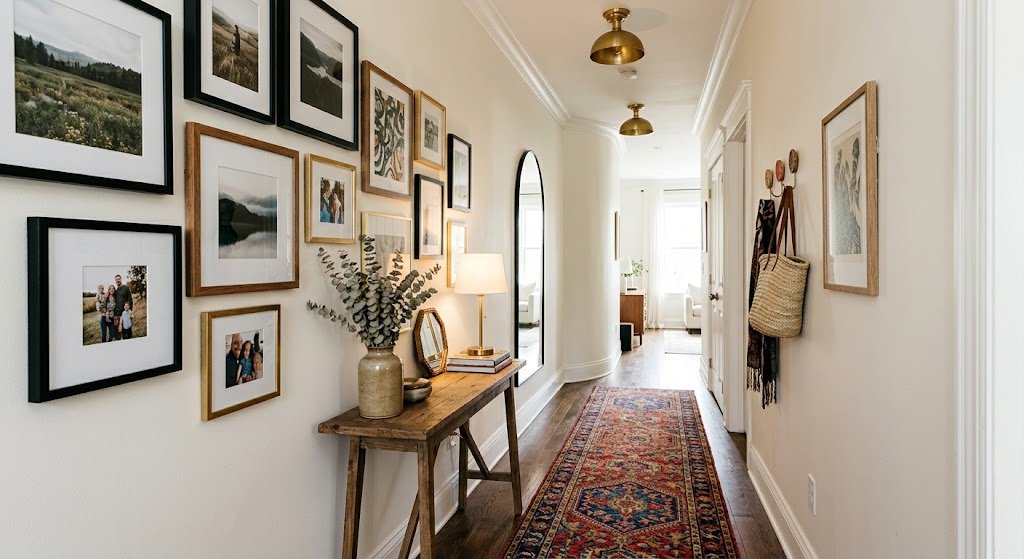
I’ve lost count of how many long hallways I’ve stood in over the years — client homes, rentals I helped stage, my own place twice over. Most of them share the same fate: a coat of white paint, a mirror stuck somewhere near the middle, and everyone just… stops there, like the effort to decorate a long hallway used up its whole budget of attention in the first ten minutes.
That always struck me as odd, because a skinny stretch of hallway wall often adds up to more square footage than half the actual rooms in the house. So if you landed here trying to work out how to decorate a long hallway so it stops feeling like a leftover strip between two real rooms, stick around. There’s more to cover than most guides on how to decorate a long hallway ever let on.
Why Long Hallways Get Ignored (And Shouldn’t)
Hallways get treated the way empty parking lots get treated — spaces you cross, not places you notice. Makes sense on the surface. Falls apart the moment you actually count how often you’re in one.
Here’s the math nobody runs: your hallway sees every person in the house, every single day, multiple times. Your living room might host a guest once a week if you’re social. The hallway doesn’t get days off, which is exactly why the choice to decorate a long hallway pays off more than people expect.
I’ve watched more than one client finally redo theirs and say almost word for word, “wish I hadn’t waited this long to bother.” Most of the time it barely costs anything — half the work it takes to decorate a long hallway is stuff already sitting in a closet, just never placed where it could actually do something.
How to Decorate a Long Hallway: Start With Light, Not Paint

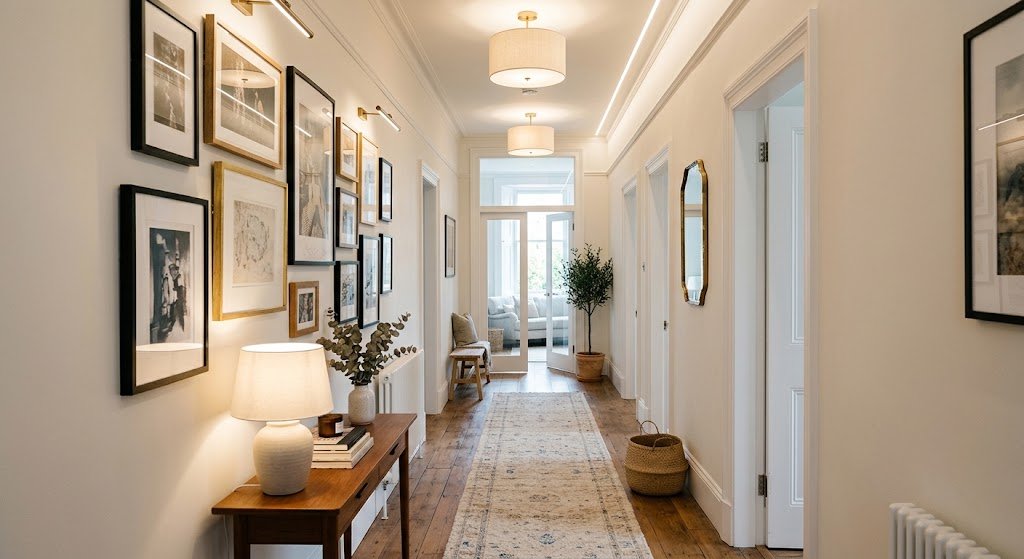
Paint swatches are always the first thing people grab. Backwards order, in my view — sort the lighting before you even think about a color, especially if you’re serious about how to decorate a long hallway properly.
Long hallways almost always get stuck with one sad fixture dead center, leaving both ends dim. Deal with that first. Several small flush-mounts spaced out along the ceiling will do more for a narrow hall than any wall color you’re agonizing over.
Steal the Lighting Trick Restaurants Use
Walk into any decent restaurant and count the light sources. Never just one. Same rule applies when you’re figuring out how to decorate a long hallway:
- Overhead flush mounts for the baseline light
- A sconce or two positioned near your art
- Something small and warm at floor-lamp height near one end
Do that layering right and the hallway quits reading like an office corridor and starts feeling like a room somebody actually lives in.
Warm Bulbs Change Everything
Cool-white bulbs in a hallway are a mistake I see constantly, and it’s a cheap one to fix. They flatten the space into something closer to a hospital corridor than a home. Swap to a warm 2700K bulb and watch the whole stretch soften within seconds — five bucks, ten minutes, done.
Pick a Color Strategy That Fights the Tunnel Effect
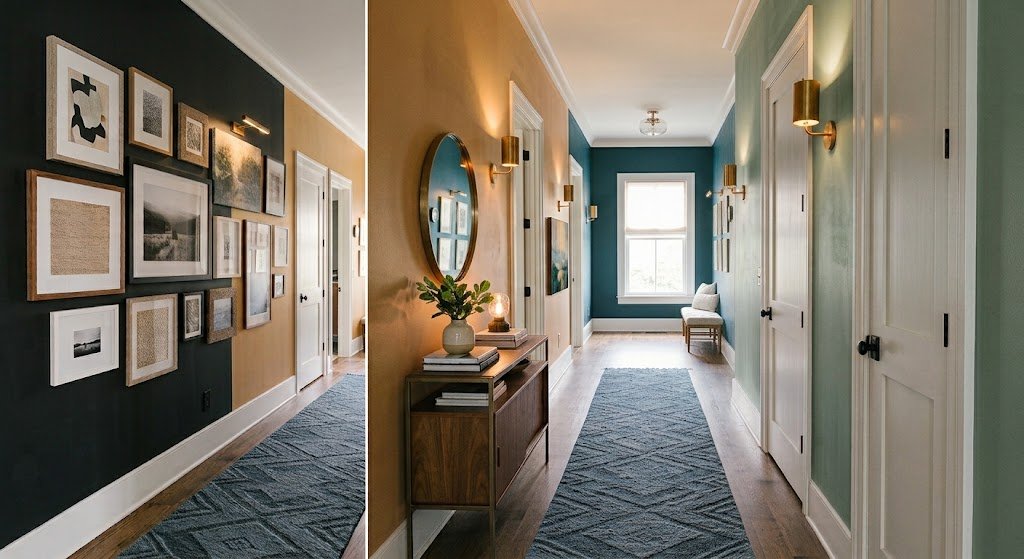
Narrow, elongated rooms have a built-in problem: they read like tunnels. White walls make this worse, not better — the eye can’t find an edge, so everything blurs into one long smear.
What actually helps when you decorate a long hallway: going darker instead of lighter. Forest green, charcoal, ink navy. A darker wall makes the boundary between wall and air harder to pin down exactly, and oddly that reads as intimacy rather than confinement. I didn’t believe it either, until I watched it happen in three separate houses in the same month.
Try an Accent Wall at the Far End
Skip the full dark-wall commitment if it feels too bold. Paint just the far wall instead, in something with punch. It gives the eye somewhere to land at the end of the walk, rather than a stretch that trails off into nothing. There’s a whole world of creative long hallway looks built around exactly this move, and it consistently earns its keep in long hallway decor.
Wallpaper Works Harder Than Paint Sometimes
Grasscloth, oversized botanicals, sharp geometric prints — a hallway might be the single best room in a house to go loud with wallpaper. You’re never sitting there long enough for a bold pattern to wear thin, the way it might in a bedroom. Small footprint, big statement, and one of the fastest ways to decorate a long hallway without touching a single piece of furniture.
Hang Art Like You Mean It
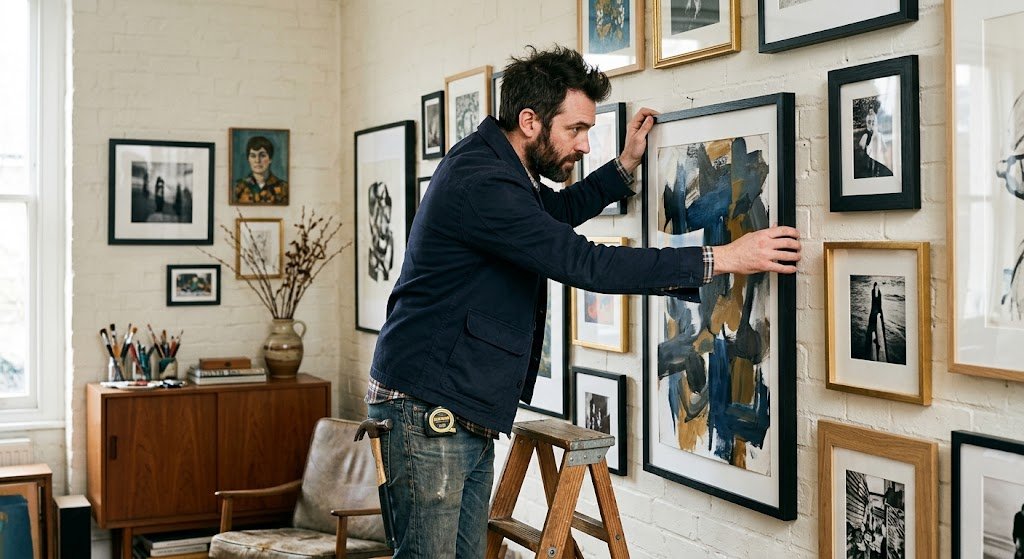
A bare wall running the length of a hallway is basically shouting for something. Just don’t answer that call with three unmatched frames spaced however they happened to land — that’s clutter wearing a gallery-wall costume, and it undoes half the point of trying to decorate a long hallway in the first place.
Build a Gallery Wall That Actually Flows
A long wall wants to be read like a single sentence, not a pile of disconnected words. Cluster some pieces tight, leave gaps elsewhere, let a couple of larger pieces anchor the smaller ones around them. Spacing consistency matters more than most people realize going in; Apartment Therapy’s spacing breakdown covers the actual inch-by-inch numbers if you want it precise.
Sometimes One Big Piece Wins Over Ten Tiny Ones
Clients love filling every inch with small frames. I talk them out of it more often than not. One large print or an oversized mirror frequently carries more visual punch than a packed gallery — especially somewhere narrow, where a dozen small pieces start reading as clutter fast.
Mix Heights, Not Just Widths
Don’t line everything up at identical eye level — it goes flat fast, almost forgettable. Stagger it a little and the wall gains a kind of pulse, like it’s moving even while you stand still in front of it.
Ground the Hall With a Console or Narrow Table
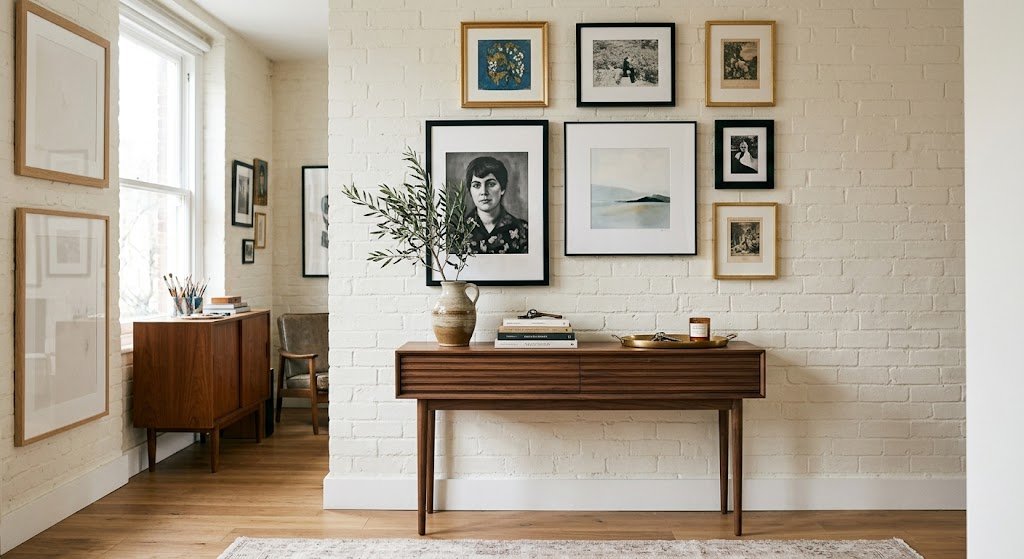
If you’re serious about how to decorate a long hallway well, furniture usually comes up next. Fitting furniture into a hallway sounds far-fetched until you see how slim the options have gotten. A console — even a shallow twelve-inch one — is often the difference between a corridor and a room you’d actually want to stand in for a second. It’s one of the quickest ways to decorate a long hallway that still feels like an actual room.
What to Put On It Without Overdoing It
Fewer objects, more intention. A lamp, one tray, a single vase — that’s plenty. I’ve seen tables buried under a dozen trinkets that just end up reading as storage, not styling. There’s some solid inspiration in these table styling ideas if you want a starting point that doesn’t spiral into clutter.
Where to Place It for Best Flow
Look for a natural widening or bend in the hallway and set it there. No such spot? The midpoint or the far end near a window both work. Just guard the walking lane — six inches of clearance is the floor, not the goal.
Runners Fix More Than You’d Think
A stretch of bare hardwood or tile down a hallway echoes, scuffs fast, and reads unfinished no matter what else you do. One runner solves three separate annoyances in a single move — the noise, the look, and the risk of sliding on a smooth floor. Rugs are almost always underrated when people plan how to decorate a long hallway, even though a runner alone can change the whole mood of the walk.
Getting the Width Right
People buy runners the wrong width constantly — too wide, too narrow, rarely just right. The common rule of thumb is a steady margin of exposed floor on both edges; Rugs Direct’s runner sizing guide spells out the exact math so it’s not a guessing game.
One Long Runner or Several Shorter Ones?
Comes down to length and how many doorways interrupt the walk. Past fifteen feet or so, I lean toward two shorter runners with a small gap rather than chasing one giant custom piece. Bonus: it lets you play with two subtly different patterns if you’re into that.
Small Hallways Need Different Rules Than Long Ones
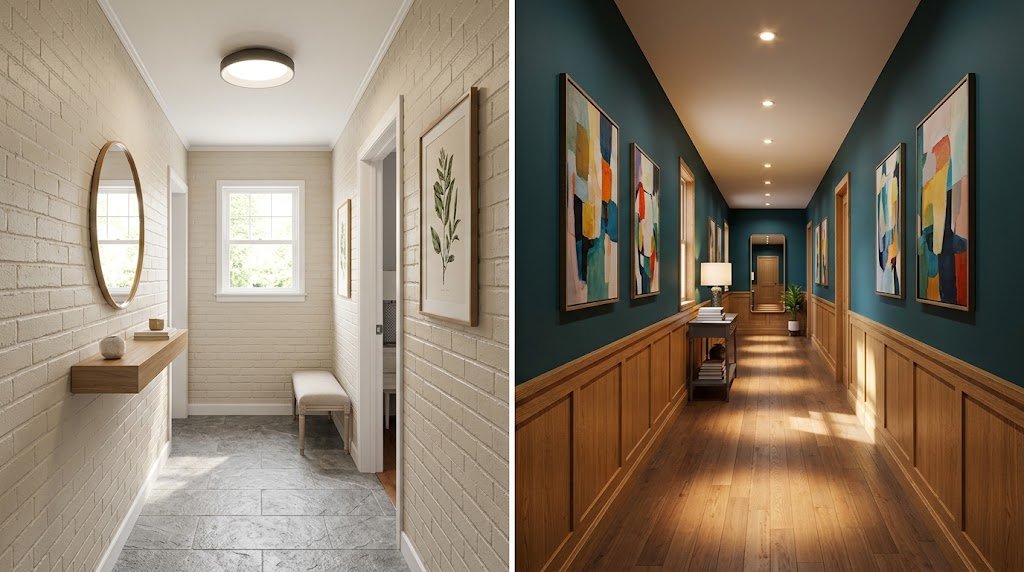
Quick detour, because this question comes up constantly — a long hallway and a cramped one are not solving the same puzzle. A long hall can carry furniture and layered lighting without breaking a sweat; a tight one can’t, and needs its own separate approach built around protecting the walking space. If yours skews narrow more than long, there’s a solid guide on decorating tighter hallway spaces built around exactly those limits.
Mirrors Aren’t Just for Bouncing Light
Everybody already knows mirrors make a hallway feel bigger. Sure, fine — but there’s more to it than propping one up and calling it finished. Mirrors are one of the cheapest tricks around whenever you decorate a long hallway on a tight budget.
Placement Actually Matters
Point a mirror at a window and the light in the room practically doubles. Point it at a bare wall and all it gives back is… more bare wall. Placement beats size most of the time, though a bigger mirror never hurts the overall effect.
Consider a Row Instead of One Big Piece
A run of smaller matching mirrors down one wall sets up a rhythm and catches light from several directions at once. It’s a slightly odd choice compared to the usual single-statement-mirror move, and it tends to photograph beautifully if that’s a bonus for you.
Texture Keeps a Long Hallway From Feeling Sterile
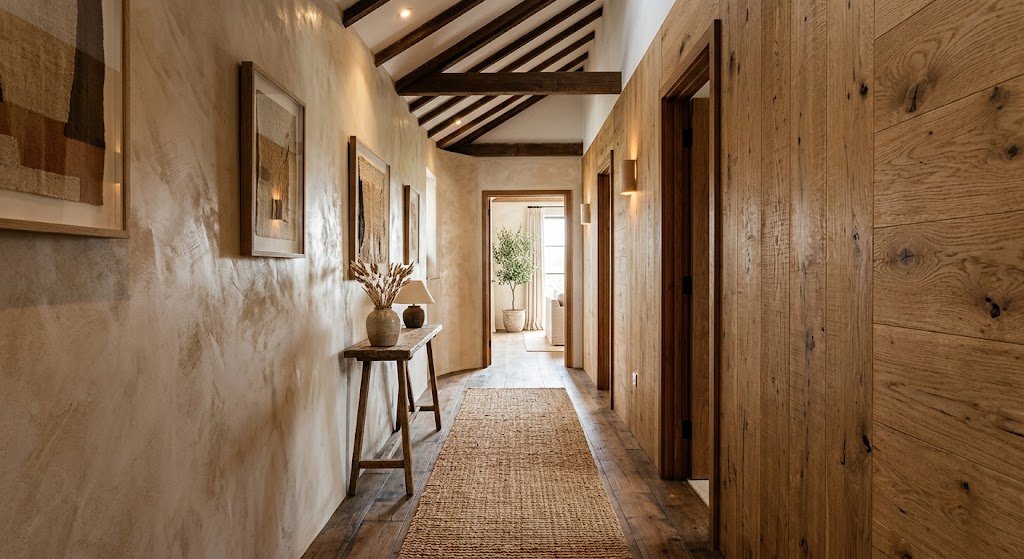
Flat wall, flat floor, flat light — stack those together and even a nicely decorated hallway can feel a little cold. Texture is the fastest fix, and it’s a step most long hallway decor plans skip entirely.
Bring In Something Woven or Natural
A woven hanging, a jute runner, a console with real wood grain showing — any of these interrupt the smoothness. I push nearly every client toward at least one natural material somewhere along the hall, since it takes the edge off what’s otherwise a hard, straight-lined stretch.
Don’t Forget the Ceiling
Nobody thinks about a hallway ceiling, which is exactly what makes doing something up there land so well. Beadboard, a subtle print, or just a contrasting paint shade overhead can turn a plain corridor into something people bring up unprompted.
Seasonal Touches Without the Clutter
A long hallway happens to be an underused spot for seasonal styling, especially around the holidays, given it’s the very first thing anyone sees walking through the front door.
Keep It Simple for the Holidays
Garland along a stair rail, a couple of candles on the console, maybe string lights tucked along a shelf edge. There’s a full rundown of holiday hallway styling if you want to go further without turning the space into a warehouse of decorations. The real key is restraint — a narrow hallway gets claustrophobic fast once the seasonal stuff piles too high.
Think About Scale Before You Buy Anything
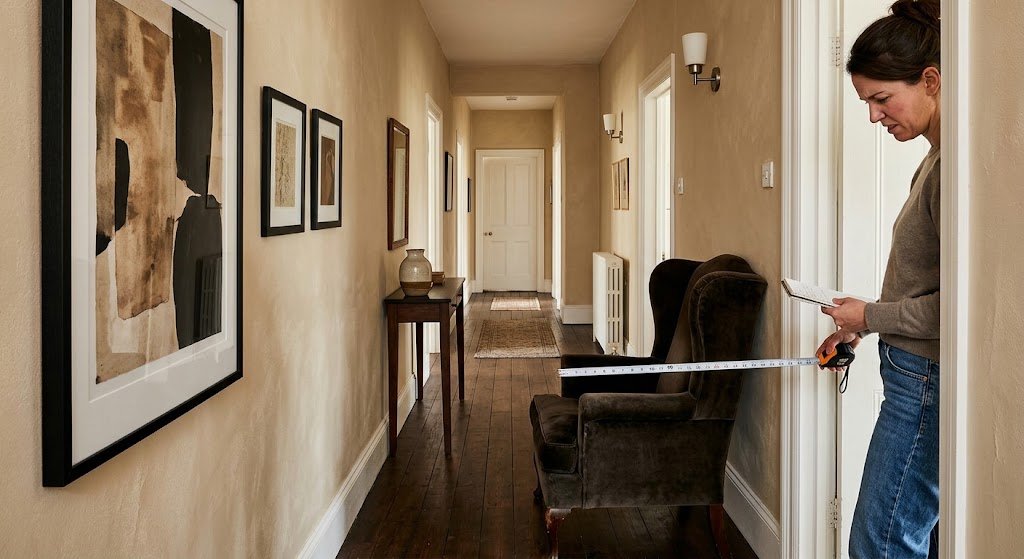
Even people with a solid design eye trip on this one — they shop for a hallway the way they’d shop for a living room, forgetting a long hallway is basically one uninterrupted sightline start to finish. A chunky armchair that looks perfect in a showroom photo turns into a hazard the moment it’s wedged into a three-foot-wide passage.
Measure the Walking Path, Not Just the Wall
Before buying furniture, measure the actual clear path with the piece sitting where you’d put it, not the empty floor beforehand. Code usually wants 36 inches minimum, though honestly, for a hall where two people need to pass each other, I’d push closer to 42. Tight spacing is fine for wall art. It’s a problem the moment furniture is involved.
Scale Your Art to the Wall, Not the Room
An 8×10 frame on a fifteen-foot wall basically disappears into it. Go big with a few statement pieces, or go dense with a proper cluster. The in-between zone — a handful of small, scattered frames — is usually what makes a hallway feel unfinished more than anything else does.
Play With Sound, Not Just Sight
This part gets overlooked constantly, but hard floors plus bare walls in a long hallway turns it into an echo chamber. Every footstep, every dropped set of keys, travels the full length of the house.
Soft Surfaces Absorb More Than You’d Think
A runner helps, sure, but so does anything with texture — a woven hanging, drapery near a far window, even a small upholstered bench if space allows. Guests won’t consciously clock it, but they’ll notice the quiet the moment they step in.
Hollow Doors Make It Worse
Several hollow-core doors lining a hallway add to the echo too, worth knowing before you pin the blame entirely on the floor. Nothing urgent, just something to keep in mind if the space still sounds loud after the runner’s down.
Don’t Forget What’s Underfoot at the Ends
The spots where the hallway meets a room, or meets the front door, deserve some attention too. A small bench, a boot tray, a plant tucked into a corner. These little transitions are what stop the hallway from feeling like a bare tube connecting two doorways.
Common Mistakes I See Constantly
A handful of missteps keep showing up whenever people sit down to decorate a long hallway, so here they are without any sugarcoating:
- Hanging art too high (eye level sits around 57-60 inches, not “wherever looked fine from across the room”)
- Buying a runner the exact width of the hallway, leaving zero border
- One overhead light and calling the lighting done
- A console piled so high it reads as storage instead of styling
- A ceiling nobody thought about once
Fix two or three of these and the hallway already reads more deliberate.
Final Thoughts
A long hallway might genuinely be the easiest room in a house to transform, and somehow also the one everyone forgets exists. That’s the whole appeal of learning how to decorate a long hallway — barely any competition for your attention, real payoff once you give it some. Sort the lighting, bring in color or wallpaper, hang art with some rhythm to it, and don’t skip a runner. Small moves here stack up quicker than you’d think.
Need more direction before you spend anything? There’s a broader collection of hallway styling ideas worth flipping through first. Grab two or three ideas off this list, try them this weekend, and check back Monday to see how different the space feels once you’ve actually started decorating a long hallway instead of just thinking about it.
Frequently Asked Questions
What’s the best paint color for a long, narrow hallway?
Darker, richer tones usually beat white — they hide the tunnel effect instead of making it more obvious.
How wide should a hallway runner be?
Aim for roughly four to six inches of visible floor on each side of the runner for a look that reads intentional.
Should I use one big light fixture or several smaller ones?
Several smaller fixtures spaced along the ceiling almost always outperform one central light when you decorate a long hallway.
Is it okay to hang a gallery wall in a hallway?
Yes — it’s actually one of the strongest spots for one. Just keep spacing even and vary piece sizes for rhythm.
Do I need furniture in a hallway, or just wall decor?
A slim console adds real warmth and function, but skip it if the hallway can’t spare the depth. Either way, decorating a long hallway usually works best in stages, not all at once.